 |
The Slaughter at Ghatialian |
|
A group of anti-Ahmadi extremists sprayed bullets with automatic weapons on Ahmadi worshippers at their local mosque in Ghatialian (Khurd), District Sialkot, the Punjab. As a result, five Ahmadis died and six were injured.
It is learnt that a car was noticed to arrive Ghatialian in the early hours of the morning on October 30, while it was still dark. Ahmadi worshipers came to the mosque for their morning prayers. After the service, at about 6 A.M. when the first worshipper came out of the building, he was hit by a man at the door who pushed him back into the prayer hall. Then two attackers rushed inside and opened up bursts from a rapid-fire weapon on Ahmadis present there. In all, eleven victims were hit. Two of them, Mr. Iftikhar and Mr. Shehzad, died on the spot.
The intruders had parked their car approximately one hundred yards away from the mosque, and two of their colleagues had remained behind in the car, ready for escape. The attackers returned to the car, and they sped away from the scene of their crime.
The mosque presented a bloody sight after the attack. There was blood all over. Prayer mats got soaked with blood. There was blood in the courtyard as well, as the injured were moved out. The locals hurriedly arranged some transport to take the injured to Narowal for medical aid. While on the way, Mr. Ataulla expired. As medical facilities were inadequate at Narowal, the injured were shifted to Lahore. While in transit, Mr. Abbas and Mr. Ghulam Muhammad also succumbed to their injuries thus bringing the total of dead to five. That left behind six injured. They lived, but not due to any lack of effort by the fundamentalists. They intended to kill them all. Authorities handed over dead bodies to the relatives by the end of the day after necessary formalities.
The strike at Ghatialian was not a bolt from the blue for the administration. It knew all along that during the year District Sialkot had generally become a hot bed of anti-Ahmadiyya activities. However no preventive action was taken by authorities to contain the mulla. Religious extremists had raised claim to a number of Ahmadiyya mosques in the district. They damaged one at Koorakot. Another mosque at Merajke was handed over to them by authorities. Reconstruction of Ahmadiyya mosque at Sialkot Cantt was ordered to be stayed. Fundamentalists also implicated many Ahmadis in criminal cases under religious laws. In this, they received ready help from authorities.
In the district, criminal cases based on religion, were registered against 20 Ahmadis this year. Although Ahmadis are accused of preaching which falls under PPC 298 C, but PPC 295 A was applied so as to haul them to Anti-Terrorist Special Courts. Mr. Munir Ahmad of Satra has not been granted bail, and is in prison for over one year under such a fabrication. Messers Abdul Jabbar, Mian Fazil and Asad Zahur were also put behind bars on religious charges. All this adds abundantly to mutual tension.
Social environment is continuously polluted and poisoned by mullas who enjoy unrestrained freedom in fanning the fires of communal hatred. Extensive anti-Ahmadiyya literature is distributed all over the district. It not only contains slander and insults, it exhorts common Muslims to take violent action against Ahmadis as an act of great religious merit. On the day of the incident, Maulvi Azam Tariq, Patron of the Sipah Sahaba, while addressing a conference in Chak 20 Ghugh, stated: No Qadiani will be spared, if the violence erupts again (The Daily Jang, Lahore; 1 November 2000). Also, on 30 October, mullas of Khatme Nabuwwat organization had planned an open-air conference near Ghatialian. The vernacular press provides the mulla ample undeserved coverage in its newspapers. Politicians like Kalsum Nawaz also wanted to cash the religious cheque; she agitated the public mind on Ahmadiyya issue. Members of the judiciary, like Justices Nazir Akhtar and Mughal of Lahore High Court, unashamedly issued statements that are license to murder. The government has adopted the policy of appeasement of the Mulla, and the bureaucracy is aware of it. As a result, no preventive effort is made. Authorities, however, cannot escape their responsibility; they failed to take obvious remedial measures.
The police issued statement that this incident could be the result of an earlier incident in which a non-Ahmadi was killed by an Ahmadi. This was highly misleading. In fact, no Ahmadi was ever charged by the police of that non-Ahmadi's murder.
Extensive anti-Ahmadiyya literature is distributed all over the district. It not only contains slander and insults, it exhorts the common Muslim to take up violence against Ahmadis as an act of great religious merit.
A few days after the incident, three men were arrested. The police claimed that the vehicle and the weapons used in the incident had also been recovered, however the fourth individual was not caught. The police announced that the culprits were RAW agents, however, there is confirmed report that their gang leader stated during the investigation that he was an office bearer of a Jihadi group and he had organized the attack to serve the cause of religion.
The Gory Riot of Takht Hazara |
|
A violent mob attacked the Ahmadiyya Mosque at Takht Hazara in District Sargodha, Punjab, killed five Ahmadis present there, ransacked the mosque and set it on fire in the early hours of the night on Friday, the 10th November 2000.
For more than a year, the anti-Ahmadiyya faction had been busy in Takht Hazara in generating communal unrest and tension. A mulla, Athar Shah, protégé of the notorious Mulla Akram Toofani (the adopted name ‘Toofani’ literally means ‘cyclone’) of Sargodha, had been posted in the village, with the only object of spreading sectarian hatred. Last year, he damaged and desecrated graves at the Ahmadiyya graveyard on 5 September 1999. He displayed in the village abusive posters. He would gather street urchins and move around in bands chanting anti-Ahmadiyya provocative slogans in streets. Ahmadis approached the authorities who advised them to remain calm and bear up with the hardship. This mulla also initiated litigation to deprive Ahmadis of their mosque and their Centre. The court decided in Ahmadis' favour.
Athar Shah reportedly is a drug addict and drug peddler. He was quite successful at maintaining communal tension at high level. On November 10, he led a group of miscreants armed with sticks, axes and firearms, and marched through the streets of the village chanting provocative slogans and shouting slander and insults. Ahmadis maintained their calm and refused to react. These agents provocateurs then came to the Ahmadiyya Mosque.
Athar Shah and his gang continued with their provocation and made another aggressive visit to the Ahmadiyya mosque. It seems they had a plan and were intent upon a serious clash. They precipitated an altercation at the Ahmadiyya mosque, in which Athar Shah was hurt. This was promptly followed by a call on loudspeakers of all the town mosques to everyone to head for the Ahmadiyya mosque. As the situation had become serious, Ahmadis informed the police. Soon a violent mob assembled and raided its target. A few Ahmadis who were present in the mosque bolted the door from inside. The mob broke open the door, demolished the outer wall and rushed in. The armed miscreants overwhelmed the few defenders. Four Ahmadis were murdered on the spot, including the President of the local Ahmadiyya Community. The fifth, a youth of 14 years, died later in the hospital. They hit the faces of their victims repeatedly with their axes, and even cut their throats. It was not easy to recognize them when their dead bodies were handed back to their kin.
The police arrived when all was over, although Ahmadis had informed them and requested their intervention before the situation had taken an ugly turn. The vernacular press presented the incident as a sectarian clash, although it was a preplanned one-sided aggression. The mere fact that all the casualties occurred within the Ahmadiyya mosque is ample proof against the story propagated by these newspapers. They reported that two non-Ahmadis were also killed. No non-Ahmadi was killed. It was baseless propaganda, and was a deliberate effort to mislead their readers. Even Mulla Athar Shah is alive.
In less than a fortnight, 10 Ahmadis were murdered in their mosques in the province of Punjab. Both the locations selected for the attack were those where Ahmadiyya population is considerable. It seems the conspirators plan to provoke Ahmadis, as that would suit their nefarious religious and political designs. [The news that the central leadership of the International Khatme Nabuwwat called an All Parties Conference for 15 November 2000 (The Daily Jang, Lahore; Nov 12, 2000) is a pointer to their designs.] Authorities, as usual, despite plenty of early warning, purposely decide not to take any preventive action. At Takht Hazara, a formal application had been submitted by Ahmadis to the Deputy Commissioner in October last year and another one recently, on November 4, 2000 informing him of the ugly communal situation and requesting him to take suitable action. The bloody riot of November 10 speaks volumes on the inadequacy and ineffectiveness of the official action on Ahmadiyya requests.
Following are the names of the Ahmadi dead:
- Mr. Muhammad Arif, age 30, married, two small children
- Mr. Muhammad Nazir, age 60, married, six children
- Mr. Nasir Ahmad, age 39, President of the local Ahmadiyya Community, married, two small children
- Mr. Mubarak Ahmad, age 15
- Mr. Mudassar Ahmad, age 14, schoolboy
After the incident a murder case was registered by the police. A counter application against 51 Ahmadis including 5 who were complainants and witnesses of the killings was filed by the opponents. Based on this, the police registered an FIR. The police proceeded against these 5 Ahmadis under PPC 365/295A, 324, 148/149, and arrested them. They were presented before an Anti-Terrorist Special Court where their pleas for bail were rejected. They are now behind bars. The police have taken action against 21 other Ahmadis under section 107/157. The mulla must be laughing. He murdered 5 Ahmadis, and then got dozens of innocent and afflicted Ahmadis implicated in criminal cases, pushing some to the Anti-Terrorist Court that refused to confirm their Bails. What a state!

Dr. Shamsul Haq, a renowned orthopaedic surgeon, was shot dead at night on January 17, 2000 in Faisalabad. He departed from Sahil Hospital at about 10 p.m. and was found dead an hour later in his car at Khurrianwala Road. His hands and feet had been tied with a rope, and he was shot through the head.
Religious extremists had been openly active in Faisalabad for the previous many weeks. Authorities did not deal with them with a firm hand, instead complied with their demands and sealed the Ahmadiyya prayer center at Khyaban Colony.
Mullahs started a disinformation campaign to confuse the inquiry. According to them the doctor was a good man and was lately thinking of conversion to Islam; his Ahmadi wife did not like his inclinations and arranged her husband’s murder. This theory, besides being ridiculous, is indicative of the crooked conspiratorial thinking of the Mulla.
According to the police intelligence itself, extremist elements had plans to hit selected Ahmadi individuals after Eid. The police knew the identity of this gang of terrorists, but failed to take preventive measures.
Dr Haq was an able doctor and a charitable person. He provided free medical advice and care to many at charitable institutions. He left behind a widow, three small children and an aged father.
Mr. Abdul Latif, another Ahmadi was added on June 8, 2000 to the long list of Ahmadis murdered only for Their Faith in Pakistan. He died of shot wounds inflicted by anti-Ahmadi fundamentalists at village Chak 18, Bhauru, District Sheikhupura, that had been a hot bed of anti-Ahmadiyya agitation for more than a year. An article 'Life at Bhauru Village' described well the situation there in our 1999 Annual Report.
The tempo of agitation at Bhauru had been kept up by the opposition all along. Only ten days before the murder incident, the extremists invited notorious mullas like Allah Yar Arshad, Akram Toofani and Mr. Shahkoti of Khatme Nabuwwat organization from other districts, who came and made fiery, slanderous and provocative speeches at Bhauru. They preached and promoted violence.
On the day of the incident, some youth subjected an Ahmadi, Mr. Shoaib, to a beating. The victim's mother tried to help him, but only exposed herself to violence. Some other Ahmadis arrived at the scene, and the opposition opened fire with firearms. As a result Mr. Abdul Latif was shot at twice and killed, while three other Ahmadis were wounded. In self-defense a few Ahmadis returned the fire and some attackers were wounded, although none fatally. The fighting spread and continued for sometime. The police arrived late in the evening and made some arrests. The dead body of the Ahmadi was taken to the police station where an FIR was lodged. The opposition also applied for a case to be registered against Ahmadis.
Although, the opposition initiated the mischief and the violence, and murdered an Ahmadi, the police and the administration took action against the victimized community. Case No. 155/2000 was registered against 31 Ahmadis at the Sangla Hill police station on 16 June, 2000 under various sections of the Penal Code, at the accusation of a leading mulla of the Tahaffuz Khatme Nabuwwat Organization. Another case was registered against these Ahmadis by the police itself, under 16 MPO. Seven Ahmadis including the president of the local community were arrested by the police and detained at the Mananwala police station.
The authorities all along knew about the activities of the religious extremists in the village. A firm preventive action by the former could have prevented the murder of an innocent Ahmadi. It is also awful that the authorities cracked down upon the victims of aggression and violence. This was perpetrated in the past at Chak Sikandar, Nankana, Naukot, and now repeated at Bhauru. Such behavior by the administration defies comment.
Harassment of the Ahmadiyya Community at Bhauru at the hands of the police and authorities continued months after the incident. Four of the detained Ahmadis continue to suffer in prison awaiting trial, as they have been refused Bail after arrest.
An Assault by Mulla: Muhammad Akram, Ahmadi, has suffered at the hands of Deputy Commissioner Mustong who expelled him summarily from the district sometimes ago at the urging of local mullas. On April 3, 2000 when he was about to board a wagon for Quetta, two pillion riders who wore masks, opened fire at him. One of the bullets hit Akram who was injured in the leg. The victim was taken to the Civil Hospital where 13 stitches were applied to his wound. He did not report the matter to the police in view of the Deputy Commissioner's hostility and the general atmosphere of anti-Ahmadiyya persecution. Unable to go back, he was staying with a friend at Quetta.
An Attempt on Life: Mr. Intizar Ahmad Bajwa, an Ahmadi youth from the village Nia Ben Bajwa, District Sialkot, suffered great opposition from mullas during 1999. He was falsely accused of blasphemy in March 1999 and was put in prison. He was released in December 1999. Mullas kept on his heels and almost got him on December 22, 2000.
Intizar was playing volleyball with his pals outside the village by the roadside in the afternoon. At about 4 p.m. a car arrived, stopped, and a few mullas jumped out of the car. These were the same mullas of Sipah Sahaba group who were his accusers in the blasphemy case the previous year. They were armed and shouted the challenge. Sensing the grave danger, Intizar ran for his life. The mullas gave a hot chase and fire one or two shots. Intizar managed to enter the outskirts of the village and hid himself in one of the houses. Losing sight of him, the mullas inquired from an old woman if she had seen a run-away youth. She did not disclose Intizar's location.
Having failed in their attempt, mullas went back and left. It was a close escape for Intizar. According to the witnesses, the gang carried a .444 bore rifle, two .30 pistols and a Mauser. Three of the attackers were identified as Shafiq Dogar, Qayyum Butt and Anwar Sarwana. Another one was a member of Jaish Muhammad Jihadi group who had earlier the same day visited the village to collect donations in support of Kashmiri Mujahideen.
Another Assault: Malik Munawar Hussain, Ahmadi, owns considerable property and an ancestral home at Rangpura, district Sialkot, but resides elsewhere. On June 11, he visited his birthplace with the intention of collecting the rent and to retrieve some personal goods like TV etc from there. When he, accompanied by his son, arrived there, he was received by a hostile crowd who were intent upon violence. They caught hold of him and beat him up. Malik Hussain's son escaped from the scene to report to the police who came and helped the release of his father from his assailants. Subsequently, Malik Hussain reported to a doctor who produced a medical certificate that mentioned all the injuries that he received. Escorted by a couple of friends, Mr. Malik went to the police station and asked a case to be registered against the miscreants. The police refused to register the complaint and advised the poor fellow to forget it all and go away. The police confided to him that the miscreants had plans to kill him.
A Murderous Assault: Mr. Allah Yar, president of local Ahmadiyya Community of Chak 163 W.B; District Vehari was sitting in his farm in the evening, when two strangers arrived on a motor bike on September 29. They asked him if he was Allah Yar, to which he replied in the affirmative. At this, one of them said, "We need some medicine for a patient whom we shall bring shortly". While saying so, they restarted the motor cycle and opened fire at the Ahmadi. One of the shots hit him in the shoulder and went through. The other bullet hit his stomach and damaged a lung. Having fired, the assailants fled away. The victim lost much blood while on his way to the hospital. He was feeling very weak but later recovered consciousness. The bullets were extracted. His daughters provided the blood as it was of the same category.
Lately, Mr. Allah Yar had been receiving threats on telephone. The police were provided phone numbers of the telephones from where the threatening calls originated. Investigation produced little result.
Authors of Ordinance XX brought Ahmadiyya mosques specifically in the ambit of the notorious law. The law prohibits Ahmadis to call their mosque a ‘Masjid’ (Arabic for mosque). Religious extremists have made a broad sweep in interpretation of this clause and tend to violate the sanctity of Ahmadiyya mosques by any means. Obviously, their actions touch Ahmadis' sensitivities to the core and cause them great mental and emotional hurt. Following incidents would show the gravity of this problem.
Badin: An Ahmadiyya mosque existed in Goth of Subedar Chandio in District Badin. Heavy rainfalls caused it extensive damage. Ahmadis started its reconstruction. They built half of it and ran short of funds. Later, when they restarted building, the Assistant Commissioner came to know of it. He arrived at the location and had it demolished. This ignoble undertaking happened at the end of 1999. It is noteworthy that a state official supervised the outrage.
Liaquatpur, District Rahim Yar Khan: Mr. Muhammad Sadiq, Ahmadi, owns a PSO gas station at Liaquatpur. He built a mosque at the station in 1994, for the facility of transiting drivers. It was open to all for worship, regardless of their creed and denomination. Six years later, mullas decided to move against this house of God in the Islamic Republic. The Assistant Commissioner conveyed that he would consider the issue; whatever that meant. Mullas, however, decided to snatch the initiative from the feeble Assistant Commissioner and announced in a press conference on July 25 that they would demolish the mosque on 28th July in any case.
The AC sent for the two parties. Under duress, Mr. Sadiq had to agree that he had no objection to pulling down of the mosque in the prevailing circumstances. Armed with this chit, the panicky police and the shaky AC sent their personnel to demolish the mosque. Mullas and the Administration thus implemented their version of Islam in the Year 2000 that the Government of Pakistan had declared the Year of Human Rights and Dignity.
Merajke, District Sialkot: The mosque at Merajke was built almost a century ago by someone who was an Ahmadi Muslim. Among his descendants, some continued as members of the Ahmadiyya Community, while some did not. The mosque, however, remained in the possession and use of Ahmadis during the last 100 years. Now, that elections to the local councils were expected later this year, one, Malik Haq Nawaz, a non-Ahmadi from the same family, became active to hobnob with mullas of Sipah Sahaba and started working towards taking possession of the mosque. He and the mullas contacted the Resident Magistrate. The RM visited the village twice. During his visit mullas put up a show of religious agitation and political strength. Some of the militants present at the occasion told the magistrate that they could take possession of the mosque by force if necessary. The intimidated magistrate decided ex parte in favour of non-Ahmadis, took the keys and handed over the mosque in August 2000 to them regardless of the fact that this mosque had remained in Ahmadiyya possession for almost a hundred years.
Bhakoo Bhatti, district Sialkot: One of the mosques here was in possession and use of the Ahmadiyya Community for the last almost half a century. A non-Ahmadi laid claim to it, and a mulla locked the mosque. The police were informed. The SHO police came, made the required inquiries, had the lock opened, and restored the mosque to Ahmadis. Later, other officials also visited the site, and the mosque remained with Ahmadis. However, mullas maintained the pressure and the agitation till they got what they demanded. The Assistant Commissioner ordered the mosque sealed, and Ahmadis lost still another mosque.
Golarchi, District Badin: The mosque that was being used by Ahmadis for worship was handed over to non-Ahmadis by the authorities, in the presence of a heavy contingent of armed police on 21 October, 2000. They washed the mosque for the purpose of cleansing it before offering prayers therein. According to the latest reports, two Islamist groups are now locked into a dispute regarding its ownership.
Sialkot Cantt: The Ahmadiyya mosque and the Imam's house here had been demolished and were under construction for enlargement. Its plan had been formally approved by the Cantonment Board. On November 16, 2000 the Khatame Nabuwwat activists put up banners:
"Stop the construction"; "Demolish the constriction" etc. The Station Commander was informed. At his orders, the authorities intervened and it was mutually agreed that a minaret and niche will not be constructed, nor the place will be called a ‘masjid’.
However, later on, the extremists filed a suit in the court demanding that the construction be stopped and the building be demolished. They managed to obtain a Stay Order.
So much for the freedom of faith to all!
Faisalabad: The authorities sealed the Ahmadiyya prayer center in Khyaban Colony, to oblige local mullas. This happened two and half months after the military had taken over the administration of the country and assured the whole world that human rights of all sections of the society would be respected. Normally fundamentalists agitate against minarets and niche in Ahmadiyya mosques, but this prayer center had no minaret and no niche, still the authorities sealed the center. Obviously, the mulla and authorities have no scruples; they only want to deny the freedom of faith to Ahmadis. The nearest Ahmadiyya mosque to this locality is eight kilometers away.
Mangat Unche, District Hafizabad: At the demand of local mullas, the police itself had the dishonour and discredit of defacing the Ahmadiyya mosque. The policemen came, hammered and broke to pieces the marble slab on which the Kalima (Islamic creed) was written. One could see that when a state bows down to mulla, it invites ignominy and disgrace upon itself.
Dastgir, Karachi: In October, A Sub-Divisional Magistrate and a Deputy Superintendent Police accompanied by a police party arrived at the Ahmadiyya mosque. They took possession of the Kalima (Islamic creed) board and carried it away. Obviously they acted in response to some mullas' demand. Such behaviour of authorities, in the cosmopolitan city like Karachi reflects very poorly on the attitude of the city administration and the provincial government.
Haroonabad, District Bahawalnagar: On January 31, 2000, Mahmood Ahmad Cheema, Civil Judge awarded two years' imprisonment sentence to Mr. Ataullah Warraich, Ahmadi of Chak 11/F.W. under the anti-Ahmadiyya section PPC 298B for building a niche and minaret in an Ahmadiyya Mosque. The law does not prescribe this penalty.
Chak 17, District Sheikhupura: During August 2000, ten anti-Ahmadi activists arrived at the local Ahmadiyya mosque at about 9 p.m. and told Ahmadi worshipers that they intended to wipe off the Kalima (Islamic creed) from the façade of the Ahmadiyya mosque. Ahmadis told them firmly that they dare not do so. The visitors threatened to approach the authorities, and left. Ahmadis contacted the authorities during the next few days and asked them to protect the Ahmadiyya place of worship. Instead, the police arrived at about 10 p.m; took control of the mosque and removed the Kalima (Islamic creed) themselves. Unbelievable!
Chak 100, district Faisalabad: The local Ahmadiyya mosque was constructed 30 years ago. As it was in a dilapidated state, Ahmadis demolished it and started constructing the new building. At this the Assistant Commissioner Jaranwala intervened and the police told Ahmadis to stop the construction. This is blatant intervention in fundamental rights. It happened in the month of December.
Chak 6/11L, district Sahiwal: At the instance of extremist religious elements, the authorities arranged effacing of holy words Allah and Muhammad from the local Ahmadiyya mosque.
Chak 381, Layya: Mr. Azam, an Ahmadi of the village, has built a mosque on his land. Someone reported the construction to the police. The police visited the site, and unlawfully ordered the Ahmadi to demolish its minaret.
District Okara: An Ahmadiyya mosque is located at L-Plot since long. Extremist religious elements started an agitation, demanding that the niche of the mosque be dismantled. The Resident Magistrate Renala Khurd summoned Mr. Zafar Iqbal, Ahmadi, to explain. An Ahmadi delegation met the RM and told him that the law of the land does not forbid Ahmadis to build a niche in their places of worship. The magistrate, however, insisted that in view of the unrest created by the mulla, Ahmadis should dismantle the niche. Ahmadis would not undertake the sacrilege. Later, the Ahmadi delegation called on the Colonel Incharge of the Army Monitoring Cell. He promised nothing and conveyed that he would talk to the Deputy Commissioner.
Subsequently the Resident Magistrate issued a notice that the niche should be demolished. The situation was conveyed to the DC, the SP, and the SHO; the AC Okara was also contacted personally.
The situation remained tense for weeks and caused great concern among the local Ahmadiyya Community.
Khairpur: Mullah Mohammad Siddique, the prayer leader at Bokhari Mosque, Gambit sent an application to the Police, with copies to the Governor, Home Secretary, the DC, the Superintendent Police Khairpur etc, stating that Qadianis, in rebellion against the Constitution of Pakistan, have built mosques at Goth Sultan Ali, Goth Cheema and Goth Nathey Khan; these should be demolished by the authorities by August 11, otherwise activists of Majlis Khatame Nabuwwat will themselves destroy these mosques. The mulla warned the authorities not to interfere with the activities of these Mujahidin, as in case of bloodshed, the authorities themselves will be held responsible. Copies of this notice and warning were distributed in public by the mullas.
Ahmadis contacted the Home Secretary and told him that these mosques are not newly constructed as implied by the mulla; in fact these are more than 30 years old. The one at Goth Nathey Khan was built in 1935.
In consultation with authorities, Ahmadis agreed that enclosures be built around the minarets and niches of the mosques. Authorities failed to muster sufficient courage to proceed against the mulla.
District Nowshero Feroz (Sind): The village, Goth Imam Bux Alavi has its Ahmadiyya mosque. The mullas are agitating against the niche in the mosque, even though it is not visible from outside. Mullas have also demanded removal of the Holy Quran from the mosque. This generated a great deal of tension in the village life.
Kot Rasulpur Fazal, Distt. Okara: Ahmadis have their own mosque and community house at this town. On June 25, two locals, carrying a camera arrived at this house in dark hours and knocked at the door. Mr. Jamil, the resident Ahmadi religious teacher opened the door and asked them their business. The two wanted to make a forced entry and take photographs of the interior. Jamil stopped them and told them that there was nothing objectionable inside. At their insistence, he let them come in and see for themselves. They were shown all the rooms. The intruders wanted to take away a picture of the Holy Kaaba (at Mecca) and some Ahmadiyya literature, and wanted to take photographs. They were not permitted to do that.
It seems they had come with evil intentions, however their mischief did not bear any fruit.
The Evil of the Anti-Terrorism Act |
|
The government legislated Anti-Terrorism Act in 1997, whereby Anti-Terrorist Special Courts were set up to expeditiously handle cases involving terrorism and to award punishments. Grave apprehensions were expressed at the time by various sections of the society about the possibility of misuse of this legislation. Future events have shown that those apprehensions were justified. The religious extremists were delighted to discover in this legislation possibilities of harming and terrorizing the peaceful Ahmadiyya Community. The government gave them a big helping hand by declaring the religious clause PPC 295A as cognizable by anti-terrorism courts. Ahmadis who are not even remotely involved in terrorism have been hauled up before these courts, and punished heavily. Mr. Waheed Ahmad, an Ahmadi was accused of filling in someone else's Census Data form incorrectly and was awarded 10 years' imprisonment. He is in prison for the last two and half years. The malpractice has continued during the military regime and despite the fact that the regime has declared that Year 2000 will be observed as the Year of Human Rights and Dignity, no breaks have been applied to the misuse of the ATA Act against Ahmadis. Fifteen Ahmadis from Sind who were wrongfully charged under PPC 295A, are in prison for the last two and half years; they remain incarcerated awaiting a Supreme Court decision on whether they should be tried in a normal court. Fresh cases registered during 2000 C.E. are mentioned below.
Sargodha: Laiq Ahmad, an Ahmadi shopkeeper in Liaquat Colony, Sargodha had the Kalima (Islamic creed) written in his shop. Ahmad Ali Zafar, a local magistrate took notice and had the Kalima (Islamic creed) removed. Extremists were still not satisfied, and maintained their agitation. Obligingly, the police registered a case in the Cantonment police station against the Ahmadi on January 28, 2000 under sections 295A, 298C and 16 MPO. The severe clause of 295A was applied against the victim on the grounds that the word O Allah, O Mohammad and Bismilla were found written in his shop. According to the police FIR, it was under the direction of the Deputy Commissioner (Nr 116800), that the inquiry was held. The DC's instructions were given on an Intelligence Report titled: Activities of Qadianis. The police report incorrectly mentioned that these words had generated great tension and agitation in the local population. Only a local mulla had passed a resolution against the inscriptions, in the mosque.
Daryapur, District Sialkot: Section PPC 295A was applied on April 28, against 10 Ahmadis who have been implicated in two criminal cases on religious grounds. One case has been registered for preaching, while the other is a two years old case based on objection to a niche in a mosque. It is noteworthy that the Deputy Commissioner, who is expected to protect human rights of marginalized communities, himself intervened and was instrumental in application of the ATA section. The Deputy Superintendent of Police here was the same individual who was the SHO when the ugly Chak Sikandar anti-Ahmadiyya riots erupted there in 1989 against Ahmadis.
The police of P.S. Sabz Peer arrested Mr. Ghulam Mustafa, the president of the local Ahmadiyya Community, Mr. Muhammad Yusuf, his brother and Mr. Muhammad Afzal, an ex-president.
The mulla-bureaucracy duet made this vicious assault on the persecuted Ahmadiyya Community with a vengeance in not only applying the Anti Terrorism Act but also making it a weapon of mass harassment. Of course, no terrorism whatsoever was involved.
Bharokay Kalan, District Sialkot: Four Ahmadis, namely Messers Ghulam Mustafa, Hamid, Maqsud Ahmad and Mian Fazil were booked under PPC 298C and 295A by the police, at the accusation of some mullas on July 31, 2000. A few Ahmadis of Bharokay Kalan were watching a TV program on MTA (Muslim Television Ahmadiyya) in the garage of Mr. Nawab Din. On account of the hot weather, the garage door opening in the street, was left open. At this, someone from the village informed a Mulla Firoz at Daska Town, who conspired to have a criminal case registered under the Anti-Ahmadiyya Ordinance against four Ahmadis. The whole case is false and baseless. One of the named accused, Mr. Ghulam Mustafa was the president of Daryapur Ahmadiyya Community. He was not even present at the occasion; in fact, he has never visited Bharokay. He had been earlier implicated in another Ahmadiyya case during last April, and the mulla wanted to put him to more trouble. Another Ahmadi, who was not even accused, was taken in custody by the police.
Subsequently, fifty men of the local non-Ahmadiyya faction, gave in writing to the police that the charges were false. Ahmadis sent this supporting evidence to all the senior officials including the Governor, and requested them to hold the enquiry. As a result, the charge under PPC 295A was dropped and alibi of two Ahmadis was established, but PPC 298C remained stuck despite the fact that the lie of the mullas had been exposed.
Takht Hazara: As if murder of five Ahmadis of Takht Hazara and desecration of their place of worship on 10th November was not sufficient harm, the police implicated five local Ahmadis in a case of PPC 295A and other clauses. These Ahmadis were important as complainants and witnesses of the riot; they were charged simply because extremist elements involved in the riot demanded so. This amounted to adding insult to injury.
Endless Prosecution on Religious Basis |
|
Some observers are of the opinion that Pakistan is fast becoming a lawless country. They may not be far wrong but the fact is that the anti-Ahmadiyya and religious laws are being applied against Ahmadis energetically, even on occasions when they do not apply. Anti-Ahmadiyya laws were enforced in 1984. Since then they have been applied against thousands of Ahmadis with relentless effort and frequency. Vicious application of PPC 295A has been described in Section 7 above. Similarly other such laws are used as handy tools to severely persecute Ahmadis. Registration of a criminal case under these laws can entirely change the life of a victim. Most of them have no previous experience of a visit to a police station. But registration of a case means not only dealing with police but going to courts, the risk of detention, seeking bail, hiring lawyers, going into hiding, perhaps arrest, years of prosecution and in some cases years of imprisonment. Often, the victims are the breadwinners of the family, so the prosecution brings along financial hardship, and thus the whole family suffers. Everyone is on trial, in a way.
During the Year 2000, 166 Ahmadis were implicated in various criminal cases of religious nature. These are briefly mentioned below; a chart is placed at Annex I to this Report.
1. |
Mr. Laeeq Ahmad of Sargodha was charged under sections 295A, 298C and 16MPO on January 28 for displaying Islamic words in his shop. He faces 10 years' imprisonment. Some details of this are available in Section 7. |
2. |
Mr. Sahib Khan of Mangat Unchai, district Hafizabad joined the Ahmadiyya Community two years ago. His father did not like it and tried hard to deny him his birth right of freedom of faith. He did not succeed, so he decided to seek the help of the state in his vile attempt. He approached the police, and in collusion with them, got registered a criminal case under PPC 298C on February 14, against his own son and two other Ahmadis, including Mr. Fazal Ahmad, the Ahmadi teacher and Mr. Sikandar Hayat. The accused applied for Bail before Arrest, but Mohammad Siddique Tabassum, the Additional Session Judge refused their plea. The police arrested all the three. |
3. |
Mr. Khalid Javed of Nishtarabad, district Sialkot joined the Ahmadiyya Community, but kept it to himself. At the Eid festival, the news got leaked, and the opposition flared up. Javed left his home and took refuge in an Ahmadi's house from where he fled again late at night and went to Sialkot.
At this, his relatives got a case registered on March 22 with the police under PPC 365 that Javed had been abducted, and they named four Ahmadi men and three women. Th police detained all the accused it could find. Latr the women were released.
A writ was moved under section 199 with the High Court on behalf of Mr. Khalid Javed. On 31 January, Mr. Javed stated before the court that nobody had abducted him; he had chosen to become an Ahmadi of his own free will, and that he left the village for fear of harm from the miscreants. He requested the court to withdraw the case and release the accused. The police withdrew the case and released the victims who had a few very rough weeks of their life. |
4. |
The dreaded Section 295A was applied on April 27, against Messers Muhammad Yusuf, Mustafa, Afzal, Yaqub Tahir Ahmad and Muhammad Ahmad of Daryapur, district Sialkot for the Ahmadiyya mosque with a niche. The police arrested Yusuf, Mustafa and Afzal. |
5. |
Section 295A was applied at the same police station as above on the same day against Messers Mohammad Salim, Muhammad Yusuf, Irshad and Daud, allegedly for preaching. Some details of this and the case above are given in Section 7 above. The two cases were registered in evil collusion of the police and the fundamentalists. |
6. |
The Hafizabad police registered a criminal case No. 242/2000 under the Anti Ahmadiyya Law PPC 298C, on May 19 against four Ahmadis, namely Khalid Ahmad, Muhammad Abdullah, Nasir Ahmad and Shafqat Hayat. The FIR indicates some business deal between the accused and the accuser; however the charge is that of preaching. The accuser and the police used again the oft-repeated technique of implicating numerous Ahmadis in the same case. The accused moved fast and managed to avail of Bail before Arrest. They have avoided the arrest, however they face the grim ordeal of defending themselves in a long-drawn case at the courts to avoid imprisonment for three years. |
7. |
Mr. Iftikahr H Azhar, an ex-resident of Chak No. 1/DNB, District Bahawalpur, later turned Norwegian national was visiting Pakistan. An anti-Ahmadiyya activist applied to a magistrate on 31 May that Mr. Azhar claims to be a Muslim, hence he should be prosecuted under the law. The magistrate told the police to register a case, and the police registered Case No. 148/2000 at Bahawalpur Cantt police station against the visitor on 1 June 2000 under PPC 298C. Under this clause, the accused faces three years' imprisonment for being unmindful of his presence in Pakistan where the freedom of faith is denied to him unlike in Norway. The visitor hurried to flee from this country. The police repeatedly visited his lodging but were disappointed not to find him, and Norway is outside the reach of Pakistani police and magistracy. |
8. |
Thirty one Ahmadis of village Bhauru, district Sheikhupura were charged under PPCs 324, 148, 149 and 452 on June 16 subsequent to an attack on Ahmadis by the opponents in the village, in which one Ahmadi was killed. There was no loss of life among non-Ahmadis. The incident is described in Section 4. |
9. |
Subsequent to the same incident mentioned above at Serial 8, 17 Ahmadis were in addition charged under 16 MPO two days later on June 18. |
10. |
Anti-Ahmadiyya situation in L Plot, District Okara had been tense for months. Mullas had succeeded in promotion of hatred among the local population, and litigations and visits to authorities had become frequent. During the last week of June, a few opponents manhandled two Ahmadis, Salim Ahmad and Mian Zafar Iqbal. The brawl developed into an exchange of shots. There were no fatal casualties, however one non-Ahmadi was slightly wounded. The police registered a case under PPC 324/34 against three Ahmadis, namely Messers Zafar Iqbal, Saleem Ahmad and Mubashir Ahmad. Although the police knew who were the miscreants and fomenters of discord, they were partial against Ahmadis. |
11. |
Messers Khalil Ahmad and Saeed Ahmad, Ahmadis of Karachi, had an appointment on July 29, 2000 with some of their non-Ahmadi acquaintances at Goth Muhammad Hussain. When the former arrived at the village, someone informed the mullas who arrived and bounced upon them. Mullas tied up their victims with ropes, gagged them and declared their intentions to slaughter the two visitors. The village chief came to know of this and he delivered the two to Sarjani Town police station. The police obligingly registered a criminal case against the victims under PPC 298B and 298C. If declared 'guilty', they could be imprisoned for three years and fined any amount. |
12. |
The police registered criminal case No: 300 under the anti-Ahmadiyya PPC 298C on 19 August 2000 at police station Chichawatni Sadar against three Ahmadis, namely Messers Ghaffar Ahmad, Ilyas Ahmad and Manzur Ahmad, of Chak 37/12-L, District Sahiwal in a false accusation by a local opponent who was supported by mullas of the Khatme Nabuwwat Organization.
The cause of the case was essentially a land dispute. An aunt of the accused, who died sometimes ago, donated a piece of land to the local school. One, Arshad son of Ghulam Rasul forcibly occupied the land and cultivated it for personal use. Mr. Ghaffar Ahmad, an Ahmadi took up the initiative and made attempts to recover the land from Arshad to give it to the school. An official inquiry was held in which Mr. Ghaffar exposed the high-handedness of Arshad who did not like it. After the departure of officials, Arshad, accompanied by a few gangsters, attacked Mr. Ghaffar, who complained later to the police. The police took no action. On May 28, 2000 Arshad and his colleagues threatened Mr. Ghaffar of further action. Mr. Ghaffar again asked for police help but got nothing, as the police were in collusion with the opposite group. Mr. Ghaffar thereafter wrote to the District Magistrate, but nothing happened. In the meantime, the opposition group got in touch with mullas of the Khatme Nabuwwat organization who came forth in a big way against the three Ahmadi families of the village. The local SHO of the police was also not happy with Mr. Ghaffar for contacting higher authorities in seeking redress. As a result, the mullas and the administration moved decisively and effectively against Ahmadis. A religious agitation was launched from the mosque, and Mr. Ghaffar's house was attacked by a group of miscreants. They stoned the house and broke the glass windows and ventilators. Then they sent a written application to authorities that Ahmadis posed themselves as Muslims and preached their creed. A delegation of the Majlis Tahaffuz Khatame Nabuwwat called on the Assistant Commissioner Chichawatni and made demands against Ahmadis. The AC sought direction from the DC who ordered registration of a criminal case under the Anti-Ahmadiyya 298C against the three accused. This was done.
Mr. Ghaffar was arrested by the police and sent to a prison. The other two rushed to arrange a bail before arrest.
A property dispute thus landed three Ahmadis in a criminal litigation on fabricated charges under religious laws. The victims face three years in prison, if held guilty. |
13. |
Messers Ghulam Mustafa, Hamid, Maqsud Ahmad and Mian Fazil of District Sialkot were charged under PPCs 295A and 298C on July 29 by Daska Sadr police. This case is described in Section 7. |
14. |
Dr Khalid Mahmud, Mr. Manzur Qadir Khan the president of the Ahmadiyya Community of Bhera, Mr. Muhammad Hayat and Mr. Muhammad Idrees Shahid, an Ahmadi missionary, were charged in FIR No. 209 on August 25, 2000 under PPC 298C at police station Bhera, for preaching. Mohammad Suleman, who is named as the one 'preached', has affirmed on oath to higher authorities that no one preached to him. As Dr Khalid Mahmud and Mr. Manzur Qadir are in government service, the administration transferred them away from Bhera. The accused applied for bail but the judge rejected the plea of Mr. Khan and Shahid. They were pushed to the jail at Sargodha where they had to stay for weeks before a magistrate released them on bail in December for the period of trial. If found guilty of the religious charge, these four notables could end up in prison for three years.
Mr. Muhammad Suleman, the Non-Ahmadi in question, made a lengthy statement on oath, in writing. Its translated summary is given below:
|
15. |
Mr. Abdus Sami, Ahmadi of Sarai Siddhu, District Khanewal, was at home on 18 August 2000 in company of a few friends when one, Muhammad Bilal came over and joined the sitting on some false pretext. While there, he made some foul remarks against Ahmadis and their leader. He accused the Supreme Head of the Ahmadiyya Community of fleeing abroad in the face of persecution. Mr. Sami reminded him that the Holy Prophet also had to leave Mecca and go to Medina. At this, Bilal got annoyed, left in anger, and came back a while later in company of a dozen men bent upon mischief. Mr. Sami, tried to calm them down, but they refused to respond, and the next day Bilal addressed a written accusation to the Police. In this he was supported by a gang of local mullas, and approximately 200 students from the madrassas went along as a show of strength. At the police station, Bilal stated that the Ahmadi, while referring to the Holy Prophet used the words ‘went to Medina’ and not ‘ hegira to Medina’ thus insulting the Holy Prophet. The SHO issued orders to the two parties to present themselves at the police station on 25 August. This gave sufficient time to the fundamentalists to make their battle cry heard all around the area. August 25 was a Friday - an ideal day to incite the people with help of loudspeakers of the mosque. Mullahs of Sipah Sahaba and Khatame Nabuwwat factions cried hoarse in their Friday sermons and speeches, and agitated the worshippers to make sacrifices for Islam that was in danger. Eventually, three to four hundred persons marched on to the police station. The police officials assured the crowd that a case would be registered against the Ahmadis. And sure enough, the police registered an FIR Nr 336 on August 29, 2000 at Police Station Sarai Siddhu against Messers Abdus Sami, Bashir Ahmad and Mohammad Ismail, under PPC 298C. The mullas, however, demanded that the accused be charged also under PPC 295A (for trial in an Anti-Terrorist Court) and PPC 295C (the Blasphemy Clause). |
16. |
The police registered a false case No. 456 under PPC 295B at police station Landianwala, Faisalabad against Mr. Munir Ahmad, an Ahmadi school teacher, on September 20, 2000. The police arrested the accused.
As for facts of the case, a miscreant called M. Tufail himself tore open a religious book called ‘Alim-ul-Ghaib’, threw it away, and put the blame on Mr. Munir Ahmad. Tufail agitated the public on the grounds that the book was based upon teachings of the Quran and Hadith. Thus he managed to assemble a mob and led the same to the police station. The police took his application and registered the case under PPC 295B, although this clause is specific to defiling the Holy Quran. It provides for life ‘imprisonment’. |
17. |
Mulla Khan Muhammad of Khatme Nabuwwat Organization reported to the police that one, Shafi Mohammad of Bucha Band, District Umarkot (Sind) had switched over to Qadianism, and at that Muslims had become very agitated. He added that Shafi Mohammad went into hiding but they located him with great difficulty and made him recant. At the Mulla's demand, the police registered a criminal case on September 12, 2000 under PPC 298C against as many as six Ahmadis, namely Messers Manzoor, Rashid, Arshad, Mubarik and two others. |
18. |
The police registered a case under anti-Ahmadiyya laws PPC 298B and 298C, against Mr. Asad Zahur of Ladhar, District Sialkot on September 19, 2000. The accuser engaged Mr. Zahur in a religious discussion, and then reported to the police that Zahur preached him Ahmadiyyat and used the term Amirul Momineen (leader of the faithful) for the Head of the Ahmadiyya Community. The magistrate rejected the victim's plea for bail, so he stayed on behind bars. |
19. |
The police registered a case under PPC 295B, 341 & 506 at police station Muhammad Pur, District Rajanpur against Mr. Nasir Ahmad, Ahmadi, on a false accusation of defiling the Holy Quran on October 13.
The facts of the case show the nature of such cases. The accuser visited the accused and indulged in a hot argument. When the accused re-entered the house, the accuser bolted the door from outside. A passer-by opened the door. When Mr. Nasir came out, the accuser hit him on the head with a brick. Nasir was injured. In self-defense, he pushed the attacker who fell in the nearby drain. Subsequently, Mullas raised hue and cry that the accuser carried a Quran in his pocket and the accused had thus defiled the Holy Book.
Although the village folk refused to support the accuser, mullas persisted in their efforts to implicate the Ahmadi. Reportedly, the Army authorities got involved as well. They decided to support the Mulla.
The accused was arrested. |
20. |
A serious case FIR No. 80/2000 under the Blasphemy Law PPC 295C, the anti-Ahmadiyya PPC 298C, and PPC 298A was registered against an unknown Ahmadi at police station Badin on April 29, 2000. The case was registered simply because someone sent to the accused a parcel containing Ahmadiyya literature. |
21. |
Imtiaz Shah, an anti-Ahmadiyya miscreant has been active in Faisalabad for the last 15 years. He is a man of ill repute and has a very poor police record. There have been cases registered against him (not by Ahmadis) under sections 452/506, 468/471, 452/148, 337 PPC and then again 377 PPC. He was detained sometimes ago by the Deputy Commissioner for his illegal activities. He then disappeared for years and has surfaced again lately. He shifted from the town of Jaranwala to Mustafa Abad in Faisalabad where there is considerable Ahmadi population. He indulged again in anti-Ahmadiyya activities and disturbed the peace of the locality.
Fearing escalation, Ahmadis informed the police who took no preventive action. Then Ahmadis sent a letter to district officials, the DC, SSP, DIG on November 25, 2000, but they took no action.
This encouraged Imtiaz Shah. On December 1, he attempted to enter the Ahmadiyya mosque in Mustafa Abad along with an armed companion. Before this, he had been throwing stones on Ahmadis' houses and shouting abusive language. Again, Police Rescue 15 was informed by Ahmadis. When the forced entry was resisted, Imtiaz Shah sustained minor injuries.
Instead of proceeding against the miscreant, the police registered case against 10 Ahmadis. They detained 5 Ahmadis and arrested two of them. This was done to cover up the negligence of the police.
Ahmadis in Faisalabad are greatly disturbed. They wrote to the Governor, informed him of the details of the incident and posed him the following questions, inter alia:
- Is there no law for the protection of Ahmadis?
- Why is it that the Administration never listens to Ahmadis and invariably tries to placate the vagabonds?
The Governor is consistent in doing nothing to relieve Ahmadis in their impasse. He seems not to mind another Takht Hazara in the making.
Ahmadis informed the Governor and other senior officials of the facts of the incident. |
22. |
51 Ahmadis from Takht Hazara face criminal charges in the incident in which 5 Ahmadis were killed. Five of these were charged under PPC 295A and other clauses; they were arrested and put behind bars. |
23. |
Mr. Nematulla who was performing a security duty outside a mosque as per government instructions was wrongfully charged on December 22 under PPC 188, that he displayed his weapon. When questioned, the policemen conveyed verbally that the case was registered at the instance of mullas who were pressing for one since long. |
24. |
The police arrested Mr. Muzaffar Ahmad, Ahmadi, under PPC 188 for playing an audio cassette loudly at his shop. PPC 188 is applicable in case of Section 144 if in force by the Deputy Commissioner; that was not the case. Still the police acted, reportedly to placate the mulla. |
Since the promulgation of the notorious Ordinance in 1984, not a single day has passed when an Ahmadi was not in prison as its consequence. A number of Ahmadis are made to stay behind bars while awaiting trial. Magistrates and trial courts tend to refuse them the benefit of release on bail. The victims then have to go to High Courts or the Supreme Court to seek relief. It is expensive and tiring. Occasionally they have to wait for a long time before their plea is heard and granted. Ahmadis have been often charged frivolously and baselessly under the religious law of PPC 295A, which is cognizable by Anti-Terrorism Special Courts. These courts tend to refuse bail. When higher courts are approached with the plea that the accusation involves no terrorism act whatsoever, they are too busy to give a decision; in the meantime the victims rot in prisons where living conditions are terrible. As Ahmadis, being good citizens, have no previous experience of interaction with police, courts and prisons, they find the ordeal excessively painful. Some of them have been in prison for months, even years, without being held ‘guilty’.
It is almost two and half years that fourteen Ahmadis arrested for defending their mosque at Naukot, though unsuccessfully, continue to suffer in prison. There is no case; their only fault is their faith. Some of them are seriously ill in prison. For example, Mr. Irshad Ahmad is suffering from serious kidney inflection. He was hospitalized on 7 November 2000. As he is under trial in an ATA Court, eight policemen stood guard on him all the time and he was kept chained to the bed while his feet remained in fetters. The criminals who attacked their mosque go about freely.
Mr. Nazeer Ahmad, 14 years old when arrested, in a similar situation, is in prison for two and half years because he helped demolish on old dilapidated mosque and construct a new one at the site.
Mr. Waheed Ahmad of Golarchi is suffering highly unjust and harsh 10 years' imprisonment awarded by an Anti-Terrorist Special Court for allegedly filling in Census Data Form incorrectly. He is in prison also for over two and half years. He is now suffering from cardiac problem, in addition.
Mr. Tahir A. Nadeem of District Mirpur Khas wore a shirt with Islamic Creed on it. He is in prison for almost a year and half for something so petty. It is ridiculous and criminal to punish someone so harshly for displaying a statement that the society believes to be a great truth.
Mr. Munir Ahmad of District Sialkot, a 70 years old Ahmadi was frivolously charged under PPC 295A for preaching and taken to an Anti-Terrorist Court. He is behind bars for over one year.
The above mentioned current cases whose victims have suffered the longest are described in some detail in Annex II to this report.
On 31 December 2000, 25 Ahmadis are in prison. Other then those mentioned above, the remaining cases are mentioned below:
- Four Ahmadis of Chak Bhauru, Punjab are in prison. Fundamentalists had poisoned the village community life, so it led to a clash. One Ahmadi was murdered. There was no loss of life among the opponents. Four Ahmadis are awaiting trial in prison, in addition to others who are out on bail.
- Mr. Munir Ahmadi of Faisalabad was falsely charged under PPC 295B in September 2000.
- Mr. Asad Zahoor used the term Ameerul Mominin (leader of the faithful) in a letter to the Head of the Ahmadiyya Community. He was arrested and sent to Sialkot jail. The magistrate rejected his plea for release on bail.
- The police arrested Mr. Muzaffar Ahmad, Ahmadi, on December 28 at Rabwah under PPC 188 for playing an audio cassette loudly at his shop. PPC 188 is applicable in case Section 144 is enforced by the Deputy Commissioner; but that was not the case. Still the police acted, reportedly to placate the mulla.
General Musharraf took over the government approximately one year ago. In the first few days, he put up a liberal face. He said that all citizens were equal. However, he soon succumbed to the pressure tactics of clerics. Wherever the mulla took a stand the general made a hasty retreat. He even appointed an anti-Ahmadi cleric on his National Security Council; now the same person (Mr. Mahmud Ghazi) is a member of his cabinet. The Chief Executive's latest retreat is from his design to replace Separate Electorate with Joint Electorate.
The mulla has further dug in on the Ahmadiyya issue, so Ahmadis' situation has further deteriorated, as following developments would show:
- As early as February 2000, the Ministry of Law made an express public announcement that status of Ahmadis had not changed.
- Mr. Ghazi, the theocrat on the Security Council declared that Qadianis (Ahmadis) will remain Non-Muslim, and he chose to deny that the present government promotes Qadianism.
- The Chief Secretary of the Punjab addressed a letter on the subject to all D.Cs.
- A mulla, Ghulam Murtaza appeared on state-owned television PTV on December 30, 1999 and made slanderous and provocative remarks against the Holy Founder of Ahmadiyya Community.
- Justice Nazir Akhtar, a serving judge of Lahore High Court made a public statement that “Ghazi Ilm Din Law is available to deal with apostates”. The Daily Insaf: August 28, 2000. (It implies that any Muslim can take the law in his own hand and kill any Ahmadi. Ghazi Ilm Din killed a Hindu in the 1920s, who committed blasphemy against the Holy prophet.) He thereby openly instigated and urged the common Muslim to murder Ahmadis.
- The Daily Nation reported on September 13: "Dr Mahmud Ghazi, Federal Minister of Religious Affairs said that the decision to declare Qadianis as not-Muslims was a well thought out decision. I am a firm supporter and believer of this decision."
During the fourteen months of General Musharaf's rule, Ahmadis have been murdered only for their faith. The number of murders of this period is twelve. Killing at Takht Hazara happened despite the fact that Ahmadi locals had earlier complained in writing to the authorities that communal tension against Ahmadis had mounted to a dangerous level, and requested that the authorities should do something about it. At other locations also, murder attempts and incidents of kidnapping have not stopped. 166 Ahmadis were booked under religious laws or in religion related situations (Annex I refers). The Blasphemy Law was also applied simply because an Ahmadi was sent a parcel of Ahmadi literature. The PPC 295A clause, cognizable by Anti-Terrorist Courts was applied against fifteen Ahmadis, while none of them even remotely committed an act of terrorism. Mobs have attacked Ahmadis' homes in the presence of authorities who took no action except registration of criminal cases against the victims (e.g. in Okara). Ahmadis have been expelled from districts by summary orders of the deputy Commissioner (e.g. in district Mustang in Baluchistan). Ahmadi families had to leave their homes and flee elsewhere (e.g. L Plot/Okara and Dhudial/Azad Kashmir). The Dhudial case is described in essential detail in Section 13. Ahmadiyya mosques were demolished (e.g. at Goth Chandi/Sind and Liaquatpur/Rahim Yar Khan), sealed by authorities (e.g. Faisalabad), and not allowed to be constructed (e.g. at Liaquatpur).
The Federal Government compiled with mullas' demand by incorporation of all the religious provisions of the defunct Constitution in the military regime's Provisional Constitutional Order (PCO) with retrospective effect. The Government also backtracked on its declared intentions to modify the procedure for registration of cases under the Blasphemy Law.
The proposed modification in the procedure was much trumpeted by the military regime and was strongly recommended by the Convention on Human Rights and Dignity, held at Islamabad in April, 2000. The mulla threatened agitation, and the government beat a hasty retreat. As for the courts, they continue to refuse bails and continue to punish Ahmadis on religious grounds. Two years' imprisonment was awarded to the president of a local Ahmadiyya Community in district Bahawalnagar for building a niche and minaret in an Ahmadiyya Mosque. On October 11, 2000 a magistrate at Qasur awarded one year's imprisonment each to three Ahmadis for displaying Islamic creed and Quranic verses at home and in their shops, in a 13 years old case. Nothing has changed; Ahmadis are getting more of the same.
The institutionalized systematic persecution of Ahmadis continues in high gear with full support of the state. The government conveniently ignores any notice taken by foreign human rights concerns. Occasionally lip service is paid to the paper doctrine of equal citizenship but no concrete step is taken. At present, 24 Ahmadis are suffering in prisons on spurious grounds (See Section 9). Mr. Tahir Nadeem is in prison awaiting court decision for the last one year and three months for putting on a shirt with kalima (Islamic creed) written on it. A friend of his in US had sent it to him as a gift. There are other highly compassionate cases that deserve humanitarian concern for prompt relief.
Following facts are also very relevant in the context of the official attitude to Ahmadiyya situation:
1. |
The Government of Punjab has hired the services of one Allama Tahir Ashrafi as Advisor to the Governor. Ordinarily one would expect such an appointee promote religious harmony, shun partisan comments and promote tolerance and religious freedom among all denominations. That is not so with Ashrafi. He is hobnobbing with the Majlis Tahaffuz Khatame Nabuwwat leadership in general and with notorious Mulla Chinioti in particular whose sole aim in life is to promote anti-Ahmadiyya hatred and violence in Pakistan. In May 2000, Mulla Chinioti rushed to see him at Lahore regarding the non-issue of Rabwah signboards and the disposal of defective stillborn embryos by the hospital at Rabwah, and claimed supportive assurances from the Advisor. A few days later they shared a crowd as audience at Pindi Bhatian where the Advisor issued an open warning to Ahmadis to restrict themselves within the framework of the law or face handling by an iron hand (The Daily Jang, Lahore; 26 June 2000). Subsequently the ill-advised Advisor visited Chiniot and Rabwah and met the anti-Ahmadiyya extremists there. According to a report published in the Daily Jang, Lahore of June 29, 2000, he declared that no one who denies the Finality of Prophethood is a member of the present government. He reiterated that there is no change in the status of Qadianis. The Sipah Sahaba leader, Mulla Zia-ul-Qasmi offered to co-operate with him. The Advisor visited the Madrasa at Rabwah, and made it clear that the accusation against the present government of being pro-Qadiani was unfounded and was only a propaganda of the deposed rulers. In this he was correct. |
2. |
Some persons of the police department approached the president of Ahmadis of District Sialkot and demanded the numerical strength and addresses of all Ahmadis in the district. The president told them that he was not in possession of exact details of this ever changing situation. |
3. |
Housing and Physical Planning Department, Jhang decided to sell by auction a large number of residential plots in Muslim Colony area of Rabwah. These plots belong to Ahmadis but were forcibly and unlawfully taken over by the government. Authorities advertised the Auction in the Daily Jang of August 31, 2000. In the ad, the Department unashamedly published the following note:
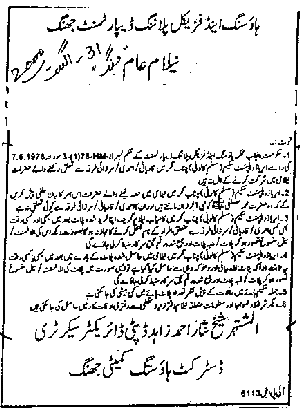
As per Order No. 3-(1)76-HM-II dated 7.6.1976 of the Government of Punjab, Qadianis / Ahmadis / Mirzais are not eligible to participate in the auction of the plots at the Area Development Scheme (Muslim Colony) Chenab Nagar.
Participants in the auction will declare on oath that they believe that Hadrat Muhammad is the Prophet of Latter Days, and that they are not linked with Ahmadi / Qadiani / Mirzai denomination.
Awardees of plots in this scheme will never be permitted to transfer their plot to an Ahmadi / Qadiani / Mirzai. If so, their allotment will be cancelled, and their plot along with the building and paid up sum will be confiscated by the government.
|
4. |
Pakistanis in UK who wanted a Pakistani passport were required to fill in a proforma, on which one of the columns was 'Religion'. It seems the High Commission found it rather embarrassing to ask people in UK to state their religion. So they have changed the form. In the new form, the religion column is missing, however, scared of the mulla, the High Commission has added a sub-para C to the certificate to be signed by Muslim applicants. The new entry, unashamedly reads as follows:
- I consider Mirza Ghulam Ahmad Quadiani to be an imposter nabi and also consider his followers whether belonging to the Lahori or Qadiani group to be non-Muslim.
Signature of the Applicant
This sub-para was not there in the old form. The change is for the worse. In addition to the preposterous sub-para C which is required of every Muslim applicant (although neither Ordinance XX nor the subsequent legal provisions of PPC, nor the Constitution obligates Pakistani Muslims to make this statement), the new format denies the applicants the right to state their own religion, as henceforth the High Commission will issue passports with Religion entry as simply ‘Muslim’ or ‘Non-Muslim’. But ‘Non-Muslim’ is not a religion. Pakistan is perhaps the only country in the world whose passport carries the religion entry. Now its passports will be burdened with additional absurdity of stating someone's religion that is no religion at all. It will indeed be offensive to many passport holders - certainly to Ahmadis. |
5. |
It is amazing to what length the religious extremists can go in Pakistan with their violent exhortations and in their slander and profanity against respected leaders of the Ahmadiyya Community. More amazing is the tolerance shown by the authorities to their outrageous attacks. Recently, the Central Body (Markazi Shura) of the Almi Majlis Tahaffuz Khatame Nabuwat Pakistan issued a pamphlet that is being circulated in the Punjab. Some extracts (translated) are given below.
Traitor, Son of a Traitor, Mirza Ghulam Ahmadi Qadiani, the Founder of Ahmadiyyat, was the Great Apostate, Deserving-Death. He is burning in Hell.
The Muslim nation demands from the Government of Pakistan where the official religion is Islam and which was created only in the name of Islam and for Islam, that :
Ahmadi apostates be given an ultimatum of three days to revert to Islam like other 1100 million Muslims worldwide; Ahmadis who do not become Muslims within three days should then be made to stand in lines and their killing should start and continue till all Ahmadis are killed and not stopped till these apostates have been killed.
Published by
The Central Consultative Body, International Organization for Protection of the Finality of Prophethood, Pakistan - Head Office, Multan; Founder-Patron Khatame Nabuwwat Youth Force Pakistan, Dar Plaza, Sialkot, Pakistan
Sajjad Ahmad Khan Shirwani, Sialkot |
The authorities neither confiscated the outrageous pamphlet nor took any action against the carefree provoker. Copy of the translated parts of the original is shown at Annex III. |
6. |
Mullas made written accusation on religious grounds against Ahmadi of the Nagar Parker area in Thar, Sind to the authorities. The district authorities at Mirpur Khas referred the matter to the Nagar Parker police. A police inquiry in Pakistan often means undue trouble and harassment. The police inspector visited the Ahmadiyya mission house. He went through Ahmadiyya books and literature. The next day he sent for the boys of the Ahmadiyya hostel; these were presented to him. Their statements were recorded on paper and they were told to sign those. The inspector demanded other information about other Ahmadi communities in the area. This had to be provided. The police found nothing wrong and forwarded its report to higher authorities. Then the Tehsildar of Nagar Parker ordered the Ahmadi headman to appear before him. Just compare this official behavior with that apparent from the entry at serial 5 above. |
Whenever a callous and unjust law is brought into force, the role of the Judiciary is automatically brought into play. The Judiciary should always, and it does, as is the universal practice, try to remove or at least reduce its rigor so as to save the citizen from becoming a mauled victim of such a law. But it does not so happen in the Ahmadiyya case in Pakistan. The Criminal Jurisprudence requires a penal law to be very specific so as to put the citizen on guard, and to make him understand in the most unambiguous and certain terms where he stands vis-a-vis that law. An ambiguous and uncertain penal law is not to be given any weight and is hence to be ignored by the Judiciary.
This basic principle was however not adhered to by the Judiciary for application in Ahmadiyya cases. The mulla took full advantage of the situation, and availing himself of the intentional ambiguity provided in the anti-Ahmadiyya Ordinance, started registration of criminal cases against Ahmadis all over the country. The courts, instead of applying strictly the said principle of Criminal Jurisprudence and curbing the gross miss-use of the law, allowed the mulla free play in his nefarious practice, through their inaction generally and active guidance occasionally. The case of Mirza Khursheed Ahmad (PLD 1992 Lahore 1) can safely be referred to as a typical example in this regard. The Lahore High Court held in this case that,
when an Ahmadi recites Kalima (Islamic creed) and says, “Muhammad-ur-Rasoolullah” (i.e. Muhammad is the Prophet of Allah) he really means at heart ‘Mirza Ghulam’; he thereby commits blasphemy; a case under section 295-C PPC entailing death penalty should therefore under such circumstances be registered against him. |
Since this decision, applications started pouring in to courts seized with 298-C PPC cases to change them into those of much harsher 295C PPC. The said High Court decision thus opened a floodgate of tyranny. This decision was subsequently reinforced by the Supreme Court decision in 1994 wherein the court observed:
“When an Ahmadi or Ahmadis display in public, or a placard, badge, or a poster, or writes on a wall or ceremonial gate, or bunting the Kalima (Islamic creed) or chant other Shaare Islam (Islamic epithets) it would amount to defiling the name of the Holy Prophet (p.b.u.h.).” |
The mulla carries this opinion in his pocket and shows it to the police to slam the vicious law on Ahmadi victims.
In 1997, the Parliament passed a new law, the Anti-Terrorism Act. It was ostensibly intended to curb terrorism in the country. In addition to the terrorist acts mentioned in the main body of the Act, a Schedule containing certain additional offences was annexed thereto. A power was given therein to the Government to make amendments to the Schedule as and when a need therefore was felt. The offences of 298-A (later deleted) and 295-A PPC were included in it. The Mulla, feeling that it was much easier, quicker and surer to get an Ahmadi convicted by Anti-terrorism court, started making applications for the transfer of such cases to these courts that are always willing to get these cases before them. An example in this respect can be quoted of the case of Ghulam Mustafa, Ahmadi against whom a case under section 295-A PPC was fabricated and registered. All that he had done was to explain Ahmadiyya position to an acquaintance who raised no objection to this conversation. It was in his post-arrest bail application that the session's court of Dera Ghazi Khan made an observation that a case under section 295-C could have been made out. Feeling encouraged by this observation, the complainant made an application to the Anti-terrorism Court D.G. Khan for the transfer of the case to it. The court was readily receptive. It not only transferred the case to itself but it convicted and sentenced the accused to rigorous imprisonment of thirteen years within only a fortnight of the receipt of the case.
This general trend has continued for the last sixteen years with occasional whiffs of fresh air from a few judicious and courageous officials of the world of judiciary. On the whole, the judiciary has acted in league with the establishment to suppress the Ahmadiyya community beyond the call of the statute book. The Year 2000 had its due share of this reprehensible contribution from the courts, the law officers and the bar. Some examples are cited below.
1. |
In January 2000 Mahmood Ahmad Cheema, Civil Judge awarded two years' imprisonment sentence to Mr. Ataulla Waraich, Ahmadi of Chak 11/F.W. district Bahawalnagar under the anti-Ahmadiyya section PPC 298B for building a niche and minaret in an Ahmadiyya Mosque.
Mr. Warraich is the president of the local Ahmadiyya Community. Case No. 302 was registered against him on September 8, 1999 under 298B at police station Chishtian Sadr for building a minaret and niche in an Ahmadiyya house of worship. The accuser was none other than a magistrate, namely Beqa Mohammad of Chishtian. It is noteworthy that the law 298B does not forbid Ahmadis to build minarets and niche in their places of worship.
Subsequent to Mr. Warraich's arrest, his plea for bail was rejected by the Judicial Magistrate, the Session Judge and Justice Nazir Akhtar of Lahore High Court. The latter, while rejecting the accused's plea for bail, went out of his way to observe and direct:
The present case does not involve commission of an ordinary penal offence against one or more individuals but is an exceptional case involving commission of an offense against the society as a whole which may have national as well as international repercussion………I feel that the interests of justice would be adequately met if the trial court is directed to conclude the trial within a period of three months…… (and to) conduct proceedings on day to day basis. |
Judge Nazir Akhtar is known for his declared opinion that there is no need of any law to punish a man who is guilty of defiling the name of the Holy Prophet, and anyone who commits blasphemy against the Prophet can be dispatched to hell (the Daily Jang, Lahore of September 5, 1999). In the recent reshuffle, this judge was also invited to take oath under the PCO, which he did.
The Civil Judge was very mindful of the directions received from above and concluded the case within the prescribed period.
It is relevant to mention that the first mosque initially built by the Holy Prophet of Islam had no minaret nor a niche. Dr Omar Khalid, a well known Muslim scholar and a specialist in mosque architecture stated at a seminar in Lahore: “Even if no minaret or niche is provided in a mosque, it makes no difference, as the real purpose of a mosque is to offer prayers. The Prophet's Mosque initially had no minaret nor a niche; these were added later during the reign of Uthman”, (The Daily Nawai Waqt, Lahore: January 24, 2000). |
2. |
In September 1997, Mulla Hamadi of Tando Adam, who is on government pay roll, approached a court to try the Supreme Head of the Ahmadiyya Community and Mr. Kunwar Idrees, an ex provincial minister and Chief Secretary Sind, for blasphemy. The mulla based his case on an interview given by the ex-minister to the Daily Jang in which the latter presented a letter from the Supreme Head who quoted from the Holy Quran. According to the mulla, this injured the feelings of Muslims. The judge gave the verdict that there was a prima facie case that calls for a trial (under the law that prescribes death punishment). Mr. Idrees obtained a Bail Order and got the case transferred to Karachi for hearing.
It may seem unbelievable but nevertheless it is true, that the federal authorities approached the provincial government to ask the Sind High Court to expedite trial proceedings. The Chief Justice accordingly instructed the trial court to complete the hearings within 3 months, and render a fortnightly progress report.
The defense applied to the court under Section 265 K that the case is not fit for hearing. The court rejected this plea. |
3. |
Mr. Mirza Mubarak Ahmad Nusrat, an Ahmadi of Mirpur Khas (Sind) was arrested in 1989 for alleged distribution of a Prayer Duel pamphlet and was detained in a police lock-up. While under detention, Mulla Ahmad Mian Hamadi, accused him of offering prayers behind bars, and another criminal case No. 13/1989 was registered against him at Police Station Tando Adam under Section 298 PPC.
The accused faced prosecution during the last 11 years. His case was heard at various locations: Tando Adam, Sanghar, Hyderabad and Karachi. It was referred to the Sind High Court on three occasions. Eventually, the High Court ordered that the case be transferred to Hyderabad and decided early. Mr. Fida Hussain Mughal, Judicial Magistrate (1) Hyderabad Sind heard the case and announced his decision on May 20, 2000. He declared that, “the prosecution has established its case against the accused beyond all shadow of doubt". Convicting the accused of the charge of offering prayers in the Muslim way, he sentenced him to imprisonment for 2 months 21 days which were to be considered as already served for remaining in jail for the same period in 1989 prior to his release on bail. The accused was ordered to also pay a fine of Rs 3000, in default thereof he shall have to suffer imprisonment for one month more”.
A few observations mentioned in the judgment are particularly significant and noteworthy. They deserve a mention and a comment.
- The Magistrate found that the "accused, being Qadiani offered pray like Muslims with Sajdah (prostration) and Rukoo (bent forward) with face towards kabatullah Shareef (in Mecca), by posing himself as Muslim". He writes: "No doubt offering pray by any person as per his own faith is no offence but when hurt has been caused the feelings of other persons then it becomes an offence,… (stet.)". Having said that he found the accused ‘Guilty’, although he offered prayers as per his own faith. It appears that the only yardstick the magistrate had was the simple ‘statement’ of a Mulla that his feelings were hurt.
- Some unsympathetic authorities question Ahmadis' right to practice their faith in public just like other denominations. Why don't you do it in private - they ask. Well, the magistrate would not permit even that. He wrote: "There is nothing in this section (of law) that if a person of above group (Ahmadi) poses himself as muslim at private place then it is no offence. The person of Qadiani and Ahmadi Group if poses himself as muslims, irrespective of public or private place, then it is an offence U/S 298C PPC".
- The magistrate went on to remark: "Their (Ahmadis') use of Shaaire (practice) Islam thus amounts to either posing as Muslim, or to deceiving others or to ridicule". Well, here is a bowl that is hotter than the soup. The magistrate would not allow Ahmadis to worship like a Muslim. Mullas are not the sole proprietors of obscurantism, prejudice and irrationality.
It is also noteworthy that this trial went on for over 11 years. The accused and his attorney, Mr. Ali Ahmad Tariq, Advocate traveled tens of thousands of kilometers to make court appearances. Mr. Nusrat, the accused kept meticulous records, and he claimed in January 2000 that by then he had traveled 98,840 kilometers to appear in various courts in this trial. The prime prosecution witness died early during the trial. Another witness admitted in the court that he decided to appear as a witness at the urging of Mulla Hamadi, and perhaps for that reason he had lost his eyesight without any disease or any other apparent reason. The decision in this case is very significant for the reason that it forbids Ahmadis to worship and declares it a crime in Pakistan. It is also expressive of the dangerous influence of mullas on the establishment. |
4. |
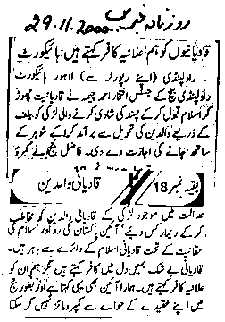 Justice Nazir Akhtar of Lahore High Court is not alone in giving free vent to his prejudice against Ahmadis. Justice Iftikhar Ahmad Cheema of Rawalpindi Bench of the same Court, while hearing a case, addressed the following remarks to an Ahmadi:
“According to the Constitution of Pakistan and the Truth in Islam, Qadianis are outside the pale of Islam. No doubt, Qadianis consider us ‘infidels’ in their hearts, but we call them ‘infidels’ openly. Our Constitution also does the same; and as a Judge, I cannot compromise in view of my belief.” The Daily Khabrain; November 29, 2000 |
Well, here is another judge, who goes by his religious beliefs in giving legal decisions - and says so. |
5. |
A magistrate at Qasur awarded imprisonment terms of one year each to three Ahmadis in two religious cases and also fined them Rs. 5000 each, on 11 October, 2000.
The first case had been going on since 1987 against Sh. Muhammad Yusuf. He was accused of displaying Quranic verses at his shop and the Kalima (Islamic Creed) at his door.
Messers Mohammad Hussain and Muhammad Sadiq, father and son, were co-accused in the second case. They were accused of displaying the Kalima (Islamic creed) on their house. |
6. |
Approximately two years ago, Dr. Saeed of Jaranwala, District Faisalabad was charged for preaching. Later, it was a magistrate who took the initiative to apply the Blasphemy section PPC 295C to the case. It was a vindictive and baseless action; no Ahmadi is ever blasphemous against Prophet Muhammad whom Ahmadis consider their own Prophet.
Additional Session Judge, Jaranwala heard the case. The defense took the plea that PPC 295C was not applicable in this case. On April 12, the judge rejected the plea.
If the government and judiciary does not mind following up such absurd cases in courts, it should not complain of the unmanageable burden of court cases and shortage of judges. It should blame only itself. |
Bails Denied
The impact and tyranny caused by the Anti-Ahmadiyya and religious laws can be toned down considerably by releasing the victims on bail during the period of judicial process. This relief is denied often to Ahmadis by magistrates and trial courts. In numerous instances the victims have to approach the High Courts for bail. Occasionally when judges of the high courts also reject their appeal, the accused have to go to the Supreme Court for relief. It is not rare that justice is delayed even at the apex court. In the case of the ‘Mianwali Four’, the victims of the Blasphemy Law had to wait for four years and one month in prison before a bench of the Supreme Court eventually decided to release them on bail. In the trial that followed, the judge found them Not Guilty. Some of the Ahmadis who were denied the relief of Bail during the Year 2000 are mentioned below. It need not be repeated that majority of the criminal accusations were false and fabricated.
- Dr. Abdul Ghani and Mr. Munir Ahmad charged under 295A and arrested in September 1999 were denied bail even by the Supreme Court. Dr. Ghani was found Not Guilty in November 2000 and released after 1 year and two months in prison for nothing.
Mr. Munir Ahmad is still in prison. He is 70 years old.
- Civil Judge, Kamran Basharat refused to grant bail on 18 October to Mr. Asad Zahur, Ahmadi, who had been charged under PPC 298B and 298C for addressing the Head of the Ahmadiyya Community as Ameerul Momineen i.e. the Leader of the faithful. The accuser remained behind bars to face the trial that may go on for years.
- Additional Session Judge Bhalwal refused, on October 31, to confirm the Bail of Messers Manzur Qadir Khan and Muhammad Idrees, Ahmadis, who had been accused of preaching. The former is the president of the local Ahmadiyya Community while the letter is the religious teacher. The police arrested the two Ahmadis.
- Mr. Munir Ahmad of District Faisalabad was charged under PPC 295B in a fabricated and false case on 20 September 2000. He is a school teacher. The Session Court has rejected his plea for release on bail. He remains in prison.
- Mr. Abdus Sami and two others were charged under the anti-Ahmadiyya Law PPC 298C on 29 August 2000. They were arrested. Their plea for bail was rejected by the magistrate and later by the Sessions Court. They were kept in the prison at Multan.
- Mr. Asad Zahur was targeted under the notorious Ordinance, sections 298 and 298C. They arrested him in September. His plea for bail was rejected by the magistrate, and subsequently by the Additional Session Judge Sialkot on November 4, 2000. He is behind bars at Sialkot prison.
- Three Ahmadis namely Messers Zafar Iqbal, Saleem Ahmad and Mubashir Ahmad of L Plot, District Okara were booked in June under PPC 324 and 34. They had been granted temporary bail. When they approached the magistrate for confirmation of the bail, he confirmed that of Mr. Mubashir Ahmad, but refused to confirm those of the other two. These were arrested by the police and sent to a lock-up.
- The plea of Bail of four Ahmadis of village Bhauru who are behind bars for the last six months after the incident in which Mr. Abdul Latif, an Ahmadi was murdered, was rejected by the Session Judge Sheikhupura on November 28.
- The Anti-terrorism Court rejected the Bail plea of 5 Ahmadis of Takht Hazara who are the complainants and witnesses in the case in which 5 Ahmadis were murdered by rioters.
A Mulla in the garb of a Judge
Judge Nazir Akhatr of Lahore High Court can be credited with openness if nothing else. He is frankly immodest and unblushing about his obscurantist opinions and views. He finds the rule, “a judge gives his opinion only through his judgments” too restrictive, so he continues to give vent lewdly to his spiteful and vulgar ideas in public. Three recent specimens from the national press:
“The Ghazi Ilm Din Shaheed law is available to respond to any blasphemy against the Prophet”, Justice Nazir Akhtar
The Daily Khabrain, Lahore: 28 August 2000
(Note: Ilm Din was a Muslim who in pre-partition days murdered a Hindu who committed blasphemy against the Holy Prophet. Judge Akhtar raises Ilm Din's act of murder to the status of Law itself.) |
“Unity of the Muslim Umma is essential to safeguard the doctrine of Khatme Nabuwwat. Ghazi Ilm Din law is available to deal with apostates”. Justice Nazir Akhtar
The Daily Insaf : 28 August 2000
(Note: The judge, thus has openly instigated and urged the common Muslim to murder Ahmadis) |
'“We shall slit every tongue that is guilty of insolence against the Holy Prphet”. Justice Mian Nazir
The Daily Din; 28 August 2000 |
Justice Nazir Akhtar is perhaps the only judge of a high court, in the whole world, who openly promotes terrorism on religious grounds. According to a press report, he has recently moved up in the ladder to become the senior most judge at Lahore High Court, after the Chief Justice.
Quick Disposal of Criminal Cases
On September 9, Mr. Ashiq Jaura, the Judicial Magistrate Chiniot was due to hear 40 cases involving Ahmadis from Rabwah (Chenabnagar). At the court appearance, the magistrate stated that he had received orders from the District and Session Judge that all cases that were registered prior to 1990 must be immediately decided. “Hence I would hold the hearings on daily basis”, he said.
A few days afterwards, the press splashed the following news:
The High Court orders all cases against Qadianis to be decided by a given date.
The Civil Court, Chiniot has been ordered to announce decisions by 15 October.
48 cases were registered against Qadianis prior to 1990. A number of accused are abroad.
The Daily Ausaf; September 13, 2000
Orders issued to decide cases of Chenab Nagar Qadianis by October 15.
The Daily Jang: September 12, 2000
|
The news were correct. The magistrate subsequently held the hearings almost daily. The 48 cases, that have been going on for more than 10 years are going to be decided within a few weeks. The magistrate could not meet his target date of October 15. But he is trying his best for speedy trials that are still going on.
All is not necessarily Well that ends Well
A good news arrived from Mianwali in September 2000. Judge Khadim Hussain gave his decision in the famous Blasphemy Case of the Mianwali Four. He declared them Not Guilty. In order to avoid any untoward incident in the courts' premises at the time of announcement of the decision, a unit of the Elite Force was at hand to deter the mullas who were lurking around. Men of the Punjab Police were also standing by in the courtroom, with handcuffs available, in case the judge gave the verdict of ‘guilty’. The accused, who were fending for their lives, heaved a sigh of relief when they heard the decision. A short resume of this important case would be in order at this occasion - many of the features of this case are typical.
A case was registered against four Ahmadis, namely, Messers Riaz Ahmad, Basharat Ahmad, Qamar Ahmad and Mushtaq Ahmad of Chak No.15/D, Mianwali on 21 November 1993, under Section 295C i.e. the Blasphemy Law, and they were arrested. However, there was a noteworthy background to this case.
There had been a dispute between the main accused, Mr. Riaz Ahmad, Ahmadi and the plaintiff, Muhammad Abdullah over the post of Numberdar (village chief). Mr. Riaz Ahmad had been Numberdar of the village for a long time; the plaintiff applied to authorities to have him removed from this post because Riaz was an Ahmadi. The Deputy Commissioner gave the verdict against Mr. Riaz. However, on appeal, the Commissioner gave the ruling that there is no prohibition in law for an Ahmadi to be Numberdar. Under these circumstances, the plaintiff contrived an easier and more effective plan to deal with his rival, in that he got registered a concocted case of Blasphemy against Mr. Riaz Ahmad and his relatives. Thus the four were arrested the same day and placed in Mianwali jail.
An application for their release on bail was filed in the court of Additional Session Judge, Mianwali. On December 7, 1993, the date of hearing, the plaintiff with the help of Mulla Akram Toofani and his gang created a noisy situation outside the court. The case was sent up to the court of Session Judge. The hearing there was postponed a number of times. On 3 January 1994 the date of hearing, mullas gathered in a large number at the court premises. The Sessions Court rejected the bail applications of the accused.
The bail application was then moved in Lahore High Court. After hearing, the judge decided to send this case to the Chief Justice and requested that a larger Bench of judges should be constituted to give their comment on some pertinent questions arising from the Blasphemy Law. The Bench heard the case in April 1994. The judges upheld and defended the Blasphemy Law. This law was defended on various grounds including, “If the provisions of Section 295-C were repealed or declared to be ultra vires of the Constitution, the time old method of doing away with the culprits at the spot would stand revived”. ("The Nation" and "The News International" of April 27, 1994)
Subsequently the bail application was heard afresh by Justice Nazir Akhtar on 25 May. Assistant Advocate General Mr. Nazir Ghazi, representing the State, vehemently opposed the grant of bail to the accused. He argued that if an insult were uttered about the Holy Prophet, Muhammad, we would not look into the intentions behind such an utterance. Thus according to this ranking officer of the law, the complainant's opinion on insult could not be questioned by the defense and the latter's intentions or explanation were not relevant. The Judge then rejected the bail application. The accused stayed on in prison.
Bail application was then moved in the Supreme Court of Pakistan on 20 July 1994. The defense took the plea that the accusation was a false one. The Chief Justice ordered that the petition be heard by a larger Bench of the court.
For more than 1½ years, the Supreme Court was not able to give a date for hearing the case. The accused stayed on in prison for over four years awaiting release on bail. Mother of two of the accused died during their stay in prison. The appalling conditions of Pakistani jails are well known. As the breadwinners were in prison, their families faced acute financial problems. Their situation remained distressing and pathetic. Eventually they were released on bail in December 1997.
Subsequently the case dragged on for more than two and half years. Fearful of their lives, two of the accused, Basharat Ahmad and Qamar Ahmad left the country and took refuge in a foreign land. Mr. Riaz Ahmad and Mushtaq Ahmad had to flee from their village. They became refugees in their own country. They could not till their lands to make a living and became dependants along with their families. Four years of imprisonment and seven years of their criminal trial has left them exhausted and feeling old before their time. Although they have been finally declared Not Guilty, who and how one is to account for the mutilation of 7 prime years of their lives? It has been a painful experience not only for them and their families but also for the entire Ahmadiyya Community who shared their plight of unjust detention and trial. Only Allah can mitigate their sorrows and rehabilitate them physically and emotionally. In the presence of the black Blasphemy Law, they remain vulnerable. Someone has to only write a fabricated complaint of blasphemy on a piece of paper and arrange two false witnesses of which there is no shortage around, and the victims could again be in courts and prison for years.
God has His own ways of retribution. The accuser and his accomplices were not present in the court at the time of announcement of the decision. The judge asked as to their whereabouts, to which the prosecutor replied that they were locked up at the time in a prison on a charge of murder.
The Judge's Decision and remarks
Mr. Mian Khadim Hussain, the Judge acquitted the Mianwali accused of the charge on September 9, 2000 in the dire circumstances described above. Some extracts from his Judgment of this historic case are interesting:
“26. In the light of the above discussion, this court has come to the conclusion that firstly this is case of no evidence, secondly that the complainant party have made the sentiment of the Muslims as tool for the worldly benefit and aim and also used the name of Hazrat Muhammad (Peace Be Upon Him) for this purpose. The evidence of the prosecution is based on previous enmity, litigation and interested and false witnesses are produced to prove this case of punishment of death which has also created doubts and the prosecution has also failed to prove the case beyond any shadow of doubt rather they have falsely implicated the accused present persons in the present case.
27. The accused while recording their statement u/s 342 Cr. P.C. has clearly mentioned that Mirza Ghulam Ahmad was a servant of Rasool-e-Pak (the Holy Prophet of Islam) which has impressed this court positively to believe that in fact the accused have been involved by the complainant party for their worldly aim and they choosed section 295C PPC for this purpose, but failed to prove the same.” |
|
In this case, the role of the police, the Deputy Commissioner, some officers of the lower judiciary and the Law Department, some judges of the High Court and the Supreme Court was not laudable - to say the least. It is doubtful if the souls of the authors of the Blasphemy Law, General Zia and Prime Minister Junejo are going to rest in peace either. It is hoped that someday someone will find time to write a book on this case and expose all that is evil and disgraceful in the official and clerical world in present day Pakistan. Hats off, however, to judges like Mian Khadim Hussain who have the courage to be just and who dare speak the truth. May they prosper in life here and Hereafter.
The Bar acts Timid
There is no shortage of advocates and lawyers in Pakistan. Normally, many of them are found waiting in their offices for clients. In the wake of Takht Hazara incident and the recent police action against Ahmadis there, the accused approached a few criminal law lawyers at Sargodha to defend them in the court. They all expressed their inability to take up Ahmadis' defense. Apparently, they do not have any professional objection; they are only afraid of incurring mullas' displeasure.
Disturbance, Tension and Insecurity all Over |
|
Provisions of the anti-Ahmadiyya Ordinance XX apply all over Pakistan including Azad Kashmir. As the evil influence of the mulla is also present, in greater or lesser degree, all over the country, the mischief of this law raises its ugly head wherever the mulla chooses to exert himself. In smaller towns and villages, any grave happening like a murder drives a wedge in the local community, creates serious tension and the inhabitants get divided on the basis of religion. A religious divide, not unlike in Balkans or Beirut precipitates on a small scale like in Takht Hazara and Bhauru. At places where serious developments take place, like desecration of a mosque, arrest or registration of criminal case, the local and nearby Ahmadiyya communities come under great pressure, tension prevails and Ahmadis feel very disturbed because of the unsympathetic attitude of authorities and resulting insecurity. Such situation tends to linger on for months, even years. Their opponents and mullas exploit the sensitive environment and make Ahmadis' life close to unbearable. Then there is always the possibility of a flare-up which results in further hardship for Ahmadis. The tense ‘Life at Bhauru Village’ was related at some length in 1999 Annual Report. Authorities were informed about it but they took no preventive action. No wonder, the Year 2000 was marked by an attack by the opponents on Ahmadis in which an Ahmadi was killed and a few individuals from both sides were injured. Criminal cases were registered by the police against dozens of persons from both sides, and many arrests were made. As a result the village community life is severely affected and two groups once living as friends, now consider each other as enemies. The same situation prevails at Takht Hazara. The burden and responsibility of these developments rests squarely on authorities and the government who despite full knowledge of the potential evil took no action to nip the evil in the bud. The opinion that ‘the Pakistani police arrives only to collect the dead bodies and register cases’ is not without basis.
Tension prevails and most Ahmadis live severely disturbed lives at all those places mentioned in earlier Sections of this Report where slaughter, riot, murders, desecration of mosques and registration of criminal cases occurred. Those are not repeated in this Section. Only those locations are mentioned below where the mulla is busy preparing the ground for mischief and the fire is summering. In view of the government's laissez faire attitude towards the mulla, the possibility of still more Ghatialians, Takht Hazaras and Bhaurus cannot be ruled out.
THE PUNJAB
Faisalabad: This is an important industrial town in the Punjab. A sizable Ahmadiyya community lives here. Anti-Ahmadiyya activists are applying a steady pressure, and with the connivance of authorities, have made considerable gains against their beleaguered victims. A number of serious incidents happened here.
a. |
Anti-Ahmadiyya agitation had been going on in Khyaban Colony area for weeks. The authorities, rather than doing their duty of protecting human rights of a small community, played in the hands of extremists and co-operated with them. On 17 December 1999, the police forcibly prevented Ahmadis to offer their prayers at their Center. On January 2, 2000 the authorities sealed their prayer hall. Mullas took to extensive highly provocative wall chalking in the Colony. Some of the outrageous writings are translated below:
|
Mirza, the false prophet, and his fellows are Cursed and Hell-bound. |
|
Infidel Mirzais are Traitors to both Islam and the Country. |
|
Those who do not believe in the Finality of the Last Prophet are Infidels and Apostates. We are at War with Them. |
|
Mirzais are Apostates; thus They are Liable to be put to Death. Sharia Punishment be Imposed upon Them. |
|
Qadianis and Satan perform the Same Function. |
|
We cannot Tolerate Qadianis in this Pure Land. |
|
Guard against Three Evils; Satan, Shehzan and Qadian. |
|
|
b. |
In a Friday sermon during August, the local mulla in Madina Township urged the worshipers to move decisively against Ahmadis who congregated at a neighborhood residence for prayers. He gave them the precedence of Khyaban Colony where the joint action of residents had denied the Qadianis the right of worship. "Why the same cannot he done here?" he asked. |
c. |
In the same month one, Tanvir Shah of Rabbani Colony, had an extremely derogatory anti-Ahmadiyya pamphlet published, and circulated it. An Ahmadiyya delegation called on the Commissioner to complain. He issued orders to the DC to take appropriate action. Ahmadis were advised by the Community officials to remain calm. |
d. |
A few workers led by a mulla type have formed a pressure group in Magna Textile Industries Limited, which is owned by an Ahmadi. The mischief monger is working on the basis of religion, to generate industrial unrest in the factory. He has sought help from other mullas who have nothing to do with this Textile industry. During August in two of his letters to mullas he stated:
- We intend to cleanse the factory of Qadianis. Only two Qadianis are left in the laboratory - these will be expelled as well.
- Qadianis defile our crockery in the mess.
- One Qadiani, Abdur Razzaq has been made to recant.
- Workers of the Arzoo Mills and Etmad Mills support us.
- We intend to build a mosque in the factory. We propose to initially build the four walls quickly, so that no one can then dare demolish it.
- Contact me discreetly at the premises on a Friday, as it is closed for being a holiday. If you join us in setting up this mosque, Maulvi Muhammad Hussain will get the credit.
|
It is obvious that once this mosque is built, it will be conveniently used to generate any amount of unrest and agitation in the factory. |
e. |
Sheikh Muzaffar Ahmad, the District President of the Ahmadiyya Community returned home along with his family on 25 September evening, after two days' absence. Outside the gate, there still hung a wooden case that once enclosed the electric meter. In that case he found a book that was just about to fall over. He took the book and discovered that it was a copy of the Holy Quran. Some parts of the Book were marked with red crosses and underlines. Obviously, some miscreant had planned a mischief that fortunately failed to materialize. |
f. |
On September 25, a police party visited the Ahmadiyya Mosque and made inquiries about an alleged meeting and conference there, that had not taken place. |
g. |
A team from security and intelligence agencies visited the residence of an Ahmadi, Mr. Shah in Millat Colony during dark hours of September 26. They came to make inquiries in the context of a report made by Mulla Faqir Muhammad, the Propaganda Secretary of Majlis Khatame Nabuwwat. The mulla had reported that Mr. Shah's house was a center of Ahmadiyya activities, where Muslim children and adults were induced to come, entertained with sweets etc and coerced to join the Ahmadiyya Community. The agents were told to see for themselves and report as they deemed fit. Having talked to the neighbors, they went back satisfied that nothing objectionable was going on there. |
h. |
Sheikh Saleem Akhtar, owner of the Community House in Madina Town, was contacted on phone by an official who conveyed that someone reported to the Brigadier that the location was being used to entice children to join the Ahmadiyya Jamaat. The official was told that the authorities had already sealed the building there, and it remains sealed to-date.
Authorities obviously act in league with Mullas. |
i. |
The mulla kept on with his relentless drive to upset the Ahmadiyya Community and succeeded by sending a miscreant to the Ahmadiyya mosque, who precipitated a brawl that resulted in the arrest of two Ahmadis, and registration of a criminal case against 10 Ahmadis who all had to seek bail to avoid long detention. A trial will now follow. It is almost certain that the mulla is going to think of fresh initiatives to suppress Ahmadis at Faisalabad to a greater degree. |
Muzaffargarh: During August, Allah Wasaya, a leading anti-Ahmadiyya mulla made a tour of a number of such villages in the district, where Ahmadi communities are found. He addressed congregations and told them that Qadianis are the worst of all infidels. According to a press report, he stated that as long as he is alive he would not allow Qadianis raise their head. He had meetings with Khatme Nabuwwat Youth Force personnel and urged them to step up their activities.
In the same district, Mullas held an open air conference in Azizabad near the primary school on 1 November at 10 a.m. They made fiery speeches against Ahmadis and urged the people to undertake complete social boycott of Ahmadis.
Ahmadis had to take precautions, informed the Assistant Commissioner of the situation subsequent to the conference.
Chak Sikandar, District Gujrat: Mubashir Ahmad was forced in November by the local mulla and his gang to recant. He was admitted to their circle in a nocturnal ceremony. Speeches were made in which it was said: ‘Qadianis are going to meet worse treatment than they had at Ghatialian and Takht Hazara, so that their future generations will remember it for long.’
Mullas Muhammad Munir, Muhammad Salim and Zaman were the most provocative.
Kot Rahmat Khan, District Sheikhupura: A local miscreant often invites extremist mullas from other locations to deliver sermons in the village. This gave rise to tension in the two communities, Ahmadis and non-Ahmadis. Ahmadis maintained vigilance to defend themselves in the event of an attack.
Chak 20 Ghugh, District Jhang: Mullas organized an open-air conference in the Ahmadiyya neighbourhood. As it was meant to be provocative, Ahmadis complained to the Assistant Commissioner. He took no action. Ahmadis then approached the Deputy Commissioner who ordered the fundamentalist to shift their venue — and they did.
Shorkot: In this town, mullas held a conference on October 30. Mr. Amjad Masood, an Ahmadi has a burger shop. The mullas urged people not to buy anything from his shop. Activists came over to his location and demanded that he close down. Fortunately, no damage was done; but he has lost some customers.
Dera Ghazi Khan: Officials of the Sipah Sahaba Pakistan (SSP) held a closed-door meeting after the Ghatialian incident in which 5 Ahmadis were killed. Thereafter, during the night of 5/6 November, three unknown persons jumped inside the Ahmadiyya mosque. They were noticed by a neighbour, so they left without doing any harm.
L Plot, District Okara: Non-Ahmadi mullas of L Plot kept the pot of social disturbance boiling for some weeks in July and August. An agitation and social boycott was mounted against Ahmadi residents of the village. Some weeks earlier, the opponents invited a magistrate to the village. He took away the Kalima plaque from an Ahmadi's shop. Later, the police arrived and demolished the niche of the Ahmadiyya mosque. The extremists invited some mullas from other towns, who delivered poisonous anti-Ahmadiyya sermons. Zafar Iqbal and Sufi Mubashir, Ahmadis, were nabbed by a group of fundamentalists and were beaten up. Pushed to the wall, Saleem Ahmad fired in self-defense to free the captives. Miscreants received gunshot wounds that were not serious. The police registered a case against the three Ahmadis and arrested two of them.
Faced by the mounting tension, that became unbearable, four Ahmadi families quit the village and took refuge elsewhere. Most of the Ahmadi men have lost their work.
Hafizabad: An outsider Mulla was invited here on 29 September 2000 for the Friday congregation. In his sermon, he delivered a great deal of slander and calumny against the Holy Founder of the Ahmadiyya Community. He told them that a Muslim who does not consider Ahmadis as infidels, is himself an infidel. He urged them to implement a complete social boycott against Ahmadis. Leaflets were also distributed.
Mangat Unche, District Hafizabad:The Imam of the local mosque delivered a hateful sermon against Ahmadis. Some religious activists approached the authorities to take action against Ahmadis on the issue of the graveyard, the call to prayers and the posting of Ahmadi teachers etc. Accordingly the police and the administration intervened. This disturbed the community life of the village and caused unnecessary tension.
Chak 35, District Sargodha: Mulla Manzoor Chinioti visited this village in August and made a very poisonous speech against Ahmadis. He told his audience that those who had social relations with Qadianis had their Nikahs (marriage bonds) broken; they should arrange a fresh ceremony to have their marriages restored. Villagers were not pleased with this Fatwa, and jointly rejected it.
Samina, District D.G. Khan: The Anti-Ahmadiyya Majlis Khatme Nabuwwat wrote a threatening letter No. 1060 dated 9 August 2000 to Mian brothers of Dha tribe to take action, by force if necessary, against those who socialized with Mirzais; otherwise they would deal with them themselves with the help of police.
Kot Radha Kishan, District Qasur: Some opponents of the Ahmadiyya Community wrote a few lines on a piece of paper and sent the application to the Resident Magistrate to register a criminal case against the local Ahmadis, in August 2000. The RM directed the police to take suitable action. This was enough to worry Ahmadis who were confronted with protracted criminal litigation and years of imprisonment. They contacted the local folks who gave them full support. Eventually the police and the administration conveyed their assent to withdraw the charges subject to illegal gratification.
District Attock: This district is one of the many where anti-Ahmadiyya activists manage to stoke the fire of hatred one way or another. In May, in the village Kasran, they undertook highly provocative wall-chalking on houses and the local mosque. The writings include: MIRZAI DOGS; THOSE WHO ARE FRIENDS OF MIRZAIS, THEY ARE TRAITORS TO ISLAM; MIRZAIS MUST BE KILLED; MIRZAIS ARE INFIDELS etc. Such wall-chalking in a village does great damage to the peace of the local community. Authorities took no action.
Rajanpur: At the Friday prayers, mullas urged their flock to implement a social boycott against Ahmadis, and sought their commitment to this scheme by show of hands. One of the mullas demanded of the crowd to promise to chop off the nose and ears of Mian Iqbal Ahmad, the District President of the Ahmadiyya Community. Such sermons have had some effect, and Ahmadis did come across a certain amount of social isolation and victimization there.
The authorities took no action against the fiery mulla who promotes violence.
District Jhang Rabwah, the Ahmadiyya headquarters town is located in District Jhang. As such the behaviour of the district officials is a good indicator of the government policies. Their conduct did not raise any hopes during the year.
a. |
An Ahmadi died in a village Chak Korwala, and was buried in the local common graveyard. Mullas approached the Deputy Commissioner and demanded that the Ahmadi dead should be disinterred. The DC sent the SHO who told the Ahmadis to dig up their dead, or face consequences. Ahmadis argued that the graveyard was a common property and they had the same rights over it as the others, unless the authorities allot them another piece of land to bury their dead. The administration decided to consider the proposal.
During April, a community official from Rabwah decided to visit the community at Chak Korwala and address them. The district administration directed the police to intervene, so the event had to be postponed. As it was Friday, the congregational prayers were held. The police raided all the same. They came, made their observations and noted down the names of volunteers on duty on the pretext that the DSP had ordered accordingly.
The authorities support to clerics causes many-faceted problems for Ahmadi citizens. |
b. |
Mullah Ghulam Hussain spoke at length in the Deobandi mosque of Garh Mor on 2 June, 2000, and urged his audience to greater action against Ahmadis. He asked them to implement a social boycott against them and stop all dealings with them. He told them not to allow Ahmadi burials in the village graveyard. He urged them to lodge criminal cases with the police against Ahmadis, based on religious laws. He offered his services to become a ‘complainant’ in such cases and promised legal support. Subsequently he repeated the same mischief, provocation and instructions at Ahmadpur Sial. Ahmadis felt disturbed and threatened. |
c. |
The same mulla joined hands with notorious Mulla Allah Yar Arshad, and addressed congregations during September. He spoke at Jhang and, later, at Wasu Astana. At Shorkot, a team of two mullas and two constables visited the burger shop of Malik Ahmadi, an Ahmadi. They told him to switch off the recitation of the Holy Quran on his audio cassette. They also told him to boldly display his identity at the shop (that he is a Qadiani). |
NWFP
Hazara Division is another pocket where mulla keeps on blowing hot and rarely cold. Ahmadis of Data have suffered harassment for years. There is always tension in the air and Ahmadis have to use all their tact, forbearance and faith to avoid a major trouble. Hazara Division is another pocket where the mulla keeps on blowing hot, and rarely cold. Although tension and insecurity prevails all the time, special mention may be made of the following:
Haripur: A mulla made a very provocative anti-Ahmadiyya speech in the Kangr Mosque. He declared that Ahmadis were Wajbul Qatl (Deserving death according to Sharia).
The local press was there to give a helping hand. Some headlines:
- Open Proselytizing by Qadianis in Haripur
- Simple folks are being misled by clever talk
The Daily Mahasib- September 25, 2000
- Freedom of Propaganda to Mirzais is dangerous to the Federation - Qazi Rehman Gul
- Non-Muslims should be removed from key posts. Otherwise activists of Khatame Nabuwwat will themselves take action.
The Daily Mahasib; Sept: 25, 2000
|
Abbotabad: Sipah Sahaba and the Jamaat Islami have adopted a policy of physical violence against Ahmadis rather than registration of criminal legal cases against them. They think the latter helps them in seeking political asylum in other countries.
Mansehra: Mulla Allah Wasaya visited Mansehra as well, and took the Sipah Sahaba and Majlis Khatame Nabuwwat activists in confidence. They, consequently, stepped-up their anti-Ahmadiyya activities. They intercepted a delegation of two Ahmadis who went to visit Mangal village. They were intent upon violence, but refrained on account of intervention of a friend of the visitors.
Data: Data has been continuously in the news concerning persecution of Ahmadis for years. It appears that Ahmadis at Data are not fortunate enough to have their ups and down. The situation never looks up; they have been kept under constant pressure. In July they made another written complaint to the deputy commissioner of the district. They hoped it might help, although their petitions even to the Prime Minister proved futile during the preceding five years. In their petition, dated July 8, 2000 they complained about a mulla and his gang of miscreants. They protested against a social boycott and picketing. They mentioned blaring loudspeakers of the three local mosques that preach hatred and violence. The law of the land forbids all such activities but the police and law enforcing authorities refuse to budge. Ahmadis forwarded a copy of this letter to the Superintendent of Police and one to the Colonel of the District Monitoring Cell. Ahmadis hope some dutiful and fair official would redress their situation. The official effort required for such redress is not much.
Mullas then kept the communal pot at the boiling temperature. They sought administration's help, and got it more often than not. They approached the DSP and invoked Anti-Ahmadiyya Law; he obliged them by giving orders to an Ahmadi religious teacher to leave Data. On 12th August, miscreants intercepted a five years old Ahmadi child on his way back from school. They treated him harshly, threatened him with beating and made him recant. The little fellow returned home crying. Four days later, Hassan Shah, a drug-pushing felon, intercepted a 13-years old Ahmadi student, Jawad Mahmud and beat him up. At Mahmud's resistance, the gangster tore open his shirt. When the lad returned home, his mother got very upset and went to the police station to make a report. The police sent the boy to the hospital for a medical report. On hearing of his son's ordeal, the boy's father returned home from his job at Haripur. He filed written complaints with the Principal, the AC, the SP and the Army Monitoring Cell. Tension reached danger level in the village.
To add fuel to the fire, Majlis Tahaffuz Khatame Nabuwwat invited Mulla Allah Wasaya to visit the village. He came on September 8 and delivered a venomous Friday sermon that was full of slander and insults against Ahmadis. He stayed on to address a nocturnal session on September 10. He issued the following Fatwas:
- Do not work on Ahmadis' land.
- Do not buy their fruit and other produce.
- Do not give or take water from them for agriculture.
- Within the same family, if some members are Ahmadis, do not live in the same house with them. etc.
|
In his speech, he declared that Ahmadis are Wajibul Qatal (those who must be killed). When all this was being said on loud speaker, the police was present at the site. They, of course, took no action against the fire-brand cleric.
Phagla: Mr. Bashir Shah, now residing in Rabwah, went to visit his ancestral village of Phagla. Armed activists of Sipah Sahaba intercepted him. They proposed to set his car on fire. The situation calmed down only when some relatives of Mr. Shah intervened. They, however, advised him firmly not to visit Phagla again.
AZAD KASHMIR
Despite their concern with situation across the border, mullas of Azad Kashmir spare adequate time to make life difficult for Ahmadis. They mounted a major operation in August at Dhudial and managed to scatter most of the Ahmadis from there (for details see Section 13). They were active in Kotli also.
Kotli: A few residents of Kotli had joined the Ahmadiyya Community one and half year ago. However, they kept it confidential. In March, two of them disclosed their conversion. It caused a great reaction among the local mullas, who raised great hue and cry. They tried to drag the converts to courts. They urged them to disown their allegiance to Ahmadi leaders. Fiery speeches were delivered on mosque loukspeaker. People were exhorted to violence. Ahmadis received threatening letters. Opponents moved administrative and departmental authorities to take action against Ahmadis. The situation remained disturbed and Ahmadis felt concerned.
Kotli was hit by a fresh wave of anti-Ahmadiyya agitation again in August 2000. In July, a slanderous and threatening ‘Fatwa’ (religious edict) was issued against Ahmadis and distributed in public. A police raid was made at the Ahmadiyya mosque on 12 August. They found nothing objectionable. On 13 August, some religious extremists nabbed an Ahmadi youth and accused him of preaching. When Ahmadis went to recover the lad, a crowd of almost 30 miscreants attacked them and beat them up. The president of the local Ahmadiyya Community was injured under the eye.
SIND
Hyderabad: Encouraged by their achievements at Ghatalian and Takht Hazara, fundamentalists are planning to precipitate more of such incidents. They even say so in their public utterances. Cities like Faisalabad and Hyderabad seem to be on their agenda. In Hyderabad, they focused their attention during November on Goth Lalu Lashari area, and have managed to create the required tension. Extensive anti-Ahmadiyya wall-chalking was done. An anti-Ahmadiyya conference was held in which extremely provocative speeches were delivered. Street urchins get together and provoke Ahmadi residents of the area. On 12 November 2000 they got hold of an Ahmadi youth and beat him up. The incident was reported to the police. They threw stones on Ahmadi worshippers in the mosque at the time of Friday prayers on 10 November. The community again reported the matter to the police who took no action. It was learnt from reliable sources that they had plans to set the mosque on fire. The SDM was then contacted who ordered the police to stand guard and maintain vigilance against any disturbance. Ahmadiyya Community reported the matter to the Army Monitoring Cell, Hyderabad Division on November 13, 2000 in a written application, and requested timely effective action.
An anti-Ahmadiyya conference was held at Ghummanabad also where mullas spoke most provocatively against the Ahmadiyya Community. It was announced that Maulana Noorani (of JUP) would attend a conference on 29 November, and that event would be the last nail in the Ahmadiyya coffin.
Mirpur Khas: Anti-Ahmadiyya wall chalking was undertaken in Punhor Colony during November. Some slogans:
Qadianis are infidels
Qadianis reject the Quran
Qadianis are Wajibul Qatl (The term Wajibul Qatl means that according to their version of Sharia, Ahmadis must be killed) |
Police officials were informed by local Ahmadis - for whatever it was worth.
Mullas stepped up their anti-Ahmadiyya campaign. People are instigated to implement social boycott against Ahmadis. A building contractor who undertook to build an Ahmadi's house was told by extremists to stop the construction.
Bucha Band, District Umerkot: Some new converts were made to recant by mullas in August 2000. Extremists howled themselves hoarse to implicate Ahmadis in various criminal cases under the anti-Ahmadiyya laws. The authorities appeared sympathetic to them on the pretext of law and order.
District Badin: Sipah Sahaba (SSP) organized an open air anti-Ahmadiyya meeting at Khadpro Stop on May 10. A mulla, Pyar Ali Khadai made a long speech and summed it up as follows:
- Do not let Ahmadis bury their dead in your graveyards.
- Implement social boycott of Ahmadis. Do not let them drink water at your restaurants. Do not let them even sit there.
- Do not allow the construction of the desalination drain that would benefit Ahmadis.
- You were wrong when you shut down your business at the demise of Ilyas Qadiani on the excuse that he was a very good man. You must make amends by condemning him openly.
- He urged an Ahmadi turncoat to organize an anti-Ahmadiyya meeting.
|
Other Towns in Sind: Open-air meetings were held in most of the big towns against Ahmadis. The participants were educated on registration of criminal cases against Ahmadis under religious laws. Although the attendance level in these meetings was low, the loud speakers are turned on high for all to listen even if they had decided to stay at home.
ISLAMABAD
Mullas do not spare Ahmadis even in the capital. The Khatame Nabuwwat Educational Society distributed pamphlets in October 2000 in large numbers to generate anti-Ahmadi hatred among the masses. They compiled a list of out-of-context short excerpts from the writings of the Founder of Ahmadiyyat. They also published corrupted photographs of Ahmadiyya mosques to misguide the general public about Ahmadiyya articles of faith. In November, a few miscreants broke open the lock of the outer gate of the Ahmadi missionary's residence and entered the premises at 10.p.m. As he and members of his family were still up and about, the miscreants fled. Similar incident had earlier happened at the residence of Mr. Zafrullah, another missionary. It seems the miscreants want to create a sense of fear and lack of security among Ahmadis living in Islamabad/Rawalpindi.
A Fuller Report from Azad Kashmir |
|
This report describes a recent ordeal of two Ahmadis families of Dhudial, District Mirpur, Azad Kashmir. This part of Kashmir is a dependent territory of Pakistan, and in its milieu it shares with the parent country the culture of intolerance and persecution against the Ahmadiyya Community. This report is important in that it throws a flood of light on the general mulla — authorities teamwork in their contemptible drive against this peaceful religious community.
Mr. Mansur Ahmad Zahid is the president of the rather small Ahmadiyya Community at Dhudial. Till a few months ago he had a small tailoring business in the town at a rented location. The house in which his family resided was also a rented house. The community at Dhudial in general and Mr. Zahid in particular had faced harassment at the hands of religious extremists for months. The administration and the police have rarely provided any protection. In fact, they often join the fundamentalists in exercise of tyranny over the persecuted community.
On 8 August 2000, a procession led by mullas, comprising tailors and other shopkeepers arrived at Mr. Zahid‘s business, shouting angry and insulting slogans against Ahmadiyyat. The demonstrators told Zahid to close down his shop, otherwise to remain prepared to face death. The situation was very tense, however it was defused for the time being, thanks to the intervention of a good man. The mob withdrew. Their leaders, however, wrote a complaint on a piece of paper and addressed it to the Sub-Divisional Magistrate. They accused Zahid of showing Ahmadiyya TV programs to non-Ahmadis and being instrumental in the conversion of a good Muslim. Then they marched on to the local police station. The police obligingly collected Zahid, took him to the police station and treated him harshly. They, however, let him go after an admonition.
The next day, Hafiz Bilal, who had earlier switched over to Ahmadiyyat and was an employee at Zahid‘s shop, was intercepted by a few gangsters in the bazaar. They forcibly took him inside a tailor‘s shop and subjected him to severe questioning. They asked him if he had become an Ahmadi, to which Bilal replied in the affirmative. At this, they beat him up with fists and a pair of scissors. They let him go in an injured state with blood all over his clothes. At this, Zahid and Bilal decided to go to the police station to lodge a complaint. The police, however, received them with bad grace, refused to register their complaint, used insulting language against them and detained them. In the meantime, another Ahmadi suffered violence at the hand of gangsters in the town. Mr. Aziz Ahmad, a government employee in water supply service was grabbed by a gang, while on duty, and was beaten up severely. In an injured state, he also arrived at the police station in the evening. The police detained him as well. The three Ahmadis spent the night in the police station. Members of their families were extremely worried for them and spent a sleepless night.
The next day, on August 10, mullas, tailors and gangsters again took out processions, shouted anti-Ahmadiyya slogans and pasted posters on walls. The three Ahmadi detainees felt relatively safe in police custody. The mob therefore went for other Ahmadis who worked in government offices. Mr. Manzoor saved himself by jumping over a wall, and escaped. The mob, however, got hold of Iqbal and Abdul Aziz, Ahmadis, and beat them up badly. The nasal bone of Mr. Iqbal was broken and he bled profusely. They forced Ahmadis to go bare footed to the bazaar. They tied their hands behind their backs, pushed a wreath of shoe bits around their necks (a form of profuse insult), and led them around in the town‘s main streets. The local administration took no action whatsoever to check the mob action. A few notables however intervened and recovered the two victims from the mullas and gangsters. On release, they immediately departed for Mirpur to escape further harm.
At the police station, they gave a very rough time to Hafiz Bilal whom the police and mullas of Lashkar Taiba wanted to recant under duress. Bilal stood firm and refused. At about 4 p.m. they let go the two detainees. Immediately, these Ahmadis hired a taxi and fled to Dolya Jattan, in district Kotli. The exit from Dhudial was full of risk in view of the hostile pickets all over, but they succeeded by avoiding the main roads and through camouflage. Although, now safe themselves, they were worried about the safety of their families at Dhudial. They learnt that mullas had announced on mosques‘ loudspeakers that the next day, a Friday, they would take out processions all over the town and set Ahmadis‘ houses on fire. Ahmadis of Dolya Jattan proposed to hire a van and make the risky trip to Dhudial to recover the stranded families from there during dark hours. They accomplished the proposed evacuation successfully. However, the next day, mullas of Dhudial came to know of their targets‘ escape to Dolya Jattan, so they urged their colleagues there to act. Accordingly, the next day, religious activists of Dolya Jattan got hold of four Ahmadis and beat them up severely in the bazaar. The president of the local Ahmadiyya Community received injuries in the face that resulted in much loss of blood. The Dhudial mullas demanded the Jattan people to expel or hand over to them the two Ahmadis who had taken refuge in their town. As the noose was getting tight around them, the two Ahmadis left their sanctuary during dark hours and spent the night out in the wilderness. At dawn they boarded a vehicle and fled to Mirpur, a district headquarters town. There, they told their woeful tale to the Ahmadi elders, who received them with sympathy and provided them the necessary care.
Their persons were now safe at Mirpur, but their households and business at Dhudial were closed and vulnerable to loot. They were dutifully concerned about their customers‘ unstitched and stitched clothings locked up in the shop. A few days later, the landlord of the shop sent to Mansur Zahid a notice to vacate the premises. Accordingly, during the next three to four weeks, a few Ahmadis helped Zahid in recovery of personal effects and part of the shop inventory at Dhudial. In the meantime someone forcibly took possession of the shop and its contents.
With no place for his devastated family to put up, Zahid sent his wife and children to the Punjab to stay with his in-laws. He now intends to start his business from scratch at Mirpur. Hafiz Bilal had to send his afflicted family to Rahim Yar Khan, hundreds of miles away, while he faces the threat of murder for alleged apostasy.
By the end of the year they have not been able to settle down. One of them was Mr. Aziz Ahmad. He was an employee of the Health Department. He received injuries during the riot and had to go away to Mir Bharka for fear of life. As he could not return in view of the opinion and threats to his person, he could not report on duty. As such his pay has been stopped. He has a family to support. He has received an official warning to return to duty. He is unable to do so and is facing great hardship.
Rabwah remains a Prime Target |
|
Rabwah, the headquarters of Ahmadis in Pakistan, has been targeted by the opponents and the government for the last quarter of a century. Last year the Nawaz Sharif government committed the unsupportable outrage of changing the name of Rabwah, first to Nawan Qadian and then to Chenab Nagar. Ahmadiyya traditional annual conference remains banned. The Military government did not permit the holding of this purely religious conference despite Ahmadiyya request, while all other denominations and faiths are permitted to hold their conferences and ceremonies. Ninety five percent population of Rabwah is Ahmadi, still the authorities permitted religious extremists to hold numerous anti-Ahmadi rallies and conferences in the town. Most of the participants and speakers were transported from other towns to Rabwah to hold highly provocative assemblies against the local population.
The government permitted numerous anti-Ahmadi organizations to hold highly provocative conferences at Rabwah. At such occasions, Ahmadis have to remain vigilant against any outbreak of violence. Ahmadi women are restricted to their homes by the community on these occasions to ensure their safety. A few of these conferences, expressly permitted by authorities are mentioned below:
October Conference
Almi Majlis Tahaffuz Khatame Nabuwwat held its annual conference at Rabwah on 12,13 October 2000. Some notable figures in the religio-political field also participated. A number of ulema made incendiary speeches. Some quotes:
|
Mulla Ikramulla Khan:We should undertake Jehadi training and then pursue them (Ahmadis). We need to firmly decide not to spare them. We should become Mujahid to bury this mischief. We ought to pursue them until no Qadiani is left. 
|
|
Mulla Munawar Hussain:Give me a small space in Chenabnagar - I'll make sure that no Qadiani is spared. If Jihad was obligatory against Musailma, the liar - why not against Musailma, the Punjabi. (By the latter term the mulla was referring to the Holy Founder of the Ahmadiyya Community.)
|
|
Aziz-ur-Rahman Jalandhry:Mirza Ghulam Ahmad was Wajibul Qatl (Deserving Death by Sharia law), so is his progeny.
|
|
Mulla Abdul Malik:Mirza Ghulam Ahmad was a British agent. We shall crush him with our toes.
|
|
Mulla Muhammad Murad Harery:Qadianis are not only apostates but also Zindique-and Zindiques are Wajibul Qatl. If you ask me that who should kill them, I tell you: ‘Pass a law that they are Wajibul Qatl, they will all revert to Islam. However, if the government does not implement Islam, would you not take it upon yourself. I have been accused in 15 to 20 murder cases of Qadianis, but I have never been shown to prison’.
|
|
Mulla Muhammad Saeed son of Mulla Yusuf Ludhianvi:It was a wish of Allama Yusuf Ludhianvi (someone killed him last year in Karachi) that not even a Qadiani child should remain in Pakistan. They should all recant or should be exterminated.
|
|
Mulla Abdus Sattar:If Qadianis are outside the pale of Islam, why don’t you all unite to exterminate them. I urge reverend Khan Mohammad (the Patron of Majlis Khatame Nabuwwat) to urge the Government of Pakistan to finish off all the Qadianis.
|
|
Mulla Abdul Ghafoor Qazi:We are not prepared to tolerate Qadianis. There can be no peace in Pakistan till all Qadianis are pushed out of the country. We shall eradicate them (Qadianis) from all over the world.
|
|
Mulla Luqman Alipuri:Thank God, our ulema have been instrumental in dispatching thousands of Qadianis to prisons. If I get a chance, I will get them all killed.
|
|
Mulla Azam Tariq (SSP):O the worst infidels, Qadianis, do not think that we are not united. Obey the constitution, lest we reach for your necks. We shall break your legs. We urge the government to restrict them, otherwise we know how to take it upon ourselves. Leave alone Pakistan, we shall not spare them anywhere in the world.
|
|
It is noteworthy that none of the speakers faced any criminal charges for instigating violence – not even a warning from authorities.
Still another Provocative Conference at Rabwah
The extremists held a conference again on 17 November 2000, this time at Masjid Bokhari. The main guest speaker was mulla Manzur Ahmad Chinioti, the ex-MPA.
Although this religious seminar was held in a mosque, no one including the guest speaker said a word about morality, spiritual excellence or religious values. Mulla Chinioti’s address contained nothing but sectarian politics, clerical rhetoric, unmitigated slander and high provocation. It would be futile to quote him at length; a quote from his tirade should suffice as a sample:
“(O Qadianis) How few you are? Not even as little as salt in bread. By God, if all the Pakistani Muslims urinate together, you will be swept away by the flood. If all we Muslims spit at the same time, you will be drowned in our spit. How few you are? Why do you put our tolerance to test? When tolerance reaches its end and the law is violated, such are the results (as Ghatialian and Takht Hazara- ed.). If the authorities do not take notice, and these people (Ahmadis) continue to violate the (anti-Ahmadiyya) law- and Muslims take to the streets, not even one of their children would be spared. How few they are? They have a concentration in this city – every one of them will be exterminated…” |
The miscreant mulla said all this in the presence of government officials who were dutifully present but, as usual, took no action except perhaps keeping a record.
Provocation on Friday
This town, being the headquarters of Ahmadiyya Community, has its own importance and sensitivity. Ordinarily, one would expect that anti Ahmadiyya activists exercise care at this place, or the authorities would tell them to exercise restraint. On the contrary, the mullas posted here often cross the limits and try to precipitate an ugly situation. Thanks to Ahmadis, who frequently control their emotions and maintain peace. What, Mulla Allah Yar Arshad said in his Friday sermon of March 3, 2000 is translated below:
‘Who calls the Qadianis, Mussulman? O Mussulmans, it is your duty to finish off all the bogus Muslims. Make all the efforts to this end…. I urge General Musharaf to support us in eliminating Qadianis from Pakistan…,. Next week I promise to break you a good news which will be a blow to Qadianis – an unprecedented blow’. |
The next week he did not disclose the promised ‘good news’. In fact, he did not take up any controversial issue - a rare occasion. The mulla does respond to a serious warning. The authorities need to exercise courage in putting the Mulla in his place. It is not a difficult undertaking.
And now – a Baton Force
Following self-explanatory note was sent by the Ahmadiyya Office to relevant authorities:
On May 21, 2000, ex-MPA Maulvi Manzoor Chinioti delivered a highly provocative and abusive speech in Naseerabad, a Mohallah of Rabwah. It was full of filthy and vitriolic abuse against the founder of Ahmadiyya Movement and its other leaders as usual. But in addition he also incited the listeners to arm themselves and attack any place where ‘RABWAH’ was written, break all such boards or hoardings, obliterate the word Rabwah and if anyone resisted he should be beaten. He also asked his audience to attack the offices of the newspapers and magazines and journals published from Rabwah and burn these publications. He exhorted his audience to put oil on their dandas (sticks) and teach Ahmadis a lesson. He declared that he had asked Maulvi Allah Yar Arshad to supervise and lead this violence against Ahmadis of Rabwah. All this incitement to violence and law breaking was openly advocated on loudspeaker. I bring this threat of violence, which has been widely reported in the press, to your notice and request you to take suitable protective measures and take legal action against the instigators of violence.
Nazir Amoor-e-Aama
Sadar Anjuman Ahmadiyya Pakistan
RABWAH- 35460 |
|
The mulla announced at this occasion to establish a DANDA FORCE. Authorities took no action against the rabble-rouser. In fact, a few days later, this mulla met the Advisor to the Governor of Punjab, who rather than showing him the Criminal Penal Code, tried to placate him.
Kot Wasawa, Rabwah
Mullas of Majlis Ahrar held a conference in the village on the night of 11 November. They used bad language against the Holy Founder of Ahmadiyya Community and declared that Ahmadis are infidels, cursed, heretics and hell-bound. One of them declared that anyone who maintains social relations with Ahmadis is equally hell- bound.
Naseerabad, Rabwah
Mulla Abdul Hadi stated in his Friday sermon on 11 November, inter alia:
|
Qadiani are great rogues; I’ll flush them out even if they go underground. |
|
If Qadianis cast an evil glance at our maulvis, I shall pull their eyes out of their sockets. |
|
If you call us a bad name, I shall pull out your tongues. |
|
You must forsake Mirza Qadiani, the cursed son of a cursed, and rejoin Islam. etc. etc. |
|
This mulla has built a mosque within Rabwah and uses the loudspeaker extensively and most provocatively. What he said in his sermon on 10 November is so filthy that it defies putting down in writing. The authorities know about his vulgarity.
Fabricated Cases and arrests at Rabwah
In view of the rampant terrorist activities of religious extremists in the country, the government has ordered all denominations to take effective security measures at their places of worship.
In compliance with this directive, the community at Rabwah had arranged posting of guards outside the Aqsa Mosque on Friday the 22nd December. Nematulla, an Ahmadi youth was also posted there. He had his licensed gun in the car. The police arrested him under section PPC 188, accusing him falsely of showing off his weapon. When questioned, the policemen conveyed verbally that the case was registered at the instance of mullas who were pressing for one since long.
In another case the police arrested Mr. Muzaffar Ahmad, Ahmadi, on December 28 under PPC 188 for playing an audio cassette loudly at his shop. PPC 188 is applicable in case Section 144 is enforced by the Deputy Commissioner; but that was not the case. Still the police acted, reportedly to placate the mulla.
A Deliberate Policy of Discrimination by the Government
Ordinarily a good government posts in small towns suitable functionaries who belong to and understand the local community so as to render efficient and smooth public service. At Rabwah, the government has taken pains to ensure that all government departments are headed by non-Ahmadis. Their performance is generally less than satisfactory, at times even hostile. To be specific, all the following functionaries at Rabwah are non-Ahmadis:
the Resident Magistrate, the Police Inspector, the Postmaster, the Railway Station Master, the water and power SDO, all officials of the Town Council, the College Principal, the boys school Headmaster, the Taxation Officer, the telephone Supervisor, etc.
This absurd policy has been stretched to the extent that in the semi-government National Bank of Pakistan (local branch) that employs a score of personnel as staff, not a single individual is Ahmadi.
Mullas, authorities, or anyone else in Pakistan who for any reason would like to commit an excess against an Ahmadi finds the environment very conducive and supportive. We list below a few of the known incidents and happenings to illustrate the multifarious nature of anti-Ahmadiyya activities. Care has been taken to include only those events that could not be included in any of the preceding Sections of this Report.
Death of a Fugitive: Mr. Nasir Ahmad Baloch, an Ahmadi of Kotri, had been charged under the Blasphemy section 295C for burning a copy of the highly provocative anti-Ahmadiyya periodical Khatame Nabuwwat in December 1998. Afraid of the prescribed death punishment, he fled from Kotri along with his family and went into hiding. He had a wife and six children to support. The family lived in fear and want. The poor fellow reportedly died during January while in desolation.
His elder son, Mr. Zafar Ahmad faces the same charge as his father. The mischief of this law defies description.
Killed by Police Torture: Mr. Basharat Ahmad, an Ahmadi teacher of Massan Badah was held by Dokri police on August 9, 2000. Mr. Basharat had 2000 rupees with him, and the constables intended to plunder him. They took their victim to the police station where he became unconscious. The police moved him to the local hospital and later to the hospital at Larkana where he died. Subsequently, the police asked for pardon; the relatives of the deceased readily granted.
How easy for the police to murder a citizen, and get away with it if he happens to be an Ahmadi!
Forced to Flee: It is not seldom that mulla succeeds in making life impossible for entire Ahmadi communities in certain villages and towns. He achieves this in co-operation with local officials who get an approving nod from their superiors. Ahmadis, exposed to severe persecution over a long period of time, sometimes cannot bear up with perpetual stress and strain and decide to quit. This has happened at Data and Mansehra in NWFP, Chak Mohsin Shah, and partially in L Plot in the Punjab, and Dhadial, Azad Kashmir. Their departure from their ancestral abodes raises a host of other problems, but they find them less severe than a perpetual threat to their life and liberty.
Loss of Home and Hearth: On December 15, 1999, a mulla led mob attacked the under construction house of Dr. Muhammad Nawaz, the District President of the Ahmadiyya Community, Okara. The mob demolished the new-construction, looted the old house and set it on fire in the presence of authorities who later shamelessly arrested the victim and his two sons, and registered a case against them under the anti-Ahmadiyya law, while none of the rioters or their leaders were taken to task. The family of Dr Nawaz had to flee from their home to seek protection elsewhere. Later when the agitation calmed down, the doctor requested authorities’ help to return to his home. They refused him point blank and stated that they could not guarantee his safety. Dr Nawaz has now no home and no work. He himself has become a heart patient. The plot that he had purchased for new construction has been occupied by a lawyer who, availing Dr Nawaz’s absence from the town, has initiated litigation against him. The victimized family, once flourishing, has become a destitute. The government does not care.
An Eminent Ahmadi Lawyer on Hit List: The press got hold of a list issued by the Government of Punjab that contained the names of individuals who were on the hit list of religious terrorists. The daily AWAZ, Lahore published the list on 23 May 2000. The list carried also the name of Khawaja Sarferaz, an Ahmadi advocate, who was very active in defending Ahmadis facing prosecution under religious laws. Khawaja Sarfraz was gravely wounded a few years ago by the notorious Aslam Qureshi who stabbed him with a knife in courts’ premises. Aslam Qureshi was patronized by notables like Raja Zafrul Haque and Maulvi Manzoor Chinioti. During the Zia regime when he disappeared for a few years, Chinioti and his fellow mullas cried hoarse and accused Hadrat Mirza Tahir Ahmad of arranging Qureshi’s murder. Fortunately, Qureshi reappeared and told the police that he had gone to Iran.
Another Disinterment: Malik Nazar Mohammad, Ahmadi, died at Chak 203 R/B, District Faisalabad and was buried in the common graveyard of the village, where fifteen Ahmadi graves already exist. Approximately ten days later, the extremists decided to disinter the dead body of Malik Nazar Mohammad. They sent an application to the Deputy Commissioner who directed the Superintendent Police to take action. The SP asked the SHO Nishatabad police station to act, who directed the Ahmadiyya Community to shift the dead body elsewhere. The community did not take any action on this shameful directive.
In the meantime, the community elders contacted the local magistrate and informed him that the graveyard was in common use and 10 Ahmadis had been buried there after the promulgation of the anti-Ahmadiyya constitutional amendment of 1974. The magistrate, Mr. Liaquat Chattha telephoned the Acting Deputy Commissioner, Mr. Babar Hasan Bharwana, who, moved by expediency rather than propriety, ordered the shifting of the dead body. Consequently, the magistrate, the police and some employees of the health department arrived at the graveyard during dark hours after sunset and performed the outrage of disinterment. Ahmadis could do nothing but watch from a distance. Many of them were in tears.
The incident is indicative of the state of submission of the Government to the will of the Mulla. The lower echelon simply follow their superiors.
Admission of Inhuman Crime and Guilt: Dr Abdul Basit, an anti-Ahmadiyya prolific writer has recently written a series of articles in the Daily Nawa-i-Waqt. He also wrote a column in the Daily Din, Lahore, of January 18, 2000. Some extracts of his article are translated and recorded below, as these are evidence of pleading Guilty.
"At the commencement of the 21st Century we find that Qadianiyyat has been uprooted from this land of Pakistan. Regardless of how, but this object has been achieved. In this goal of eradication of Qadianiyyat, this writer has also made his humble contribution. Only a few Mirzais are left in Pakistan and none is holding a key post. They pass their days in anonymity and hiding. It is a new situation, and it is essential to take a fresh view of this.
………………
"At this juncture, I would like to present to my readers a personal account of an advocate from Abbotabad, Mr. Nazir Nomani, so that they may realize how many tried to save themselves from the whirl pool of Mirzaiyyat and how they were rejected. Accordingly, Mirzaiyyat is still there, and unless we change our policy, it will continue to exist. This incident happened after 22 May 1973 (stet). A few Mirzai youth were guilty of acts of violence at Rabwah railway station against the students of Nishtar Medical College who were proceeding somewhere as tourists. Majlis Ahrar precipitated a nationwide powerful reaction to the incident. At the time, East Pakistan had separated. Almost 100,000 Pakistani soldiers were detained by Indians as prisoners. Zulfiquar Ali Bhutto was the country’s Prime Minister, and he was prepared to undertake any popular venture to perpetuate himself in power. He availed himself fully of this wave of hatred and propaganda against Qadianis as it helped him deviate the attention of masses from other serious problems faced by the country. He, therefore, supported the movement to declare the Qadianis a religious minority. People attacked the Qadianis in every town and in every street. They put their homes on fire. Rioters are normally in a state of hysteria. One such mob, in hysterical state, approached Nomani’s house to set it on fire. At that time, Nomani’s 10 years’ old son was playing outside in the street. The mob could not find the advocate, but it nabbed his innocent child. The mob leader, who was motivated by intense faith, openly consulted his colleagues on how to murder the child hostage. After collective consultations, they decided that, in order to benefit all by holy act, the boy’s hands and feet should be tied down and caustic soda be obtained from the nearby washerman’s shop and be poured into his mouth. This valiant gang proceeded accordingly. The heavens witnessed this act when these ’Mujahidin’ of Khatame Nabuwwat pushed the child down to the ground and forcibly poured the caustic soda in his mouth. They left the boy reeling on the road and went on to the next street looking for the next Qadiani. It is a miracle that the boy is still living.
"Somehow, the poisonous chemical damaged the boy’s intestines and he was saved by extensive surgery. Many years later, I feel nauseated relating this story, and I utterly hate every participant of that ugly mob. The incident frightened Nomani to the extreme and he hurried to the nearby mosque to recant from Mirzaiyyat. Anyway, while Nomani considered himself a Muslim, the city folk, including his colleagues, continued to call him a Qadiani. Under these circumstances, one Friday, Nazir Nomani went over to the mosque in the courts’ area and joined the front row. The Imam noticed him on conclusion of the prayers and shouted: "The Qadiani has polluted our mosque; and thus perhaps committed an offence calling for police intervention for defiling Islam". Nazir Nomani, having experienced Islam, decided to revert to Ahmadiyyat.
"I urge all sincere Muslims not to accept as such a person, dubbed as a Qadiani, unless they are personally satisfied after in-depth inquiry that the accuser is not malicious and evil. It is essential to discourage the greedy and mischievous.
"It is time to firmly put a stop to forcibly enlist people in Mirzai faith." |
It is surprising that the doctor (Dr. Abdul Basit) still believes in that kind of Islam, and is proud of his contribution to its present day Pakistani version, and a leading newspaper of the country has a heart to publish this so-called heroic act of mullas.
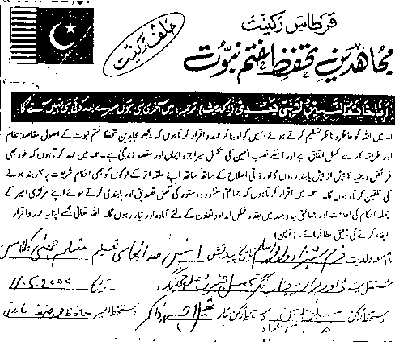 A New Mujahedin Force established: Quoting its representative at Chiniot (near Rabwah) the Daily Jang of May 24, 2000 quoted Mullah Allah Yar Arshad: "Sipah Khatame Nabuwwat has been established to block illegal activities of Qadianis. Two hundred youth have already joined. They have filled in the enrollment forms with their blood. Units of Sipah Khatame Nabuwwat will be established all over the country. Its Central body will be formed in a few days."
A filled-in membership form of ‘Mujahedin Tahaffuz Khatam Nabuwwat’ is placed opposite. It is signed by a class VI student who is 12 years old. On its back (not shown here), the objects and principles of the organization are mentioned. Besides others, it is specified as belief that the Latter-day Imam Mahdi will wage Jihad against Christians and defeat them; also Jesus will descend in those days and the two will jointly wage Jihad to spread Islam all over the world.
A Fatwa: A Fatwa, apart from being a religious edict, also betrays the attitude and the state of mind of the Mufti and his types. During September 2000 mulla, Muhammad Ibrahim Sarhindi of Umarkot issued a Fatwa against Ahmadis, dated 19 Jamadi-us-Sani 1421 (Islamic Calendar) Some excerpts:
"Qadianis are apostate infidels, as they were initially Muslims but later turned infidels. As such, it is completely forbidden to be friendly with them, to buy anything from their shop, to lend or borrow from them, to employ them or to be in their employment, as also to participate in occasions of their sorrow or joy; in short to have even minimal relationship with these cursed infidels is totally illicit.
"Do not greet them, nor reply to their greetings. God’s wrath is ever upon them and anyone who maintains any relationship with them will also be under God’s curse upon him. He will be the fuel for hellfire.
"Mirza Qadiani is a cursed infidel. While in grave, he is burning in the black fire. He is suffering great torture. O Muslim, protect thy soul and distance thyself a hundred miles from this cursed lot." |
An Ahmadi Kidnapped: A masked man, who carried a revolver, seized Mr. Muhammad Ahmad in a bazaar at Digree (Sind), and told him to board a jeep. The man had been following him for some time and knew his identity. There were two other masked men in the jeep. They blindfolded the victim and drove him out of the town for approximately 45 minutes. They took him to a Kuchha house, where they undid his bandage and questioned him at length. It appeared that they were interested to know the whereabouts of another Ahmadi, Mr. Zafar who was on a visit from Norway, but he had gone back. They asked questions about some other Ahmadis as well. Eventually they brought him back and dropped him outside Digree, warning him not to mention the incident to the police.
An Ahmadi harassed: Mr. Abdul Jabbar, Ahmadi is a resident of Multan. This city happens to be the headquarters of the anti-Ahmadiyya Majlis Tahaffuz Khatame Nabuwwat. Mulla Bashir Ahmad, the Central Coordinator of this organization decided to harass Mr. Jabbar. He mounted a campaign against him. He ostensibly obtained signatures of 51 residents, accusing Jabbar of violation of the anti-Ahmadiyya laws. He then wrote a covering letter and sent the accusation to the deputy commissioner asking him to register a case against Jabbar under PPC 298C and 16 MPO.
Mulla Manzoor Chinioti - Advocatus Diaboli: Mulla Manzoor Chinioti is the General Secretary of the International Khatame Nabuwwat Organization. He claims close contact with the President of Pakistan and his calls on him are occasionally reported in the press. On August 24, he was invited to speak as the prime speaker at the Central Mosque of New Garden Town, Multan at 9 p.m. He was introduced to the audience as the Conqueror of Mirzaiyyat (Ahmadiyyat) who had waged a life long Jihad against Mirzais. Chinioti took the stage at about 11 p.m. and harangued the audience for almost two hours. In addition to his usual slander and verbal abuse against the holy personages of the Ahmadiyya Community, he made the following remarks as well:
1. |
I am the fortunate person whose thirty years’ efforts have borne fruit and the name of Rabwah was changed to Chenab Nagar. |
2. |
Our anti-Qadiani training program is an atomic bomb against them. |
3. |
If you find any Qadiani man or woman preaching their creed, beat them up with your shoes, then have them locked up in a police station. |
4. |
Apply to the Deputy Commissioner if you find someone preaching. Arrange two witnesses; Qadianis will not be released on bail up to the High Court level. |
5. |
Zafrullah Khan (Ex F.M. Pakistan) was a tout of the British. |
6. |
The Mirza banned the Jihad and continued the Prophethood. We are now carrying out Jihad against Hindus, while these Qadianis are anti-Jihad. This proves their falsehood. The whole world is an arena for Jihad. Pervaiz Musharaf - you are a soldier; you should understand – you should move against them. |
7. |
Our constitution forbids Qadianis to preach, but it permits Muslims to preach. You should note this in particular. |
8. |
Our Qibla is at Mecca, while Qadianis’ have theirs at Israel. |
9. |
I assure you that Pakistan will frame a law whereby the Death penalty shall be prescribed for apostasy. |
|
The mulla was escorted by six commando types in uniform. They were armed and their faces were partly masked. Physical security checks were made on entrants. The commandoes moved about to show vigilance.
Mulla Masood Azhar in Chiniot: Graduation ceremony was held at Mulla Chinioti’s Madrassa on November 24, 2000. Mulla Masood Azhar of Jaish Muhammad, a Jihadi group attended as the Chief Guest. A quotation from Masood Azhar’s address:
I am grateful to Maulana Chinioti that he is pursuing Qadianis all over the world… Today I shall talk about Mirza Qadiani and will set his grave on fire… He was a protege of Americans…..He planned to destroy Pakistan…. We are not our mothers’ sons unless we destroy him…. I undertook Jihad after the Babri Mosque incident and was arrested. Eighteen mujahideen gave up their lives to rescue me…. Jews and Christians conspire to finish off Pakistan but the entire world is scared of Islamic jihad.
America, Russia Murdabad (Death to them)… Aljihad… Aljihad etc. |
Hateful Open Circular at Karachi: Copies of an open letter were circulated at Liaquat Ashraf Colony and Allama Iqbal Colony by the Tahaffuz Khatame Nabuwwat Committee; it was full of invective and slander and carried the message of hate against Ahmadis. It was asserted in the letter that Qadianis are Non-Muslims, infidels and apostates; their penalty is death. People were told that it was illicit to have any social relations with Qadianis; even to talk to them is forbidden; they should not be invited to any ceremony of any kind; Ahmadis are enemies of the Holy Prophet, as such of all Muslims etc. Finally the letter urged them to mark all Qadianis of the locality. It also informed the public of the Ahmadiyya identity of some of the residents of the area.
A Sly and Unworthy Politician: Begum Kalsum Nawaz, wife of the deposed prime minister, was leaving no stones unturned to secure the release of her husband. While none would mind any fair efforts on her part, but when she banked upon falsehood, slander, religious fanaticism and Ahmadi-bashing, she only betrayed her desperation and character. According to the Daily Pakistan of 16 October 2000, the Begum congratulated her party worker on the success of the Black day observed on October 12, 2000, and stated the following, inter alia:
1. |
Kargil Operation was a conspiracy of Hindus and Jews against Pakistan. |
2. |
The coup of October 12 was a Qadiani revolution. |
3. |
The people and the army will not allow Qadianis to occupy the country. |
4. |
The Ulema should jointly resist the Jewish NGOs. |
5. |
People will come out in the streets in a suicidal mission against the Qadiani take-over. |
6. |
In 1953, we drenched the earth with our blood for the honour of the Holy prophet. (She was referring to the Ahrar-led Anti-Ahmadiyya riots in the Punjab.) |
7. |
If the Ulema do not unite now on the one-point agenda of ‘Protection of the Finality of Prophethood’ they will never deserve the atonement by the Holy Prophet, till the Doomsday, etc. etc. |
|
False Accusations: Kanwar Intizar Muhammad Khan of Multan who claims to be an advocate of Supreme Court issued an open letter addressed to the Military Government, and gave it wide circulation. The letter was full of anti-Ahmadiyya propaganda and contained numerous fallacies. For instance:
a) |
Qadianis detonated bombs in Wapda House. They make the Sipah Sahaba and Shias fight with each other. They steal military secrets of Pakistan for enemies of Pakistan. They are planning an Israel-type Qadiani state in Pakistan. |
b) |
The General’s statement that he is not a Qadiani is inadequate. His wife is a Qadiani. |
c) |
Omar Asghar Khan, Tariq Aziz, Farooq Adam, Lt Gen G Ahmad, Sahibzada Imtiaz etc are Qadianis. |
|
The writer threatened the addressees of a bloody reaction. He stressed that unless persons of doubtful religious loyalties were not removed and decisions were made not for American pleasure, none will be able to save Pakistan from a violent revolution that is knocking at the door.
A Development Fraught with Danger: The Daily Nia Din, Multan of December 23 has published a news quoting its special representative, that the government is considering a procedure whereby all cases under Blasphemy Law will be tried in the Federal Shariat Court rather than normal courts. According to the report, some important individual gave a briefing to Mr. Moeen Haider, the Interior Minister in a high level meeting that lasted many hours. Ostensibly the aim is to minimize the misuse of the Blasphemy Law, but the fresh proposal is fraught with greater danger and is bound to raise the level of tyranny through this discredited law. A Shariat Court is most likely to deal very severely with cases of alleged blasphemy. The mischief of the bad law will increase rather than decrease. Headlines of the news are translated below:
Blasphemy: Recommendation to Empower Islamic Ideology Council to register Criminal Cases
High Level Meeting in the Interior Ministry. Proposal to try Blasphemy Cases in the Shariat Court under Consideration.
Murderers in the name of religion are not fit to be called Muslims - The Minister of Interior
The Daily Nia Din, Multan; December 23, 2000
|
The Ban on Mullas and European Visas: As in preceding years, the provincial governments and District Magistrates issued long lists of mullas in April forbidding their entries in their provinces and districts during the holy month of Muharram. This action was taken to forestall their mischief and neutralize the threat they pose to the peace of communities they visit. Most of these mullas are big names in the anti-Ahmadiyya Khatame Nabuwwat Organizations. It is interesting to mention that many of the listed are those who routinely get visas to visit the UK and other countries of the European Union, where they do little except spread sectarian hatred. The virus they spread has occasionally resulted in communal violence in British towns with sizeable Muslim populations. Some of these mullas who are banned within Pakistan but they visited UK and other European countries include Zahid-ur-Rashdi, Manzoor Ahmad Chinioti, Muhammad Akram Toofani, Zia-ul-Qasmi, Allah Wasaya, Abdul Majeed Nadeem, Shabbir Hussain, Khadim Hussain, Abdul Hayi Abid etc.
Authorities’ Share in Persecution
The state adopted the Anti-Ahmadiyya and other oppressive Religious laws and took upon itself the duty of perpetuation of tyranny and injustice. The government, consequently implements the state policy through its rules and directives. The sheer nature of the ignoble task creates the permissive atmosphere in which the government, on behest and desire of the Mulla, does more than what is obligated by the Constitution and the law. At the lower level, authorities and officials stoop still lower to enforce the law with personal motives and needs as the prime movers. They go into the forbidden area where they were not required to trespass by the wording of the law. Some of the following incidents would illustrate the attitudes, commissions and omissions of the officials concerned:
Freedom of Religion Denied: Ahmadis of the village Ghulam Jaffar Unnar, District. Khairpur faced a difficult period in September/October. Some mullas reported to the police that some of the locals had joined the Ahmadiyya Community. The police decided to intervene, although they had no business to do so. Four Ahmadis were told to report to the police station and were subjected to great harassment. A local influential non-Ahmadi helped Ahmadis in their interaction with the police. The Sub Divisional Magistrate also intervened and directed that Gulab Khan, an Ahmadi from the Punjab should be extradited; only then the criminal charges would be withdrwn. Ahmadis were made to concede to this unfair demand in writing. The situation, however has remained tense in the village.
Problems of a Proselyte: Although Mr. Mushtaq Ahmad of Muzaffargarh joined the Ahmadiyya Community in 1995, his problems are still not over. He is in the teaching service. In July, the government collected personal data of its employees in the Education Department. Mr. Mushtaq Ahmad mentioned that he was an Ahmadi. The information somehow reached the mullas of Sipah Sahaba faction. They availed of their meeting at Jatoi and passed a resolution against alleged activities of this teacher and demanded his immediate transfer. Mr. Mushtaq was then sent for by the police SHO who told him to give his explanation in writing.
The Way of the Bureaucracy: Mr. Wahid Ahmad, Ahmadi, who is undergoing 10 years’ imprisonment at Hyderabad for alleged incorrect filling of the Census Form of a friend, is suffering from a serious cardiac malfunctioning. He applied for removal to a hospital. It was after a great deal of effort that the Home Secretary permitted, on 16 February 2000, his admission in a hospital. Thirteen days later, the Jail Superintendent wrote a letter to the police to supply a strong contingent to escort the prisoner to the hospital. He wrote: Supply of very very strong police escort for shifting the UTP Waheed Ahmad from Central Prison Hyderabad to LMCH Hyderabad. The police declared their intention to provide 10 strong men when available. The suffering prisoner could wait.
No Freedom of Faith: Ahmadiyya Community at Liaquatpur, District Rahim Yar Khan acquired a plot last year for community purposes and had it registered in the name of the community president, Mr. Abdul Karim. In July, mullas and locals approached the administration with the complaint that Ahmadis intended to build a mosque at the site. The mullas stated that Ahmadis would pray, recite the Quran and offer Friday prayers there like other Muslims while they are not so allowed under the law. The administration finally gave the verdict that the construction may be undertaken by Ahmadis under the supervision of authorities and the local population, provided they would not use the location for any religious purpose. Ahmadis had no choice but to stop the construction.
Minister shows his true Colours: In October, some column writers attributed to Mr. Muhammad Ghazi, the Federal Minister of Religious Affairs statement to the effect that the decision to declare Ahmadis a ‘Minority’ was an emotional one, and that the charge of infidelity against Ahmadis was not well-founded. Mr. Ghazi refused to own up the alleged statements, and wrote an article in the Daily Nawa-i-Waqt of 13 September 2000 wherein inter alia, he stated the following:
- I myself have written three books in rebuttal of Qadianism.
- I had addressed the conference of “Jamaat Mujahideen” at Lahore and stressed that public awareness of Sharia’s rationale was essential to its smooth implementation.
If promotion of religious ‘tolerance’ is a need of the Pakistan society, the nomination of Mr. Ghazi to the post of ‘Minister of Religious Affairs’ is indeed questionable.
Mulla/Constable Team Work: Ahmadiyya communities in Baluchistan villages close to Karachi, like Hub and Gadani etc., are linked with Karachi for community administration. On May 9, a group of five Ahmadis drove to those villages for community work. The mullas of the area came to know about the arrival of these visitors, and they organized an agitation in liaison with the local police. On their return, the visitors were stopped by the police at the Gadani Mor post. Soon a vehicle arrived that carried three officials of the police Levis, two mullas and a colleague. The police required the visitors to report to Tehsildar. As this move was fraught with danger, the visitors refused to be taken to Tehsildar. Eventually the police obtained orders from the Assistant Commissioner to bring them over to him at Hub post. A police van, with SHO on board, arrived to take them there. It was about 7.30 p.m. when they arrived at the Hub Police Station. Outside the police station, there was an angry crowd about 200 strong. They were demanding that an FIR be registered. The AC proposed to Ahmadis that they deny being Ahmadis; the visitors refused this. Eventually the AC conveyed to the mullas that for technical reasons an FIR could not be registered against Ahmadis, however they would give an undertaking that they would not visit this area any more. It was thus, that the mullas were persuaded to depart, and at about midnight the Ahmadiyya delegation was allowed to proceed homeward. Ahmadis’ vehicle was however not released till two days later. In a way, the visitors got away lightly – they could have ended up in deep trouble.
Mullas trounce the Authorities – once again The village Chak 6/11-L, district Sahiwal is infested with anti-Ahmadiyya agitators. In the beginning of the year, they reportedly lost a motorcycle. In their report to the police they blamed two Ahmadi youth without any supporting evidence. The police SHO looked into the case, and finding nothing against the Ahmadis, took no action against the accused. This enraged the agitators and they decided to stoke the religious fire and started an anti-Ahmadiyya ‘sticker’ campaign through a mulla. Ahmadi youth attempted to dissuade the mulla from the smear campaign. It resulted in a scuffle, but no one was hurt. The mulla reported to the police that a murder attempt had been made against him. The SHO detained the two Ahmadi youth overnight at the police station, however on finding that nothing serious had happened released them the next day.
Mullas, who consider themselves to be a part of the ruling establishment in Pakistan these days, did not tolerate the impartial attitude of the local police. They got together and conspired to mount a severe agitation. They declared that an open conference would be held at the Ahle-Hadith mosque, and threatened wide spread agitation and violence. They made numerous unfair and unjustified demands. Ahmadis contacted the police, the Assistant Commissioner and the Deputy Commissioner. They all reassured them. In the meantime the authorities permitted the mullas to hold their open-air conference.
Eventually the authorities reacted as always - they condescended to comply with all the demands of the Mulla. They removed religious epithets from the Ahmadiyya mosque. The SHO police, who had refused to play the Mulla’s game, was transferred forthwith.
Mullas were delighted at their victory. They declared that the occasion was thenceforth converted into a Thanksgiving Conference. They made statements as follows:
The Daily Insaf (of March 25) reported the incident under the following headline:
Authorities Bow Down to the Protest of Khatame Nabuwwat - All Demands Accepted |
The question naturally arises – Who is ruling Pakistan, the Government or the Mulla?
Official Enquiry in Distt Bahawalnagar: Officials are generally slow to move in this country except when mulla approaches them concerning Ahmadis. Some miscreants wrote to the Assistant Commissioner CHISHTIAN that Ahmadis of Chak 66/Murad agitated them by their proselytizing activities, they have a mosque with minarets that should be demolished and they make call for prayers that should be banned. On July 1, 2000 the local magistrate, accompanied by three persons arrived dutifully at the site and made the following quarries:
- When was this place of worship built?
- Whether Ahmadi maulvis undertake preaching here?
- Is there a dish antenna installed here?
- Have any fresh additions been made to the building?
- Is the Kalima (Islamic creed) written inside the building?
Report of just-released Ahmadi Prisoners Messers Ilyas Ahmad, Ghaffar Ahmad and Manzoor Ahmad, Ahmadis of Chichawatni had been arrested in August 2000 under the anti-Ahmadiyya section PPC 298C in a fabricated case on false accusations.
They were detained in Block 7, which is a prison within the prison. Prisoners there are treated with greater severity and they face more hardships. Mostly, prisoners condemned to death are detained there. Ahmadis were refused the benefit of release on bail. This prolonged their stay behind bars.
Ordinarily prison officers should have nothing to do with inmates’ religion except provide some essential facilities for rites etc. But their behaviour in this case defies explanation.
Threats
‘Threats’ are a favorite tool of religious extremists. It is effective even when not converted to action. The victim remains ever apprehensive against the eventuality of the threat being carried out. Ahmadis are made to live in fear through threats; as it is not so rare that these are put into effect. Till today 56 Ahmadis have been murdered only for their faith. Some stories regarding threats are given here.
Precarious Living in Bahawalpur: Only three Ahmadi households exist in Chak 22, District Bahawalpur, but the militants of Sipah Sahaba have noticed them and are making strenuous efforts to intimidate and dislodge them. Sometimes back, an armed terrorist of Sipah Sahabah visited the residence of Mr. Faiz Ahmad, Ahmadi, entered his house and conveyed to the residents that Maulana Azam Tariq, the Amir of SSP had ordered the murder of Mohammad Sharif, the local Ahmadi President and his nephew, Zafrullah Khan. He also threatened that Ahmadi houses will be put to torch. He used slander and blasphemy against the holy personages of Ahmadiyya Community. This uninvited and unwelcome guest would not leave and stayed for over two hours. He then left, and threatened to come again. Two days later, he revisited. He was armed as before. He intimated that he had already murdered 3 or 4 persons. He demanded that their annex be made available to them for an open general meeting to be addressed by their maulvis. He threatened that in case Ahmadis did not recant, they would be murdered.
Local Ahmadis informed their community officials at Bahawalpur of the ugly visits. Subsequently, the DIG, the DSP and the Inspector of police were informed. The police advised the Ahmadis to arrange armed escorts for self-protection and to regularly shift their sleeping locations.
These Ahmadi families were understandably very worried.
Violence Preached from the Mosques At Gulistan Jauhar, Karachi, Imams of the mosque at City Villas and the mosque at Gul Houses embarked upon active and violent propaganda against Ahmadis. On May 5, the former declared that Qadianis were liable to be killed for their beliefs, as also those who joined them. The latter urged his flock on May 6 to take up Jihad against Ahmadis and declared that in near future a few funerals will come forth from Decent Houses (where Ahmadis reside).
A Threat in Writing: Dr Noor A Fazli, an Ahmadi homeopath of Nawan Kot, district Sheikhupura, received the following threat in Urdu script:
(Translation)
‘ Dr Fazli, you have become an apostate; no salvation thus is available to you. And your apostasy is of little loss to us; you are a cancer that is spreading far and wide. Remember, we shall cleanse the area soon of your foul presence. We are keeping a track of you, and you will disappear soon. Only God knows, which Muslim Ghazi is going to get this credit.
‘ If cancer appears on a body, it becomes necessary to chop off that part to save the body. If you do not want to die a dog’s death, you will have to recant from Mirzaism and join Islam. Only then we shall spare you, otherwise we shall dispatch even your children to hell. You have gone blind in your greed for wealth.
‘ We swear by God that undoubtedly you are like a cancer. And cancer is an incurable disease. According to the Islamic procedure, we give you three days to reconsider and recant, otherwise dogs will eat your corpse and the earth will reject it. We shall burn your home……….’. |
The threat could be real or otherwise, but few would like to face this haunting uncertainty.
The Rogues of Jhelum: A bearded man approached Sethi Tauseef Ahmad (Ahmadi) at his shop in Peco Centre on July 15, 2000 and told him rather firmly, "The Kalima (Islamic creed) and other Arabic writings displayed in your shops incite me. Take them off or you will be yourself responsible for the consequences." Having conveyed his threat, he left. After about half an hour, he came again accompanied by another bearded fellow. The two allowed the Ahmadi 30 minutes to do as directed. He returned an hour later accompanied by another person and ordered Mr. Ahmad that nothing concerning Allah should be found written in his shop. Mr. Ahmad took off the displays and handed them over to the proprietor of Waqas Jewelers, who took them and displayed them in his own shop. The intruders spoke to a few other traders in the Center also and told them to have nothing to do with Ahmad. Haji Iqbal, who is the owner of the Center, did not like their intrusion and had an argument with them. Five days later, someone stole Mr. Ahmad’s bicycle from the Center. Sometimes back the owner of the Center had got the office occupied by the Sipah Sahaba vacated from the Center. This could be a reaction to that move.
Instigation to Violence: An anti-Ahmadiyya poster was pasted on walls in Kasran, District Attock. Its language was highly provocative and arousing. It mentioned:
"…….Qadianism is a disease whose cure is only death. PPC 295C of the anti-Ahmadiyya Ordinance (stet) makes it obligatory that all Mirzais must be killed. If we cannot murder them, we can at least impose a complete boycott against them…. We shall destroy all their dish antennas with our hands…. Let’s all unite and eliminate the evil of Mirzais from our entire area." |
Ahmadis had to take care and step up their security measures in response to this threat of violence.
An Ahmadi on Hit List: Mr. Ijaz Mahmood, an office-holder of the local Ahmadi Community at Mandi Bahauddin was conveyed on telephone in November 2000 that he was on the hit-list of anti-Ahmadi activists. The caller stated that this was no empty threat; murder would definitely take place. The police were informed who investigated the matter actively. A few days later the extremists called again and used the same language. The police offered help in providing guards. It was politely refused, as it could be more of a problem than real help.
Freedom of Religion! Mr. Ghulam Rasul Alavi, a teacher of Drot, District Chakwal now working at Wah, joined Ahmadiyyat in 1995. His family continues to live in the ancestral village of Drot. In the month of August 2000, Mr. Alavi went to his village to meet his family. The village chief came to know of his presence and sent a dozen men to threaten him. They told him that that was the last night he could spend at home. "Do not be seen here after 7 a.m," they threatened. Alvi knew that the authorities and the police would not help him, so he left his home in the morning. His family was in tears.
Two weeks later, his uncle along with two mullas of the Khatame Nabuwwat Organization visited Mr. Alavi at Wah. They gave him a notice of three days to recant, otherwise to be prepared to face the penalty of an apostate (death). They told him that he was delinked from his entire family, including his wife, children and parents, and that his wife was now free to marry elsewhere. They warned him not to correspond with them.
A few days later, two officials of the district Ahmadiyya Community went to see Mr. Alavi’s family at the village. The family told them that all mail addressed to them was intercepted and opened by unauthorized persons prior to delivery to them. A fortnight earlier, Mr. Alavi’s children were forbidden by the extremists to go to school. The local Mufti had issued the Fatwa that Alavi deserved to be killed for his apostasy, and his family should suffer a complete social boycott. The family advised the visitors to go back, otherwise they could come to harm, as the fundamentalists would soon come there to inquire as to who was visiting. Accordingly, they departed after making arrangements for the next rendezvous at some other location.
Education
Ahmadis have suffered greatly in the field of education since the promulgation of the Ordinance in 1984. Damage has been done to the education of Ahmadi children and to the careers of Ahmadi teachers and lecturers. Some recent events are mentioned here:
Education Board Multan: Board of Secondary Education, Multan has issued Admission Forms that have been specially designed to create admission problems for Ahmadi candidates. The form makes it obligatory for the candidate to declare himself a Muslim or a Non-Muslim. Obviously, an Ahmadi will not call himself a Non-Muslim; on the other hand, if he declares himself a Muslim, he faces three years’ imprisonment. The form also obligates a Non-Muslim candidate to take up Civics as an alternate subject to Islamiat.
The above is a gross violation of human rights of Ahmadi children. It is a shameful conspiracy to deny education to them. For a state institution in the field of children’s education it is highly unbecoming to develop mulla mentality. Why must a child be denied the freedom to state his own religion? Why must he be denied the study of Islam, even if the state does not consider him a Muslim?
School teacher harassed: Mr. Mushtaq Ahmad, Ahmadi, is a primary school teacher at Jatoi, district Muzaffargarh. Activists of Sipah Sahaba and Khatame Nabuwwat Organization turned against him. He faced a general boycott. His children were not allowed to drink water from outside. The education department opponents had organized a demonstration to confront him. He was not allowed to join the school. He was posted to still another location.
In the meantime, a confident intimated to Ahmadis that the mullas were planning to murder him. Mr. Mushtaq Ahmad was worried about his safety.
Threats at a Polytechnic Institute: Inayatullah, an Ahmadi youth, is a first year student at the Government Polytechnic Institute, Sargodha. In March his father received a threatening letter. The letter accused his son of preaching the Ahmadiyya doctrine. ‘We warn you that if we find him at the college, we will not spare him….. We do not threaten only; we carry out our threats. We are Muslims and followers of Toofani Sahib,’ conveyed the letter.
Fearing harm, the father told his son to stop going to the Institute for education.
Even Children not Spared: On March 21, the children of Maryam School at Rabwah were given a test in theology. The examiner, a non-Ahmadi who had come from elsewhere, refused to assess the Ahmadi children in oral recitation of the Quran. This caused great deal of anxiety among the children and their teachers, as the recitation carried 10 marks. It was after great deal of persuasion that the examiner agreed to award marks for this, however she did it at her discretion without listening to the recitation from the candidates. What was her yardstick; only she knows. The same problem was faced at other schools. This was deliberate discrimination.
Schools and Colleges of the Capital under Attack of Fundamentalism: The Khatme Nabuwwat Organization has penetrated schools and colleges in Islamabad and spread hatred in those educational institutions. Khatame Nabuwwat (Finality of Prophethood) theme is often taken up in the Islamiat classes. The lecture is turned into a slander and hate session against Ahmadis. In March, highly provocative anti-Ahmadiyya pamphlets were distributed at Federal Government College for Women at F/ 7-2. The pamphlets incited the students to take law in their own hands in order to restore the honour of the Prophet. The titles were designed to portray Ahmadis as snakes and the material inside was edited and presented in a way to be hateful and most insulting and passion rousing. An extract follows:
"Let’s destroy the enemies of the Prophet.
Let’s call the mercy of God.
Move, that the mischief of Qadian is uprooted bare.
Move, to sacrifice your blood for the love of Muhammad." |
Ahmadis of Islamabad wrote to the Chief Executive to intervene and do the needful.
Professor harassed: Professor Tafhim Ahmad, Ahmadi, joined Cadet College, Hasanabdal in 1992 as a lecturer. At the time of joining he mentioned his religion as Islam. Eight years later, anti-Ahmadiyya activist staff of the college, are holding it against him and are agitating for his removal from the post. Mullas are giving them a helping hand, and the vernacular press is sparing double columns to make this non-issue a big news. The Daily Ausaf and Nawa-i-Waqt are in the forefront in this campaign. For example:
(Translation)
|
"The ulema give an ultimatum to the Principal and the Management on the issue of Qadiani Lecturer
………………………………………
The said lecturer should be fired and made to face criminal charge for misstating his religion………..Maulvis of all mosques expressed their anger over the appointment and misstatement of the Qadiani lecturer…….
Qadiani activities will not be tolerated in Tehsil Hasan Abdal……..If necessary, disciples of the Prophet will not spare any sacrifice to achieve their ends. They issued an ultimatum to the college principal and its management to fire the said lecturer as soon as possible, otherwise they will be held responsible for all consequences.
The Daily Nawa-i-Waqt, Islamabad; December 9, 2000
|
The principal removed the lecturer from the post of Hostel Warden and told him to take precautionary measures. He also made him answer the charge of misstating his religion. The lecturer put the record straight, and afraid of violence, took leave and left for Wah Cantt along with his family. The principal himself is feeling weak under the attack of clerics.
Livelihood
Major policy decisions were made years ago by the government to deny Ahmadis job opportunities in the public sector. They continue to be implemented and remain effective. Even in the private sector, Ahmadis face difficulties to make a living. A few examples:
Ordeal of Ahmadi Tailors: Messers Mansur Ahmad and Nadeem Ahmad, two Ahmadi brothers had rented a tailoring shop at Bhari Shah Rehman, District Gujranwala a few years ago and were earning their living. They are resident of village Jhatanwali, five kilometers away, from where they would walk to their shop every morning and go home after sunset. Fundamentalists could not tolerate a business run by Ahmadis, and they mounted a steady effort, in league with authorities, to dislodge them. They succeeded in November 2000. Some details of this event are relevant to show their usual operating procedure.
Approximately two years ago they launched a propaganda campaign against Ahmadis in Bhari; it gained momentum with time. As a result, the two communities were made to isolate socially from each other. Mullas, simultaneously urged the shop owner to cancel the hiring deal with Ahmadi tailors and expel them. Other non-Ahmadis started ‘advising’ the tailors to vacate the shop in their own interest. They did not. Sometime ago, extremists poured Elfy glue in the shop’s exterior lock. The lock had to be broken to get in. In August, the Markaz Tahaffuz Khatame Nabuwwat, Gujranwala wrote to the tailors an unsigned typed letter. The letter gave them an ultimatum of three days to vacate the shop or face consequences. In the meantime the police contacted them that they were under investigation for possession of illegal arms. The police SHO sent for them. They were called to the police station a number of times. This resulted in undue harassment. Then the police accused them of preaching on the basis that ‘ the Mulla says so and he can’t be wrong’. Non-Ahmadis of Jhatanwali helped the Ahmadi accused and told the police that the accusation was false.
Anyhow, there was danger all around. The tailors feared attack in the dark on their way back home in the evening, so they looked for a place to stay in Bhari, but nobody would rent it to them. Eventually they had no choice but close down their business, and hand back the shop to its owner on November 20, 2000. Now they have no business and no job.
The Poor Engravers: Mr. Nasir Ahmad, Ahmadi, is working as a stone engraver for the last 35 years in Jhang Sadr. His two sons work with him. Normally they receive orders to etch Islamic and Quranic verses on marble.
In January, an anti-Ahmadiyya activist took notice of this means of livelihood by the Ahmadi family, and decided to harass them. He approached them and told them that while etching, the bits of falling stones amount to disrespect to the holy verses. He told them to stop such work. Some days later, another extremist visited them and told them that the spilling of water used by them to wash the writings on the plates amounts to disrespect to the holy verses. They told him that they wash the plates the same way as others do. He retorted that the excuse was unacceptable from them as they were Qadianis. He went away after threatening them with further action. They became careful and started washing the plates prior to morning twilight.
On 20th February, an activist of Sipah Sahaba discovered Mr. Nadeem, one of the sons, washing the plates. The miscreant slapped him on the face and forced him to stop the work.
Two other Ahmadi who were in the same business were facing the same problem. They had no choice but to be careful.
Religion pushed in the Service of Mammon Ahmadis hold a tract of 72 acres of agricultural land on lease at Sial Mor in Jhang. Its value went up for reason of proximity to the boundary marked as the Council area. Ahmadis had constructed there a roadside restaurant as well. Their opponents now covet this land and have hired mullas to deny the same to the rightful possessors.
Mullas of the Khatame Nabuwwat organization passed a few Resolutions in the local mosque and moved the authorities. They demanded that:
1. |
Qadianis should be forbidden to practice Islam. They should be prosecuted under religious laws. |
2. |
The lease of the land awarded to the Qadianis at Ahmadpur Sial should be cancelled. |
3. |
Qadianis’ restaurant should be closed down, as Muslims partake their food there that is not licit as per Sharia. |
|
The DC told the revenue officials to hold an enquiry. Mullas met the Tehsildar. The problem continues.
Press
Vernacular press continued to play a very damaging role in the anti-Ahmadiyya campaign. There was no slackening on its part in this contemptible drive. Its news and articles included disinformation, fabrication, prejudice slander and outright promotion of hate and violence against Ahmadis. It was a steady effort in which the newspapers seemed to compete with one another. Some samples:
 Murder of Maulvi Yusuf Ludhianvi: |
Maulvi Yusuf Ludhianvi was murdered by some terrorists in broad daylight at Karachi in May. Mullas of the Khatame Nabuwwat organization found it a God-sent opportunity to make some more anti-Ahmadiyya mileage. The Daily Aghaz of Karachi made it the banner headline on its front page of May 20:
"Qadianis Arranged the Murder of Maulana Yusuf Ludhianvi |
The Daily Ummat of Karachi also splashed a big headline on 22 May. Other Urdu newspapers also, more or less, had their share of similar false and baseless propaganda.
The Daily ‘Ummat’ |
The Daily Ummat is an Urdu newspaper published at Karachi. Although it prints every day on its first page a verse from the Holy Quran: (O Muslims) You are the best people that have been brought forth to reform the humanity; yet to promote its sales, the paper has adopted anti-Ahmadiyya policy and prints grossly twisted and tainted news. For example:
"Qadianis have become active in sensitive border areas. Their plan to promote sectarian violence is in final shape."
7 Feb 2000
"Mirpurkhas is now a Headquarters Town of Qadianism. Qadianis offer money and women to Muslim youth to enroll them in their community……Influential Qadianis have assumed full control over country’s economy, agriculture and education…..etc"
20 December 1999
|
Press Gangsterism |
The weekly Nida-i-Millat (25 Nov) printed three anti-Ahmadiyya violent letters in its column ‘Letter to the Editor’. Some extracts:
1… We tell Qadianis plainly that we shall crush them all over…Qadianis can be inducted only in Israeli Army; they cannot be tolerated in Pak Army….. Conquerors of Qadian and Rabwah challenge them to a fight at any location of their choice…… 2… Having been declared Non-Muslims and after being booted out by courts. Qadianis are unable to show their face anywhere….At the occasion of Khatame Nabuwwat conferences, the participants are often seen kicking the effigy of the Mirza-what prestige are the Qadianis left with?……….. 3…. As a Muslim and Pakistani, let me say that the Nobel prize to Dr Abdus Salam was a gift from Israelis…..etc. |
The Yellow Press |
Bhera, district Sargodha; 26 January 2000: The Daily Asas, Rawalpindi and the Daily Nawa-i-Waqt, Lahore circulated a fabricated story about an Ahmadi teacher of the Government A.I. Model High School, Bhera.
"Bhera: Violence of the Savage Teacher against the pupil who would not agree to pay private tuition. Imran is seriously injured. The Governor and the Commissioner asked to take notice"
were the headlines in the Daily Asas on 26 January. |
It was a false story. It was given a religious bias and pamphlets were distributed in the town.
In fact, one, Afzal Piracha, a neighbor of Mr. Manzur Qadir Khan, an Ahmadi teacher, had some personal grievance against him for not giving him his shop on rent. Piracha went for the well-tried procedure: enlist the press and the mulla against the Ahmadi. He did this and succeeded in turning his personal complaint into a big issue.
The school, however, made a bold defence against this onslaught on its reputation. The headmaster issued a categorical statement that private tuition is strictly prohibited in his school and Mr. Khan had not indulged in it either. The entire teaching staff of the school issued a joint statement that the news was false and misleading and nothing of the sort had happened in the school. Despite this, Mr. Khan was transferred to a far off location.
Press Volunteers Additional Duties |
As if the “Daily Ummat” of Karachi has admirably acquitted itself of the great responsibilities of a newspaper, it has offered an interesting new service to its readers. The translation of the announcement made in its issue of Nov 2, is given below:
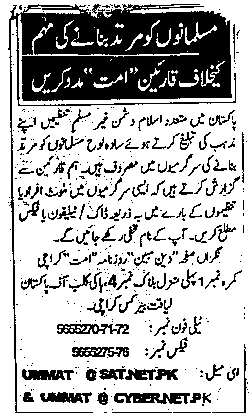 Ummat solicites Readers’ help against the campaign to turn Muslims into Apostates Ummat solicites Readers’ help against the campaign to turn Muslims into Apostates
Numerous anti-Islam non-Muslim organizations are busy in preaching their faith and converting simple-minded Muslims into apostates.
We request the readers to inform us by post/telephone/fax about such individuals and organizations. Your names will be kept confidential.
Compiler the Page ‘The Faith Manifest’
The Daily Ummat, Karachi
Room No. 1 – First floor
Block Nr: 4 Hockey Club of Pakistan
Liaquat Barracks Karachi
Telephone : 5655270-71-72
Fax: 5655275-76
E Mail : ummat@sat.net.pk - ummat@cyber.net.pk. |
The Internet Case |
The Daily Khabrain, Lahore, of May 4, 2000 printed a report, originated at Multan, alleging that Qadianis had displayed a part-map of the Pakistani Punjab on their website on Internet whereby the area had been shown as a part of India. The provocative report explicitly mentioned that thereby Qadianis had handed over the Pakistani Punjab to India. The map was printed by the Daily (even though it clearly carried the address: Expedia.Com Travel), and to misguide the public the TV logo of Muslim TV Ahmadiyya was printed next to it. The Khabrian wrote an editorial note also on the Report and urged the government to keep a strict watch on Qadianis. Mullas and the yellow press were greatly delighted at this ‘discovery’, and followed it up with plenty of poisonous propaganda.
A representative of the Ahmadiyya Community, in a press statement, analyzed the misleading report and nailed the lie. It was pointed out that the printed map clearly carried the address of Expedia. Com Travel and Microsoft that have nothing to do with the Ahmadiyya Community. Mr. Hizqil Javed from Rabwah wrote an analytical comment on the malicious Report and established beyond doubt that the Daily Khabrain was stupid to accept the report on its face value. The Daily was good enough to publish this comment; and the propaganda issue died a natural death.
Separate Qadiani State! |
A self explanatory rebuttal by an Ahmadi spokesman of a fabricated news item is reproduced below from the Daily Alfazl of 6 December 2000:
(Translation)
"The News of a Plan to create a Qadiani State in Pakistan is Baseless and Vicious Propaganda against the Ahmadiyya Community
Having taken 10 lives through Terrorist Attacks, the Opponents now plan to subject the Ahmadiyya Community to Press Terrorism - Ahmadi Spokesman
Rabwah (Press Release). The news relating to a plan of creation of a Qadiani state in Pakistan is baseless and vicious propaganda against the Ahmadiyya Community. This was stated by Mr. Malik Khalid Masood, spokesman of the Community in rebuttal of the baseless and homespun propaganda that the Ahmadiyya Community has plans to establish a separate state in the country.
According to the Ahmadiyya spokesman, the opponents, having taken 10 precious lives, plan to subject the Ahmadiyya Community to press terrorism. It has become fashionable to print news against the Ahmadi Community without minimal inquiry.
According to the spokesman, the baseless and homespun news, published with reference to some News Agency, is neither supported by evidence nor there is any truth in it. Press ethics require that the news item should have been verified in advance and supported by some proof. A News Agency originated the baseless and homespun news, and the newspapers, without due inquiry, splashed it in headlines. It is regrettable that a prominent newspaper like Nawa-i-Waqt followed it up with an editorial, without having inquired into the veracity of the news. The editor used harsh words without justification against the Community, and rather than supporting the news with some evidence, he attributed it to the News Agency. "Do the press ethics permit baseless propaganda and dissemination of false news against a community"? - asked the spokesman of the Ahmadiyya Community.
Mr. Malik Khalid Masood, the community spokesman stated that the Ahmadiyya Community had worked with the Quid-i-Azam in support of the Pakistan Movement, and has always played its role in the development and progress of the country. Pakistan is our beloved homeland and Ahmadis will spare no effort in its progress and security. They will defend the country with their lives.
According to the spokesman, such false news were spread by groups who were opposed to the creation of Pakistan; now they place obstacles in the country’s progress. The newspapers should print news after due inquiry." |
|
Rebuttals by Ahmadi spokesmen are given little space more than a postage stamp. Given above are only those incidents, which are off the beaten track, otherwise printing of false and provocative anti-Ahmadiyya news and statements is almost a daily routine with some newspapers who claim nationwide coverage. During just one week in September alone, from 7 to 13 September, a few well-known newspapers of the Punjab printed 70 such news items. These had no ‘news’ value, but were mostly statements and comments made in a highly provocative and malicious language. Translation of only a few of such newspaper entries from the month of September is produced below to give an idea of the nature of this journalistic terrorism:
Year 2000 is the year of demise of Qadianism - Maulana Firoz
The Daily Ausaf; 8 September
The main problem for Muslims and Islam in Europe is Qadiani conspiracies. Expulsion of Qadianis from the Army and cancellation of Mirza Tahir’s Pakistani nationality demanded. - Maulana Noorani
The Daily Jang ; 7 September
The accused awarded life term at Quetta for defiling the Quran belongs to a well-know Qadiani family - Ulema
The Daily Khabrain; 8 September
The presence of Qadianis in the army is dangerous. The government urged to take notice. Having been declared a minority, Qadianis have become destitute and miserable. - Alla Yar Arshad
The Daily Ausaf; 8 September
If Qadianis and NGOs are not restrained, we shall ourselves take care of them - Almi Majlis Khatame Nabuwwat
The Daily Insaf; 8 Septmeber
Jihad will continue to be waged against Qadianis - Ulema determined
The Daily Jang; 8 September
We shall not tolerate blasphemers. Muslims, unite. Khatame Nabuwwat Conference – Qadianis ought to rejoin Islam; Hafiz Makki – Resolutions passed demanding ban on NGOs, entry of Religion in the national identity cards and imposition of Sharia penalties.
The Daily Khabrain; 9 September
Qadianis involved in bomb explosions - Akram Tufani
The Daily Jang; 9 September
Apostates should be awarded death penalty – Education institutions owned by Qadianis should be confiscated - Khatme Nabuwwat Conference
The Daily Insaf; 9 September
Qadianis are like a cancer for the Muslim world. We shall persist in their rout.
The Daily Khabrain; 10 September
Qadianis are a cancer for the Muslim world, they are busy day and night like Israel in hatching anti-Islam conspiracies - Hafiz Makki
The Daily Khabrain; 11 September
Qadianis in Pakistan are a cancer that needs operation to restore peace. - Sarwari of JUP Faisalabad Division
The Daily Pakistan; 11 September
I am in love with the Prophet. I, who exposed Qadianis, cannot even think of making a statement favourable to them. - Dr Mahmud Ghazi (Federal Minister of Religions Affairs)
The Daily Juraat; 13 September
Qadianis are opposed to Islam. Qadiani mischief is the greatest conspiracy against Islam in present times. This evil has struck at Islam to the extent that the Islamic body is fractured with its stabs - Badr-uz-Zaman of Sunni Ittehad Council
The Daily Juraat; 13 September
The poisonous Qadianis literature is contemptuous of Islamic theology. Pir Mashadi of JUP Punjab stated that this country was created on the basis of Islam; here, there is no room for traitors to Finality of Prophethood. Pakistani rulers are constitution - bound to ban the Qadiani group that does not recognize the national constitution. This group’s properties should be confiscated and its places of worship should be sealed.
The Daily Pakistan; 14 September
Qadianis are enemies of Islam and Pakistan - Chinioti
The Daily Jang; 16 September
Qadiani school teacher arrested for allegedly tearing a religious book at Jaranwala
The Daily Khabrain; 21 September
If life permits, I shall completely destroy Qadianism - Maulana Chinioti
The Daily Juraat; 26 September
We will not permit handing back the three schools at Chenab Nagar to Qadianis - Faqir Mohammad
The Daily Nawa-i-Waqt; 26 September
Qadianis are supporters of India; they should be kept under constant surveillance - Chinioti
The Daily Khabrain; 29 September
The first person to wage Jihad against Qadianis was Imam Ahmad Raza Khan - Sunni Tehrik
The Daily Nawa-i-Waqt; 30 September |
With this kind of intensely vicious propaganda unleashed and permitted against Ahmadis, bloody incidents of Ghatialian and Takht Hazara should be no surprise to anybody.
|
The Year of Human Rights and Dignity
|
|
The government of Pakistan arranged a convention on Human Rights and Human Dignity in Islamabad on 21 and 22 April 2000. It was mentioned that among other actions in the field of human rights, there was need to have a procedure whereby the Blasphemy Law would not be misused. Minority representatives stated firmly that they had never demanded Separate Electorate. So the organizers took note of the recommendation of various groups that Separate Electorate should be replaced with Joint Electorate so that minorities are brought back into the mainstream of Pakistani's polity. The government declared the Year 2000 as the Year of Human Rights and Dignity. It is a pity that no progress was made later on any of the two major issues of the Blasphemy Law and the Joint Electorate. As far the general treatment of Ahmadiyya Community is concerned, there was no improvement as the present Annual Report has shown. A great opportunity has been lost to improve the human rights situation of a persecuted community. The military government had the inclination and the power to deliver but regrettably not the will. Its empty declarations will only add to the heap in the dustbin of history.
The Year 2000 had started for the Ahmadiyya Community in Pakistan with signs of some hope on the horizon. The military Chief Executive who had taken over two months earlier had uttered some brave words about equal citizenship for all and had shown his liberal and perhaps secular colours. But alas, these were not followed up by consistent and concrete policy and action. In fact, nothing was done. It seems that the progressive and liberal elements did not give up immediately. They organized a big Human Rights Conference at Islamabad in April in which all those concerned with Human Rights got together and presented their views specially laying emphasis on Joint Electorates and a rational policy concerning Blasphemy cases. The organizers conveyed the impression that they were sympathetic, and the Year 2000 was declared as the Year of Human Rights and Dignity. After that, again, nothing happened. During the entire year, the government did not retract a single step backward from the earlier state policy of persecution of Ahmadiyya Community. It was proven once again, if proof was necessary, that it is easy to utter noble words but difficult to follow them in action. The military government, despite its potential and power failed to act in the field of Human Rights - especially concerning Ahmadis.
More Ahmadis were murdered only for their faith during the year 2000 than in any previous year of the preceding quarter century. 166 Ahmadis were made to face criminal charges on religious grounds, as compared to 80 during the Year 1999. PPC 295A, cognizable by Anti-terrorism Special Courts was applied against 20 Ahmadis as compared to 12 during the previous years. These Ahmadis had committed no act that even remotely had anything to do with terrorism. The law was applied maliciously and in bad faith. Clauses of the controversial Blasphemy Law were also applied against Ahmadis on false pretences. The government maintained its active support to tyranny, in that state prosecutors vigorously and successfully opposed bail applications of Ahmadis in courts. No relief was provided to extremely compassionate cases of prisoners of Hyderabad and Mirpurkhas jails whose Ahmadi inmates are there for the third year running, on baseless religious charges. Years of prison terms and fines were awarded in fresh religious charges. Long imprisonments and fines were awarded in fresh cases for building niche and minaret in mosques and having Kalima (Islamic creed) displayed at home and private office. Encouraged by the government attitude, sitting judges like Nazir Akhtar of Lahore High Court publicly urged the common man to commit murder against Ahmadis on the pretext of blasphemy against the Holy Prophet of Islam.
Religious extremists had a field day throughout the year. With support of authorities, they demolished Ahmadiyya mosques, got them sealed, took them over and desecrated them. They held numerous open-air meetings at sensitive locations and openly preached hatred and violence against Ahmadis. The government asked them no questions, nor advised them sanity and tolerance. The vernacular press continued with its virulent propaganda against Ahmadis. Government policy severely restricted opportunities for jobs, higher education, career development, participation in self-government etc for Ahmadis in the country. The environment remained heavily loaded with persecution. The terrorist killings at Ghatialian and the mob violence at Takht Hazara in which Ahmadis were indiscriminately murdered, created a sense of insecurity all over. Authorities generally yielded to mullas wherever the latter decided to apply pressure, at the cost of Ahmadis.
Like the ‘State-Church’ teamwork of medieval Europe, the government and mullas in 21st century Pakistan appear to be mutually supportive, and human rights and good governance are very low in their priorities.
Ahmadis believe that their continued existence in Pakistan is by the grace of Allah alone; the government appears to have almost forsaken its obligation to protect life and property of the Ahmadiyya Community.
December 31, 2000
ANNEXES
|
Details of Cases Registered on Religious Grounds Against Ahmadis During the Year 2000
|
|
Note: Explanation of Sections of the Penal Code is available at the end of this Annex.
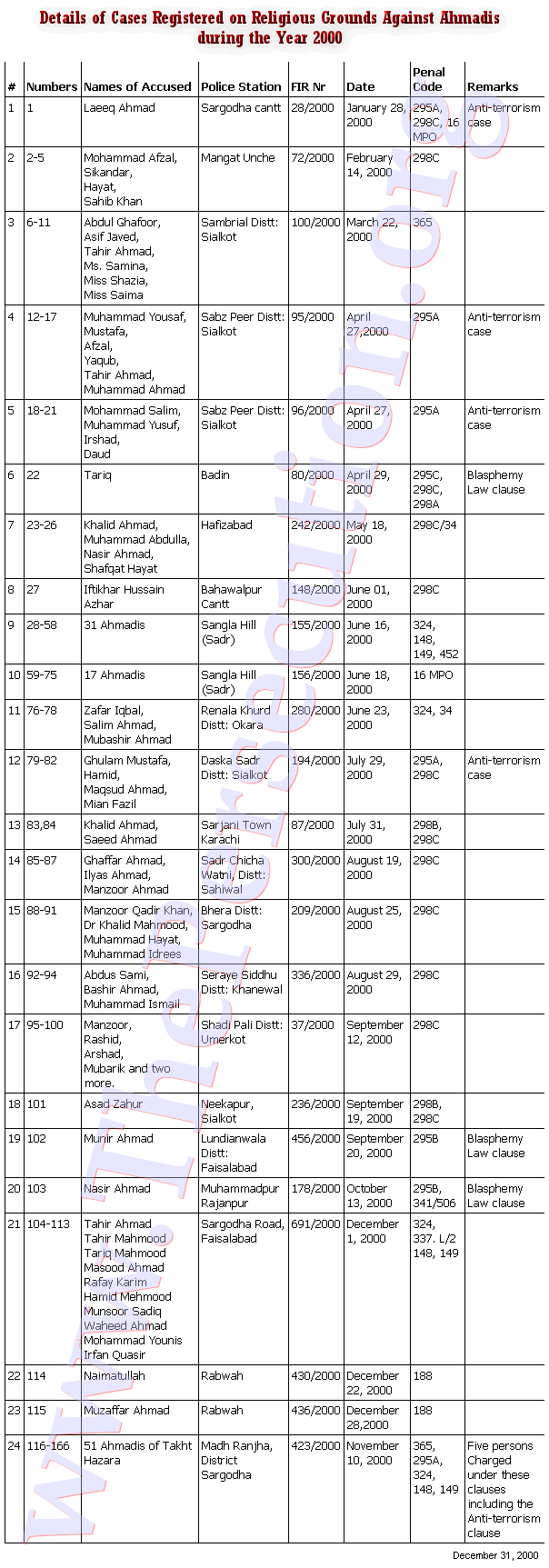
Some Sections of Pakistan Penal Code (PPCs)
Explanation and Maximum Penalties
295-C: |
The Blasphemy section for defiling the name of the Holy Prophet - Punishable with Death and Fine |
295-B: |
The Blasphemy section for defiling the Holy Quran - Punishable with Life Imprisonment |
295-A: |
For acts intended to outrage religious feelings of any class - Cognizable by anti-terrorism special courts- Imprisonment upto ten years and/or fine |
298-B: |
Anti-Ahmadiyya section for misuse of epithets, descriptions and titles etc- Imprisonment up to three years and fine |
298-C: |
Anti-Ahmadiyya section for calling oneself a Muslim or preaching or outraging the religious feelings of Muslims - Imprisonment upto three years and fine |
324: |
Attempt to commit murder - Imprisonment up to ten years and fine |
148/149: |
Rioting/assistance in rioting - Imprisonment up to three years and/or fine |
365: |
Kidnapping/abduction/wrongful confinement - Imprisonment up to 7 years and fine |
188: |
Disobedience to lawful order- Imprisonment for six month and/or Rs. 1000 fine |
341: |
Wrongfully restraining a person - Imprisonment for one month and/or 500 Rupees fine |
16 MPO |
For maintenance of public order- Imprisonment up to three years and/or fine |
34: |
Criminal acts done by several persons with common intention - Penalty same as for the main crime |
109: |
Abetment of an offence - Penalty as for the offence |
|
Five Important Cases- Special Mention
|
|
Prisoners of Naukot
An anti-Ahmadiyya procession comprising mullahs and their disciples approximately one thousand strong was taken out in Naukot (Sind) on 26 August 1998 subsequent to the incident at ‘Nafisnagar.’ The procession was harangued into frenzy, and it was led to the town’s Ahmadiyya mosque. There, it attacked the mosque while a few Ahmadis had assembled inside to defend their place of worship. As a result, two of the attackers and three Ahmadis were injured. The mob managed to enter the mosque, demolished and ransacked it. Then they set fire to the building. The fire damaged not only the mosque but also two adjacent shops, which also belonged to Ahmadis. Subsequently, in the follow-up action, it was the Ahmadi defenders and victims who were arrested. In all, 17 Ahmadis were charged under PPC 295-C the Blasphemy Law in addition to many other clauses of the penal code. This was done in pursuance of directions from higher authorities. The Blasphemy Law was applied, according to the FIR, simply because the complainant had found the Kalima “(Islamic creed i.e. There is none worthy of worship except Allah; Mohammad is His Prophet)” and Darud (Blessings on the Holy Prophet) written on plaques inside the mosque. These cases were all registered at police station Judho, district Umarkot. Of the accused, fourteen persons were arrested. They were first detained in Digree. Their cases were referred to an Anti-Terrorist Court at Hyderabad. All the prisoners were then transferred to the Central Jail, Hyderabad where on arrival they were treated very harshly.
Not a single person, from among the attackers, assailants and agitators, was arrested. High echelons in the government continue to assert repeatedly that minorities in Pakistan are treated kindly and generously. Hardly anything else could be further from truth in as for Ahmadis are concerned. The results of their actions clearly belie their words.
It is now 2 years and four months that these fourteen Ahmadis, wrongfully arrested for defending their mosque, continue to suffer in prison. Their mosque was destroyed by the opponents. Their plea of Bail has been rejected. They are undergoing prosecution, and are produced in an ATA Court regularly. The defendants approached Sind High Court with the plea that their case be tried in a normal court rather than an Anti-Terrorism Court. The High Court rejected their plea. Then they approached the Supreme Court with the same request, where their plea is pending. Decision of the ATA Court is withheld on account of a Stay Order of the Supreme Court. They are lodged in Hyderabad prison from where they are driven in strict police security to the court at Mirpur Khas. The defense counsel has to come all the way from Karachi. There is no case; their only fault is their faith. The criminals who aggressed and attacked their mosque go about freely. It is about time this cruel and unjust detention and unnecessary trial is brought to an end, and the victims of tyranny are released. They have suffered extensively, and there is no light visible at the end of their tunnel.
This is a case of gross injustice, overt discrimination and malicious administration. The victims deserve immediate redress.
Along with these fourteen, there is another Mr. Nazeer Ahmad of Nafisnagar who is suffering the same fate. He was alleged to be one of those who demolished a mud-built mosque that was in a dilapidated state; and rebuilt it afresh. He is also in the same prison for over two years and four months.
Case reference data: Dr Rashid Ahmad and others; Case No: 83 dated 2 Sept 98 at Police Station Jhuddoo District Mirpur Khas (Sind); under PPC 295C, 295A, 34
Mr. Nazeer’s case reference data: Case No. 87 dated 2 September 1998 at P.S. Jhuddoo; under PPC 295A, 295B
Mr. Waheed Ahmad’s Case
Mr. Waheed Ahmad of Golarchi, Sind was given 10 years’ rigorous imprisonment, in April 1998, by an ATA court in a census incident in which he himself was subjected to religious terrorism. The state machinery was liberally and unscrupulously used and supervised by the top brass to unjustly incriminate an innocent man.
Briefly, Mr. Bikkhar Punhor, a convert to Ahmadiyya Community approached Mr. Waheed Ahmad to help him fill in the Census Proforma, as he himself was illiterate. Waheed filled it for him. In the ‘religion’ column, Waheed, having asked Punhor, entered ‘Ahmadi’. Later, an official came to note this entry, and he scared Punhor to the bone, of the serious consequences of conversion. Some mullahs were intimated of his conversion by the official; so they, not only frightened him out of his conversion, they persuaded him to accuse Mr. Waheed of mis-stating his religious affiliation. Mullahs, in the meantime, organized processions and riots in the town and precipitated a law and order situation in which some Ahmadis were subjected to assaults and Ahmadiyya property was damaged. Thus the fundamentalists forced the administration into a kind of submission, and then jointly they proceeded to register criminal cases, not against the rioters, but against the victims. Mr. Waheed Ahmad was charged under PPC 295-A, a clause which invites action under the Anti-Terrorism Act. He was accused of injuring the feelings of the complainant by misquoting his faith.
Mr. Waheed Ahmad was presented in an ATA court on 14 March 1998 and was remanded by the police till 21 March. The next day, on 15 March, he was subjected to severe police torture, who insisted on being told as to what instructions he had received from his community superiors. On 16 March when a friend met him in the jail, he found his face very swollen due to police torture. The jail authorities were contacted and a complaint was made. They took some gratification and promised that the victim will be treated thenceforth with consideration. When an appeal was made in appropriate courts for release of the accused on bail, the Assistant Attorney General (the state official) took pains to oppose the request. Anyway, Mr. Waheed Ahmad was given a speedy trial in a Special Court under the provisions of the Anti-Terrorism Act. From the judge’s handling of the case and his own admission it had become quite obvious that he was under instructions to convict the accused and award a severe punishment. It was hardly a surprise when on 21 April 1998, the Special Court judge awarded 10 years’ rigorous imprisonment to Mr. Waheed Ahmad. Rabid mullahs who had traveled all the way to undertake sectarian violence remained free to wait for their next target of sectarian terrorism. They were quite satisfied with the support provided to them by their patrons in Islamabad.
Mr. Waheed Ahmad is in jail for almost three years, undergoing the awarded sentence. An appeal against his conviction is lying unattended with the Sind High Court. According to a recent report, his health has deteriorated. He is grown very weak. A doctor examined him and is of the opinion that he has a cardiac problem. He should be released on bail while the SHC examines the earlier judgment.
Case reference data: Mr. Waheed Ahmad; Case No: 14 dated 12 Mar 98 at Police Station S. F. Rahu, district Badin; under PPC 295A
An Ahmadi Youth behind Bars
Mr. Tahir Ahmad Nadeem, an Ahmadi youth, received gift of a T-shirt from a relative in the US. The Kalima (Islamic creed) was beautifully written on its front. He put it on and went to the town. There, mullas and some gangsters noticed his shirt and went for him. They grabbed him, beat him up, tore open his shirt and kept it with them. Later in the day, the police raided his house and arrested Tahir. They responded to the howls of the mulla, who threatened to create a law and order situation, close down the city and burn the Ahmadiyya mosque. Rather than arresting those who threatened the peace, the administration arrested the victim and charged him under section PPC 295A. If upheld in a court, the youth could end up in a prison for 10 years. Sher Khan, the DSP reported to the mullas that the police had accepted their demand and a criminal case had been registered.
At the instance of the mullah, the police again raided the residence of the victim to look for some more of such shirts. None were found. However, the inspector took away two copies of the Holy Quran saying that it was illegal for Ahmadis to keep the Quran at their homes. During the night, the police beat up the youth severely to obtain some irrelevant community information from him. The police pushed their cowardly and shameful act still further by taking steps to refer the victim’s case to an Anti-Terrorist Court.
An Ahmadi putting on a shirt with Kalima (Islamic creed) on it is considered guilty of terrorism-how absurd and preposterous!
The latest position is that the ATC has completed its hearing of the case, but the Sind High Court has issued a Stay Order that the judgment may not be announced awaiting a ruling of the High Court. In the meantime the young man continues to suffer behind bars. He should be set free. He is not a criminal - only an innocent youth.
Case reference data: Tahir Ahmad Nadeem; Case No: 17 dated 10 Aug 99 at Police Station Mirpur Khas, Sind; under PPC 295A
Mr. Munir Ahmad, a 70 years Old Gentleman in Prison for Preaching
Someone asked Mr. Munir Ahmad about his creed. At his reply, Abdul Latif intervened and behaved badly. Later, in collaboration with mullas, he reported to the police. The accused was arrested for preaching and wrongfully pushed to an Anti-Terrorist Court. This court rejected his plea for release on bail. Subsequently the High Court and also the Supreme Court rejected the plea. The accused is in prison for more than a year facing trial in a Special Court. He is 70 years old. If found guilty, he could be awarded 10 years in prison.
Case reference data: Mr. Munir Ahmad; Case No. 261 dated September 6, 1999; at Police Station Satra, Distt: Sialkot; under PPC 295A
Five Ahmadis of Takht Hazara
Five Ahmadis were killed in anti-Ahmadiyya riot here on November 10. In the initial flurry, to placate the international opinion, authorities moved against the rioters and took some action against them. However, a few weeks later, as expected, they targeted Ahmadis to appease the mulla.
After the riot, Ahmadi opponents filed a counter application against 51 Ahmadis including 5 who were complainants and witnesses of the killings. The police proceeded against these 5 Ahmadis under PPC 365/295A, 324, 148/149, and arrested them. They were presented in an Anti-Terrorist Special Court where their pleas for bail were rejected. They are now behind bars. The police have also taken action against 21 other Ahmadis under section 107/157.
Case reference data: Case No. 423 dated 10 November 2000; at Police Station Madh Ranjha, District Sargodha; under section PPC 295A, 365, 324, 148, 149
December 31, 2000
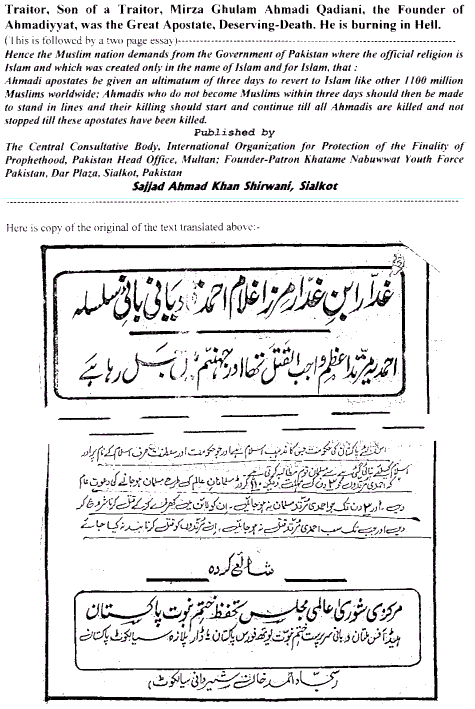
An Outline of Persecution of Ahmadis in Pakistan |
|
Some Statistics and Information - Year 2000
Murdered only for their faith |
1. |
Dr. Shamsul Haq at Faisalaad on January 17, 2000 |
2. |
Mr. Abdul Latif at Chak Bhauru, District Sheikhupura on June 8, 2000 |
3. |
Mr. Iftikhar Ahmad at Ghatialian, District Sialkot on October 30, 2000 |
4. |
Mr. Shehzad Ahmad at Ghatialian, District Sialkot on October 30, 2000 |
5. |
Mr. Ata Ullah at Ghatialian, District Sialkot on October 30, 2000 |
6. |
Mr. Ghulam Mohammad at Ghatialian, District Sialkot on October 30, 2000 |
7. |
Mr. Abbas at Ghatialian, District Sialkot on October 30, 2000 |
8. |
Nasir Ahmad at Takht Hazara, District Sargodha on November 10, 2000 |
9. |
Nazir Ahmad at Takht Hazara, District Sargodha on November 10, 2000 |
10. |
Arif Ahmad at Takht Hazara, District Sargodha on November 10, 2000 |
11. |
Mubarak Ahmad at Takht Hazara, District Sargodha on November 10, 2000 |
12. |
Mudassar Ahmad at Takht Hazara, District Sargodha on November 10, 2000 |
Sentenced |
1. |
Mr. Ataullah Waraich, Ahmadi of Chak 11/F.W. District Bahawalnagar sentenced to two years' imprisonment under PPC 298B for building a niche and minaret in an Ahmadiyya mosque. |
2. |
Mr. Mubarak Ahmad Nusrat, Ahmadi of Mirpur Khas sentenced to 2 months and 21 days imprisonment and Rs. 3000 fine for offering prayers. |
3. |
Sh. Muhammad Yusuf sentenced to one year's imprisonment and Rs. 5000 fine at Qasur on 11 October, 2000 for displaying Quranic verses at his shop and the Kalima (Islamic creed) at his door. |
4. |
Messers Mohammad Hussain and Mohammad Sadiq were sentenced to one year's imprisonment and Rs. 5000 fine at Qasur on October 11, 2000 for displaying Kalima (Islamic creed) at their house.
|
Charged |
166 Ahmadis were booked under the Anti-Ahmadiyya law, other religious laws or for religious reasons. Three of them were charged under various clauses of the Blasphemy Law.
Mosques violated |
During the Year 2000, two Ahmadiyya mosques were demolished, two were handed over to non-Ahmadis, one was sealed, construction of another one was blocked, two were desecrated and seven mosques were actively threatened with the like activity.
The Terror of Anti-Terrorism Act |
20 Ahmadis were wrongfully charged under religious law PPC 295A for preaching etc and pushed to Anti- Terrorist Special Courts.
Prisoners |
Prison population remained high throughout the year. At one time it rose to 45 Ahmadis in prison. Even at the end of the year, 25 Ahmadis were in prison on various counts, all of them for accusations related to religion. Most of them are behind bars for two and half years.
Expulsion from Home and Hearth |
Scores of Ahmadi families were forced by the prevailing persecution to leave their home and hearth to seek protection elsewhere. This resulted in immense hardship to the effected families.
Government Policy |
Throughout the year, the government actively pursued the policy of doing nothing to alleviate the sufferings of the Ahmadiyya Community. Mullas were given a free hand.
|
|



 Email this Page
 del.icio.us
 digg
digg Facebook
 Fark
Fark Furl
Furl Ma.gnolia
 NewsVine
 Reddit
 Simpy
Simpy Spurl
Spurl StumbleUpon
 TailRank


 Monthly Newsreports


 authored by the Head of the Worldwide Ahmadiyya Community

