|
Indonesia is widely described as a “moderate” Islamic nation. In many ways this has been true. Recently, however, a conflict has been brewing between those who support moderate interpretations of Islam and those who support hardline and intolerant forms. This conflict has even been seen by some commentators  to be pushing Indonesia to the very brink of a civil war. Today and tomorrow, I will try to explain the background of this conflict, whose causes belong as much to politics as they do to religion. to be pushing Indonesia to the very brink of a civil war. Today and tomorrow, I will try to explain the background of this conflict, whose causes belong as much to politics as they do to religion.
Indonesia is certainly the most populous Muslim nation in the world. Its total population is around 235 million, with 85% of this figure being Muslim. The official language (Bahasa Indonesia) is a version of Malay, but other regional tongues exist on various islands.
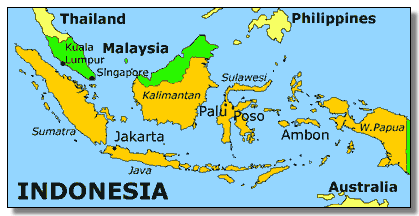
As an archipelago, Indonesia comprises a total of 17,508 islands, many of which were part of the Dutch East Indies. Indonesia sought independence from the Netherlands immediately following World War II. After 1949, the Dutch accepted Indonesia as a nation.
The first ruler of Indonesia was Sukarno, who had declared independence in August 1945. He was overthrown in a coup led by General Suharto (Soeharto), who ruled from March 1968 until he was forced to resign in May 1998. Under Suharto’s rule, there was widespread corruption. Suharto’s son Tommy (Hutomo Mandala Putra) grew rich from embezzlement. Even when he was found guilty of the murder of Syaifuddin Kartasasita (the judge who convicted him of corruption), Tommy Suharto only served four years in jail .
The current president of Indonesia is Susilo Bambang Yudhoyono who has been in power since 2004. His government has been weak when dealing with the demands of Islamists. During Yudhoyono’s presidency many areas of Indonesia have introduced bylaws which enforce Islamist laws. These laws were introduced following pressure from Islamist groups such as the Front Pembela Islam (Islamic Defender’s Front). Even though these bylaws are unconstitutional, Yudhoyonyo is either too politically weak or indifferent to oppose them.
During the three decades that Suharto was in power, Islamist groups and movements were, along with communist groups, viciously suppressed. With Indonesia being comprised of varying cultural groups, the influence of totalitarians such as communists or religious supremacists would naturally lead to conflict.
Two groups came into existence following the end of Suharto’s rule. The strident Islamism expressed by these groups has threatened to destroy the values of religious tolerance and pluralism that are promised by the constitution (called “Pancasila“) of Indonesia. Article 29, b, of the Indonesian constitution reads: “The State guarantees all persons the freedom of worship, each according to his/her own religion or belief.”
Both of these Islamist groups are said to have tacit support from senior figures within the military as well as the judiciary and police.
 Laskar Jihad Laskar Jihad
Laskar Jihad (Lashkar Jihad) was led by Jaffar Umar Thalib . This group, which allegedly was formed with the approval of members of the military and the government in 2000, was the main instigator of sectarian violence during the Moluccan War which lasted from the end of 1998 until 2002. This war pitted fanatical Islamists against Christians and at least 9,000 people, mostly Christian, were killed. The fighting was worst on the large island of Sulawesi and in the Moluccan islands (the Spice Islands).
 Thalib urged his followers to wage an attack upon Christian villagers in Soya on the island of Ambon. On Friday April 26, 2002 , Thalib spoke to Laskar Jihad followers outside Ambon’s biggest mosque. He urged a religious war against Christians, saying: “From today, we will no longer talk about reconciliation. Our … focus now must be preparing for war — ready your guns, spears and daggers.” Two days later, Laskar Jihad invaded the mainly Christian village of Soya on Ambon Island. Men, women and children were stabbed, beaten to death, burned and decapitated. Even babies did not escape machete attacks. Thalib urged his followers to wage an attack upon Christian villagers in Soya on the island of Ambon. On Friday April 26, 2002 , Thalib spoke to Laskar Jihad followers outside Ambon’s biggest mosque. He urged a religious war against Christians, saying: “From today, we will no longer talk about reconciliation. Our … focus now must be preparing for war — ready your guns, spears and daggers.” Two days later, Laskar Jihad invaded the mainly Christian village of Soya on Ambon Island. Men, women and children were stabbed, beaten to death, burned and decapitated. Even babies did not escape machete attacks.
The Soya massacre took place even though other Islamist groups had signed a peace deal with Christians on February 12, 2002 . This deal was called the Malino Accord. It was brokered by Yusuf Kalla (who is now the vice president of Indonesia), and was intended to put an end to the Moluccan War. Laskar Jihad refused to acknowledge the terms of the Malino Accord.
Thalib’s vigilantes had also driven away Christian landowners in Malaku province, sharing their lands as “booty” among Laskar Jihad and Muslims from outside the province.
Thalib himself had fought Soviets in Afghanistan from 1988 to 1989 and had met Osama bin Laden. He had been educated at the Mawdudi Institute in Lahore, Pakistan, before dropping out and joining the Afghan Mujahideen. He ran an Islamic boarding school (pesantren) called Ihya’us Sunnah Tadribud Du’at on the large island of Java. Thalib allegedly supervised an illegal Shari’a court which stoned a man to death, but though he was arrested for this, Thalib was never prosecuted. Following the Soya atrocity, Thalib was prosecuted for inciting religious violence but bizarrely, he was acquitted .
Laskar Jihad announced it was officially disbanding in October 2002, but in 2003 it was waging war against the native peoples of West Papua. This territory — the Western end of New Guinea was never ceded by the Dutch, and was annexed by Indonesia in 1963, and officially recognized by the UN as “Indonesian” in 1969. Very few indigenous West Papuans consider themselves to be Muslim.
FPI — The Islamic Defenders Group
 While Laskar Jihad continues to operate in secret, away from the prying eyes of the media, the Front Pembela Islam has been blatantly courting publicity. While Laskar Jihad continues to operate in secret, away from the prying eyes of the media, the Front Pembela Islam has been blatantly courting publicity.
The Front Pembela Islam or Islamic Defenders Front was founded in August 1998, only three months after Suharto was ousted from power. The uniformed members of this group in their white jackets and hats appear indistinguishable from the vigilantes of Laskar Jihad. Their motives are the same — to impose a strict interpretation of Islam as the sole religion of Islam and to ignore or destroy the rights of those they deem to be non-Muslims.
The BBC stated in 2003 of the FPI: “Unlike other groups it is not fighting for an Islamic state, but it does want to establish strict Sharia law.” Yet its subsequent actions in enforcing Islamist local bylaws to be imposed on all citizens, including non-Muslims, belie the BBC’s claims.
At the time the group had claimed that it was suspending its activities, while its founder was awaiting trial for inciting his followers to carry out raids on social establishments.
The founder of the group is Al Habib Muhammad Rizieq bin Hussein Shihab, more commonly described as Habib Rizieq Shihab. From its inception, the FPI began to make its presence felt in the main cities of Indonesia. During the holy month Ramadan, members of the group would attack bars and clubs that were seen to be flouting the conventions of Islam. In 2001 he organized a series of attacks against American interests, targeting businesses he believed were supportive of, or funded by, the United States.
Even though Saudi-educated Habib Rizieq Shihab could have received seven years for inciting his followers to violence, when he was found guilty, he was only jailed for seven months. Upon his release from Salemba Penitentiary in Central Jakarta on November 19, 2003, the FPI became more intransigent. The group, according to the now-defunct MITP Terrorism Knowledge Base, apparently funds itself via extortion from businesses.
In October 2004 during Ramadan, hundreds of FPI members attacked a restaurant and bar in the south of Jakarta, Indonesia’s capital city. They also raided a pool hall. Apparently when the attacks took place, police who were nearby took no action against the vigilantes.
Though there is little to distinguish them from the core group, the paramilitary wing of FPI, which carries out the raids on bars, is known as the Laskar Pembela Islam (Islam Defenders’ Army). The FPI as a whole now has a total of 200,000 members who are based in at least 22 of Indonesia’s 33 provinces.
On December 24, 2004, a massive tsunami devastated the province of Aceh, located on the northwestern tip of Sumatra Island. Relief workers came to the area to assist in the amelioration of the local population’s plight. A less positive addition to the relief work was the arrival of Islamist groups . These included the Laskar Mujahideen which had been involved with killing Christians in the Moluccan War. Additionally the Indonesian Muhajideen Council, whose spiritual head is the controversial cleric Abu Bakakr Bashir, arrived, as well as the Front Pembela Islam.
The arrival or Islamist groups had been spurred on by a decision by the largest group of Indonesian clerics to make a grim announcement. On January 14, 2005, the Majelis Ulama Indonesia (Indonesia Ulemas Council or MUI) warned that there would be a Muslim backlash if any of the Christian relief workers in the tsunami-devastated region of Aceh attempted to proselytize.
Fox News reported on January 21, 2005 on the intimidation of relief workers in Aceh by Islamists: “Hasri Husan, a leader of the Islamic Defenders Front, a militant Muslim group that is operating a refugee camp in Banda Aceh, made his feelings clear. ‘We will chase down any Christian group that does anything beyond offering aid,’ he said before making a slashing motion across his throat’”
In July 2005, the Majelis Ulama Indonesia made a “fatwa” containing 11 decrees, which decried activities involving interfaith, pluralist and “liberal” thought. The fatwa declared that liberal interpretations of Islam, secularism and pluralism were un-Islamic and therefore forbidden. This ruling was seen by some as generating a climate of intolerance in Indonesia.
On September 21, 2005 a community of Ahmadis was attacked in Sukadana in West Java. No individuals were hurt, but a mob of 1,000 fanatical Muslims carrying swords and sharpened bamboo stakes ran through the village. At least 70 homes and six mosques were badly damaged. Only five people were arrested. The attack upon the Ahmadi sect in 2005 mirrors very closely recent events that have taken place in Indonesia.
In October 2005 , Strategy Page reported that: “Armed men claiming to belong to organizations like the “Islamic Defender Front” continue to attack Christians, threatening to burn down houses and kill people if, in one instance, Catholics do not stop holding prayer services in their homes.”
The Ahmadiyah or Ahmadiyya are Muslims, but they are treated by orthodox Islam as heretics. They revere the founder of their sect, Ghulam Ahmad Qadiani (1835-1908). As many Ahmadi believe their fonder was a prophet, they are treated as heretics. They are barred from entering Mecca for the Haj pilgrimage, and in Pakistan blasphemy laws prevent them from proselytizing. In Bangladesh , political parties in the last coalition government supported attacks against the sect.
In January of this year, the MUI (Indonesia Ulemas Council) declared that the Ahmadi sect was “deviant.” On Thursday January 3, 2008 a group claiming to represent 50 Islamic organizations petitioned the attorney-general of Indonesia, demanding that the Ahmadiyyah be abolished. The two main national Muslim groups, Nahdlatul Ulama and Muhammadiyah, apparently also supported the motion. These have respectively 40 million and 30 million members. The Indonesian Muslim Brotherhood (GPMI) sent Ahmad Sumargono as a delegate.
On Sunday April 20th this year, thousands of Muslims marched in Jakarta, demanding that the Ahmadiyah sect be banned. A statement read: “We call on President Susilo Bambang Yudhoyono to immediately issue a presidential decree disbanding the Ahmadiyyah organization, confiscate its assets and demand its members and followers to disband and return to the true teachings of Islam.”
Instead of demanding that such calls to ban any religious group were in contravention of the terms expressed in the constitution, the president did nothing. A few days before the April 20th march, a government-sponsored committee had agreed that the Ahmadiyah were “deviant” and recommended that the group be officially abolished. The decision was approved by the attorney-general’s office.
 This is not the first time that President Yudhoyono has stood by while his government acts in ways that contradict the constitution. In March 2006 , one of his ministers openly condemned the Ahmadi. Maftuh Basyuni, the Indonesian Minister of Religious Affairs (pictured), had said that the Ahmadiyah sect should discontinue calling itself “Islamic” and should declare itself as a new religion altogether, adding; “If they refuse to do so, they should return to Islam by renouncing their beliefs.” This is not the first time that President Yudhoyono has stood by while his government acts in ways that contradict the constitution. In March 2006 , one of his ministers openly condemned the Ahmadi. Maftuh Basyuni, the Indonesian Minister of Religious Affairs (pictured), had said that the Ahmadiyah sect should discontinue calling itself “Islamic” and should declare itself as a new religion altogether, adding; “If they refuse to do so, they should return to Islam by renouncing their beliefs.”
A month later, the minister repeated his comments on April 17th. A group calling itself National Alliance for Freedom of Religion and Faith (AKKBB) demanded that Maftuh Basyuni within a week or face legal consequences. The minister ignored the deadline. Basyuni was educated in Saudi Arabia and appears to share that nation’s contempt for “deviant” forms of Islam.
A complaint was registered with the police against Maftuh Basyuni for “insulting and slandering… the members of the Ahmadiyah community,” but no action appears to have been taken against him. Basyuni remains employed as Religious Affairs Minister in Susilo Bambang Yudhoyono’s government.
The Religious Affairs Minister’s comments against the Ahmadiyah had come at a particularly sensitive time. In February 2006, a month before, a community of Ahmadis had been physically attacked on the island of Lombok, adjoining Bali. Almost 200 Ahmadis had been forced to live as refugees. One said of the minister’s comments: “It’s ridiculous to suggest that we form a new religion. We are Muslims who pray five times a day, fast during Ramadan, and believe in the same Quran.” 187 Ahmadi refugees later discussed claiming asylum in Australia.
This year, the Indonesian government has allowed the resentments between orthodox Muslims and those they deem to be heretical to reach dangerously tense levels.
On the morning of April 28th this year, a mob of 300 individuals attacked an Ahmadi mosque in Sukabumi district in West Java. The mosque was burned to the ground. Three days earlier, a group of Muslim activists grouped outside the mosque demanding it remove any mention of Islam from its sign board.
On the afternoon of Sunday June 1, 2008 , the National Alliance for Freedom of Religion and Faith (AKKBB) held a rally in Jakarta to support the right of the Ahmadiyah sect to exist, free from persecution. The date was significant — as it was a national holiday called Pancasila Day.
“Pancasila”, the principle of the constitution, means literally “five principles”, which are these :
1) Belief in one supreme God
2) A just and civilized humanity
3) Nationalism, the unity of Indonesia
4) Democracy guided by the wisdom of unanimity arising from discussion (musjawarah) and mutual assistance (gotong royong)
5) Social justice, the equality of political rights and the rights of citizenship, as well as social and cultural equality
The Front Pembela Islam was also holding a rally on the same day, to protest against fuel price rises. The two groups met at Monas Square, where the National Monument is situated. Here the FPI launched an attack upon the members of the National Alliance for Freedom of Religion and Faith using bamboo sticks. Seventy people were injured, with seven of these seriously wounded. Witnesses claimed that members of the FPI had shouted : “If you are defending Ahmadiyya, you must be killed.”
On the following day President Yudhoyono awake from his political torpor to condemn the attacks made by the Front Pembela Islam. There were calls from inside the country and abroad for the FPI to be abolished.
Habib Rizieq Shihab had no remorse about the incident at Monas Square. He appeared before reporters and openly told his followers on June 2nd to prepare for war. He said: “I have ordered all members of the Islamic Force to prepare for war against the Ahmadiyah (sect) and their supporters. We will never accept the arrest of a single member of our force before the government disbands Ahmadiyah. We will fight until our last drop of blood.” He added : “We will not accept Islam to be defiled by anyone. I prefer to be in prison or even be killed than accepting Islam to be defiled.”
On Wednesday last week 58 members of the Front Pembela Islam were arrested from their headquarters in Central Jakarta. Habib Rizieq Shihab accompanied the arrested individuals as they were taken to a police station. There, he too was arrested. One individual among FPI’s leadership called Munarman is still on the run.
The Indonesian police have finally acted to put a stop to the FPI, a group that has been openly practicing violence and intimidation. The actions come too little and too late. The current government has vacillated while extremists have eroded people’s basic rights and freedoms, and now the country is in danger of succumbing to violence.
In Part Two, I will show how the Indonesian authorities have colluded with violent forces, rather than confront them head-on. In some instances, it appears that the government and the military have deliberately encouraged a climate of tension and potential conflict.
June 13, 2008
Exclusive: Indonesia — A Civil War Between Islamists And Moderates?: Part Two of Two
In Part One I described how the Front Pembela Islam (Islamic Defenders’ Front or FPI) had threatened to make war on the minority Islamic sect called the Ahmadiyah.
On June 1st, FPI members violently attacked a procession of the National Alliance for Freedom of Religion and Faith (AKKBB), who support the rights of the Ahmadiyah. Several FPI members, including leader Habib Rizieq Shahib were arrested on Wednesday June 3rd in a police operation that involved 1,500 officers. Most FPI members were released shortly afterwards but Habib Rizieq Shahib and seven others remain in police custody.
The Ahmadiyah (also called Ahmadi or Ahmadiyya) revere their founder Mirza Ghulam Ahmad — with many regarding him as a prophet. This places them into the category of Muslim “heretics,” as traditionally Mohammed is the last prophet of Islam. The Indonesian Ahmadiyah have recently officially claimed that they regard their founder not as a prophet but as a pious Muslim. Their protestations have been ignored by the Indonesian government.
The FPI’s threats against the Ahmadiyah worsened this year after the nation’s leading group of clerics, the Majelis Ulama Indonesia (Indonesia Ulemas Council or MUI) declared that the Ahmadis were “deviant.” On July 27, 2005 , the same council had denounced all liberal and pluralist interpretations of Islam and condemned the Ahmadiyah, a fatwa that led to violence. The Ahmadiyah in Sukadana in West Java were attacked.
Government bodies suggested that they would ban the Ahmadiyah movement, even though such an action contravened the 1945 constitution . This constitution is based upon a set of principles known as Pancasila .
 On Monday June 9th this week, about 5,000 Muslim protesters demonstrated in front of the presidential palace in Jakarta. They called for the Ahmadiyah to be disbanded. They also called for the seven members of the FPI in police custody, including leader and founder Habib Rizieq Shahib, to be released. On Monday June 9th this week, about 5,000 Muslim protesters demonstrated in front of the presidential palace in Jakarta. They called for the Ahmadiyah to be disbanded. They also called for the seven members of the FPI in police custody, including leader and founder Habib Rizieq Shahib, to be released.
The group that protested on Monday is called the Peaceful Alliance against Islam’s Defilement (ADA API). The group is comprised of various Islamist factions, including Hizb ut-Tahrir and the notoriously violent Forum Betawi Rempug (Betawi Brotherhood Forum or FBR). Noer Muhammad Iskandar, who led the demonstration on Monday, told the crowd: “Muslims’ demand for disbandment of the deviant Ahmadiyah sect is not a violation of religion freedom because Ahmadiyah has defiled Islamic teachings by recognizing Mirza Ghulan Ahmad as the last prophet, instead of the Prophet Muhammad.”
Alliances between extremists have been a key feature of recent attempts to push Indonesian society towards Islamic “orthodoxy.”
The Government Restricts Ahmadiyah
On the evening of Monday June 9th this year, the Religious Affairs Minister, Maftuh Basyuni, issued a decree. Basyuni was educated in Saudi Arabia (where the Ahmadiyah are banned from visiting Mecca) and has previously urged the Ahmadiyah to abandon their claims to be Muslim.
On Monday Basyuni’s decree, backed by President Susilo Bambang Yudhoyono’s cabinet, told the Ahmadiyah that they must stop spreading their religion or face five year jail terms on charges of blasphemy. The decree was co-signed by Hendarman Supanji, the Attorney General.
The MUI (Indonesia Ulemas Council) has vowed to uphold the government’s decree against the Ahmadiyah sect by spying on the group and reporting its activities. It issued a statement which read: “If Ahmadiyah disobeys the decree, or continues its deviant activities, we will report it to the authorities and recommend that the president disband Ahmadiyah.”
The MUI has deliberately attempted to undermine religious tolerance in Indonesia. In May 2005 the MUI encouraged the arrest of three Christian women under the Child Protection Act for inviting Muslim children to a “Happy Sunday ” event run by their church. The women were jailed for three years on September 1, 2005.
The MUI first issued a fatwa against the Ahmadiyah in 1981, with another in 2001. In 2001 the secretary general of the MUI was Din Syamsuddin. Since 2005, Syamsuddin has been president of the “moderate” Muhammadiya movement, which has 30 million members. Currently he has attempted to be publicly diplomatic about the Ahmadiyah. In April this year, Syamsuddin had said that the Ahmadiyah should be persuaded to return to conventional Islam. Syamsuddin is a potential candidate for next year’s presidential elections.
The July 2005 fatwa from the MUI that condemned deviant, pluralist and liberal forms of Islam affected not only the Ahmadiyah. Christian communities — particularly in West Java — became targets of a group calling itself the Anti-Apostasy Alliance (AGAP). This Alliance includes the Front Pembela Islam, and exploited a 1979 ruling by former president Suharto to declare churches to be illegal. The SKB or Joint Ministerial Decree declared that religious buildings should have proper permits, and was originally introduced to prevent Islamists building mosques.
The SKB stated that before a religious building should be constructed, the community’s neighbors should be consulted. The MUI, which annually receives $600,000 from the Indonesian government, would pressure local people to disapprove of such buildings. In the month after the July 2005 fatwa by the MUI, at least 35 churches in West Java were closed down.
In March 2006 the SKB was revised. The law made it more difficult for minority groups such as Christians and Ahmadiyah to construct places of worship. The law stated that a place of worship must have a minimum of 90 members and receive approval from 60 neighbors of another faith.
On Wednesday last week, when 59 members of the FPI were arrested, some individuals avoided capture. The leader of the FPI wing that led the attack on June 1st remained at large . This man, called Munarman, this week surrendered himself to police late on Monday night. He claimed that his mission to outlaw the “infidel” Ahmadiyah sect had achieved its goal.
The Ahmadiyah have been in Indonesia since the 1920s. To become an Ahmadi, a vow is taken to “harm no one.” What seems bizarre to Western minds is that a group which is peaceful and has not initiated violence is outlawed, while a group (FPI) that is openly violent, and has publicly called for a war to be made on the Ahmadiyah remains “legal.”
Inciting Murder
On February 14th this year, Front Pembela Islam cleric Ahmad Sobri Lubis addressed a large crowd at a rally in Banjar, West Java. A video of his performance (in Bahasa Indonesian) can be found on the internet. The language used by Sobri Lubis is uncompromising.
“Kill! Kill! Kill!,” Sobri Lubis told the rally. “It is halal to spill the blood of Ahmadiyah. If any of you should kill Ahmadiyah as ordered by us, I personally, as well as the FPI, will take responsibility.”
Lubis is the secretary general of the Font Pembela Islam. He urged followers to kill Ahmadiyah members because they defile Islam. He said of human rights that they were cat excrement.
Also attending the rally was Muhammad Al Khathath, head of the Forum Umat Islam (FUI). Abu Bakar Bashir also spoke at the rally. Bashir was jailed for giving consent to the 2002 Bali bombing, in which 202 people died. Bashir was released on June 13, 2006 and following an appeal, his conviction was overturned by Indonesia’s Supreme Court on December 21, 2006 . Bashir formerly ran the Indonesian Mujahideen Council (Majelis Mujahidin Indonesia or MMI).
Calls for the deaths of those they oppose have been a hallmark of FPI activities for most of the time that the group has been in existence. In October 2000 , two years after being founded, armed members of the FPI patrolled Sukarno-Hatta International Airport. Their spokesman, Zainuddin, said: “’If we find any Israelis, we will first try to persuade them to leave, but if they refuse, we will slaughter them.”
Two months later, on December 13, 2000 FPI violence led to the death of a civilian. The group was intimidating residents of an alleged red light district in Cikijing, Subang regency, in West Java and raiding entertainment centers. The vigilantes found women whom they claimed were prostitutes. They cut the women’s hair short and then began attacking homes in the neighborhood. When one young man objected, he was stabbed to death.
The day after the stabbing, locals burned the house of Saleh Al Habsy, local FPI leader. On that Friday (December 15, 2000), the FPI under the leadership of Alawy Usman attacked a police station in Cikoko, 55 miles east of Jakarta, the capital. Three police officers were seriously injured. Usman later claimed that a rock had been thrown from the police station as his vigilantes passed. The rock caused one member to fall. Assuming he had been shot, the mob attacked the police station. No one was charged for the fatal stabbing in Cikijing.
The FPI’s threats to kill Christians have continued even after the violence that took place on Pancasila Day (June 1st) this year. On June 4th in Tangerang in West Java, church leader Bedali Hulu was threatened with death by FPI members. The threats happened as he visited his elderly mother-in-law.
The FPI has been able to act with virtual impunity. Its attacks on business premises rarely brought arrests, and when arrests have happened prosecutions rarely follow. Islamic vigilante groups in Indonesia are connected with political figures or parties. In 1998 , the FPI was linked with a voluntary militia called PAM Swakarsa. This militia was funded by B. J. Habibie, the President of Indonesia who succeeded Suharto. PAM Swakarsa and the FPI were used by the government and military to harass and intimidate student opponents of the government and the military figures supporting Habibie. PAM Swakarsa was founded in 1998 by Abdul Gafar, who was then deputy-speaker in the government. Gafur still plays a role in politics, albeit a corrupt one . FPI is still said to be linked to the military.
FPI has close links with other fanatical and quasi-paramilitary factions in Indonesia, such as the MMI which was founded by Abu Bakar Bashir. It is linked to the Forum Umat Islam, which was founded in 1999 when it was linked to President Habibie and was used to fight against students loyal to Megawati (Sukarno’s daughter).
Playboy
In 2006, FPI took on a battle that had been initiated by the MMI (Majelis Mujahideen Indonesia) — the attack upon Indonesian Playboy. In January Avianto Nugroho announced that he had gained the rights to publish an Indonesian version of the famous magazine, though he made clear that it would contain no nudes. The MMI chairman, Irfan Awas, declared that Playboy was pornographic and its publication in Indonesia would damage the nation’s morals, even without nudity.
The first issue was intended to appear in March, but was delayed. The first Indonesian edition of Playboy, edited by Erwin Arnada, appeared on April 7, 2006 . FPI members protested outside the magazine’s editorial offices in Jakarta.
Alawi Usman, who had led the 2000 attack upon Cikoko police station said: “If within a week they are still active and sell the magazine, we will take physical action.” Tubagus Muhamad Sidik, another FPI activist, said: “Even if it had no pictures of women in it, we would still protest it because of the name… Our crew will clearly hound the editors.”
Indonesian radio stations buzzed with callers, with many of these complaining about Playboy’s lack of raunchiness. One caller quipped: “It’s sinful to read Playboy if there’s no nudity!” Less than a week after initial publication, FPI members violently attacked the offices of the magazine.
On Sunday February 19, 2006, about 400 FPI members had tried to storm the American Embassy over the Danish cartoons. Stones had been thrown at the embassy. On April 12, 2006 , about 300 FPI members stoned the building in South Jakarta where Playboy was put together. Attempts were made to smash though the iron gates outside the building, and policemen were attacked.
The violence led to Velvet Media Group, who published Playboy, being forced to vacate their offices. They eventually moved to Bali.
The editor of Indonesian Playboy, Erwin Arnada, was taken to court, charged with indecency. When one of the clothed models from the first edition, Andhara Early, appeared in the South Jakarta courthouse in January 2006 , protesters insulted her. Andhara too was charged with indecency. As she left the building she was called a prostitute who would go to Hell. Others shouted: “I hope your daughter gets raped.” Andahara Early and another model, Kartika Oktavini Gunawan, were acquitted. On Thursday April 5, 2007 , Erwin Arnada was also acquitted.
Changing Society
 The Front Pembela Islam is well-known for its campaigns of violence and intimidation. In February 2006 , while the Danish cartoon crisis was going on, members of the FPI and the Anti-Apostasy Movement were intimidating foreigners in Bandung, West Java. 27 activists were arrested outside the Holiday Inn in Bandung. The activists wee asking foreigners what they thought of the cartoons. “If they support the cartoons, we will have no other choice but to ask them to leave Indonesia,” one activist said. The Front Pembela Islam is well-known for its campaigns of violence and intimidation. In February 2006 , while the Danish cartoon crisis was going on, members of the FPI and the Anti-Apostasy Movement were intimidating foreigners in Bandung, West Java. 27 activists were arrested outside the Holiday Inn in Bandung. The activists wee asking foreigners what they thought of the cartoons. “If they support the cartoons, we will have no other choice but to ask them to leave Indonesia,” one activist said.
The Front Pembela Islam also influences politics in Indonesia at a local and national level. At the start of 2006, numerous local administrations introduced Islamic bylaws. In Tangerang near Jakarta, a law was introduced that stated that any woman found alone outside after 7 pm was a prostitute.
A Muslim woman, Lilis Lindawati was one of the first to become a victim of this law. In late February 2006 as she waited for a bus to take her home, the pregnant wife and mother of two children was arrested. She had just finished work as a waitress, around 8 pm. She was placed in a cell and taken to court on the following day. In court she was made to empty the contents of her purse. Lipstick fell out. Judge Barmen Sinurat told her: “There is powder and lipstick in your bag. That means you’re lying to say that you are a housewife. You are guilty. You are prostitute.”
The judge fined Mrs. Lindawatis $45 but as she had only her bus fare home, she was forced to spend three days in jail. Mayor Wahidin who introduced the law is the brother of Hassan Wiraduya, the Indonesian foreign minister. He said of Mrs. Lindawati’s case: “She could not prove she is not a prostitute. It is true when my men arrested her she was not committing adultery, but why does she put on such make-up?” Mrs. Lindawati later sued the mayor of Tangerang, but whether she won is unknown.
In Depok , south of Jakarta, similar laws were being introduced. These had been brought in after the local administration had consulted with the FPI and the Indonesian Ulemas Council (MUI). Indonesian researcher Syaiful Mujani has claimed that such bylaws are unconstitutional and illegal.
In South Sulawesi, laws were introduced female civil servants are forced to wear Islamic clothing and government employees must be able to read and write Arabic.
On Saturday April 22, 2006 a meeting of the Indonesian Youth Circle claimed that Islamists and Muslim hardliners were threatening Indonesia’s democracy. Zuly Qodir of Muhammadiyah said: “Now the sectarian groups are pressing their agenda to change Indonesia into a theocratic state. They seek to formalize Islam as the state ideology.”
At that time, a controversial act was being introduced in the nation’s parliament, called the Anti-Pornography Bill which would have made aspects of the Islamist bylaws become standardized throughout the nation. This proposed law was opposed by former president Kyai Haji Abdurrahman Wahid (Gus Dur). As a result, on May 23, 2006, FPI members forced him off a stage at a rally in Purwakarta, West Java.
The bill would have outlawed kissing in public — resulting in a five year jail sentence for those found guilty. Exposing certain areas of the body, such the stomach, thigh or hip, could have invoked a 10 year jail sentence and $50,000 fine. On the island of Lombok, Muslim women protested against the bill. Yenny Wahid, a Muslim women’s rights campaigner said of the bill: “This is an attempt by some people to import Arab culture to Indonesia.”
When women condemned the draft Anti-Pornography Bill they were harassed by the FPI’s allies, the Betawi Brotherhood Forum (FBR).
The Front Pembela Islam helped to organize mass rallies in favor of the repressive bill, which would have destroyed the tourist trade in places such as Bali, and would have discriminated against Hindus, Christians and the indigenous peoples of West Papua. The bill was “watered down” in February 2007 but it appears not to have been fully introduced into law.
Current Problems
The potential “civil war” ‘between moderate and hardline Muslims that has been highlighted by the Ahmadiyah/FPI problems reflects a more basic struggle — the struggle between Islamism and democracy. The current government is not, it seems, prepared to alienate or antagonize the Islamist minority. As a result, it has chosen to make the lives of a peaceful group — the Ahmadiyahs — more difficult. Faced with widespread demands to ban or outlaw the Front Pembela Islam, the government of Indonesia does nothing.
Many of the leading Islamists in Indonesia — Umar Jaffar Thalib of the Laskar Jihad, Abu Bakar Bashir who is spiritual leader of the terrorist group Jemaah Islamiyah and Habib Rizieq Shahib are of Arabic descent. They do not value Indonesia’s cultural diversity, and do not value either the Pancasila principles or the 1945 constitution.
There are many in the Indonesian military who appear happy for the country to have democracy break down so they can gain power under martial rule. The current president, Susilo Bambang Yudhoyono, appears to have no desire to uphold the principles of the constitution. He will be fighting a presidential election next year. When in 2004 he was elected, it was believed that Yudhoyono was firm in a time of crisis. That firmness is no longer visible. He has vacillated while others in his government, including the Attorney General Hendarman Supanji, have sought to remove Indonesia’s democratic foundations.
Yudhoyono has become weak in the face of Islamic activism. In 2003, he wooed women voters with his voice, producing an album of love songs entitled “My longing for you.” Such a stunt now will do him no favors in the 2009 elections. He has bowed down to Islamist pressure, and failed to uphold his nation’s democracy and constitution. He has even apparently become hoodwinked by a mountebank who claimed to have a scheme to make energy from water.
While Islamist bylaws were being introduced across Indonesia, sometimes following pressure from the Front Pembela Islam, Yudhoyono’s government did nothing. According to legal expert Denny Indrayana , sharia-based bylaws can be revoked by presidential decree: ““Based on Law No. 32/2004, the government can make a decision 60 days after local administrations give bylaws for review.”
The recent decision to severely curtail the activities of the peaceful and law-abiding citizens in the Ahmadiyah movement has struck a sour note inside Indonesia and beyond. Already the group has suffered persecution in West Java and on the island of Lombok. Between 2005 and 2008 at least 25 Ahmadiyah mosques have been destroyed.
The decree has been criticized by Islamists such as Abu Bakar Bashir because it is not a complete disbandment of the Ahmadiyah. Human Rights Watch condemned the move and urged the Indonesian government to uphold the pluralist values of the constitution.
Adnan Buyung Nasution is a prominent lawyer who acts as an advisor to President Yudhoyono. He said: “I would say this is the beginning of a further war between Indonesians who want to maintain a secular state, an open democratic society, and those who want to dominate (and turn) the country into a Muslim country.”
The Indonesian rights group Kontras has also condemned the decree. Usman Hamid, coordinator of Kontras has said : “The government has not been able to protect citizens from violence, from prosecutions committed by hard-line groups. This is a serious, serious problem in Indonesia… we have been able to achieve several political reforms, political freedom. But the case of Ahmadiyah undermines the image of reform even more starkly because religious freedom has been attacked after 10 years of reform in Indonesia.”
The ideological war that is being fought now in Indonesia is between two diametrically opposed systems — Islamism and democracy. So far, the Islamists appear to be winning.
Adrian Morgan is a British based writer and artist who has written for Western Resistance since its inception. He also writes for Spero News. He has previously contributed to various publications, including the Guardian and New Scientist and is a former Fellow of the Royal Anthropological Society.
Copyright 2008 Family Security Matters Inc. |
Source: | www.familysecuritymatters.org/publications/id.315/pub_detail.asp
www.familysecuritymatters.org/publications/id.357/pub_detail.asp |
|
|
|




 Email this Page
 del.icio.us
 digg
digg Facebook
 Fark
Fark Furl
Furl Ma.gnolia
 NewsVine
 Reddit
 Simpy
Simpy Spurl
Spurl StumbleUpon
 TailRank




 <<… Indonesia >>



 June 9, 2008